
A No-Nonsense Guide to Building an Influencer PR Strategy That Actually Works
Why Influencer PR Matters Right Now
If you want people to talk about your brand in ways that actually move the needle, influencer PR is one of the sharpest tools you’ve got. Not because it’s flashy, but because real people trust real voices. The trick is doing it with intention—clear goals, the right partners, and a plan that leaves space for human moments.
Below, I break down a simple, repeatable playbook you can run today. Seven steps. No fluff.
1. Define Your Goals & Objectives
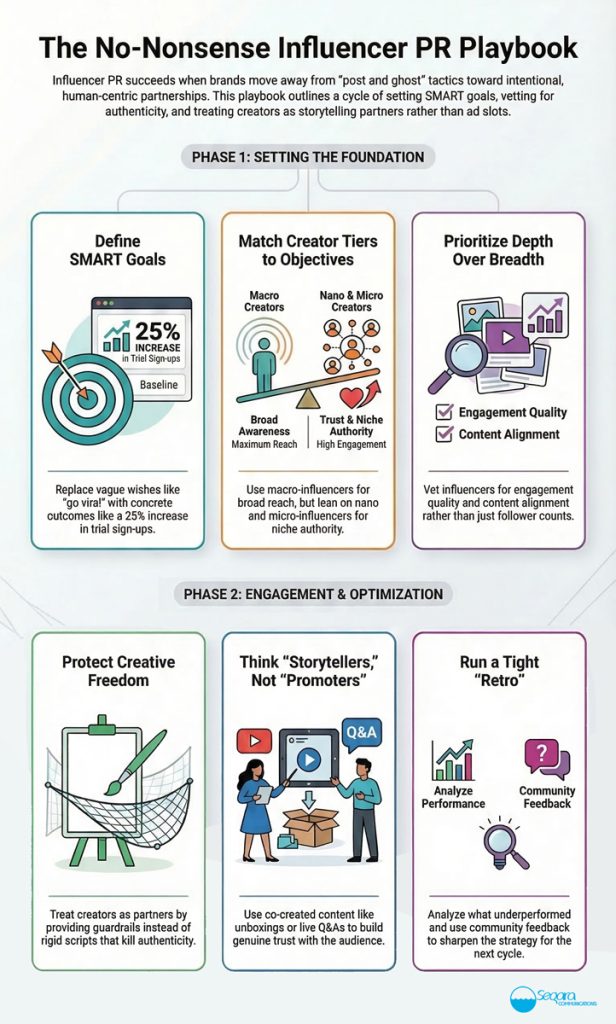
Vague goals kill good campaigns. “Go viral,” “get engagement,” or “build awareness” isn’t a strategy—it’s a wish. Pick a concrete outcome and make it SMART.
- Ask yourself: If this campaign worked perfectly, what would be different next month?
- Decide the action you want: click, sign-up, trial, add-to-cart, demo request—name it.
- Use the SMART frame: Specific, Measurable, Achievable, Relevant, Time-bound.
Example: Increase landing-page traffic by 25% in six weeks via Instagram Reels and YouTube integrations with three creators in our niche.
Match the goal to the creator tier:
- Broad awareness: macro creators with reach
- Trust, loyalty, or niche authority: nano and micro creators with tight communities
2. Identify Your Target Audience
You can’t pick the right partners if you don’t know who you’re trying to reach. Don’t guess—get the data.
- Profile the audience: age, location, interests, pains, values, platforms, watch habits
- Use your stack: Google Analytics, platform insights, CRM cohorts, surveys, user interviews
- Map platform fit: where they already spend time (TikTok vs. Twitch vs. YouTube vs. Reddit)
Then match creators to that exact crowd. If you’re targeting Gen Z gamers in Southeast Asia, a mid-tier Twitch or YouTube creator embedded in that scene beats a generic lifestyle star every time. Tight fit = authentic feel = better results.
3. Find and Vet the Right Influencers
Great partnerships feel native, not staged. Look for real alignment between their content and your brand.
- Content fit: Have they covered adjacent topics or similar products?
- Audience quality: Engagement rate, comments with substance, saves/shares, repeat viewers
- Authenticity checks: watch for sudden follower spikes, off-brand promo history, or controversy
- Tools to vet: HypeAuditor, Modash, and social listening help verify audience makeup and spot red flags
Smaller but engaged often beats massive and passive. Depth over breadth.
4. Build Relationships & Pitch Authentically
Treat creators like creative partners, not ad slots.
- Personalize the outreach: reference a recent video/post and why it resonated
- Be clear: goals, deliverables, guardrails, timelines, budgets, usage rights, exclusivity
- Give creative freedom: protect their voice; don’t script their soul out of it
- Respect their workflow: preferred formats, lead times, and review cycles
You’re here because their audience trusts them. Keep that trust intact.
5. Integrate Influencers into Your PR Plan
Bring creators in early and arm them with context.
- Share the “why”: the story, problem, and stakes—not just product specs
- Give hands-on time: early access, trials, behind-the-scenes, founder chats, FAQs
- Co-create angles: unboxings, day-in-the-life, expert breakdowns, challenges, live Q&As
- Plan touchpoints: coordinate with press, owned channels, email, and events for a consistent arc
Think “storytellers,” not “promoters.” Real reactions build real trust.
6. Execute & Monitor Campaigns
Once content goes live, keep the narrative tight and responsive.
- Align on timing: coordinate drops, embargoes, and cross-posts
- Track in real time: Instagram Insights, YouTube Studio, TikTok Analytics, UTM links, Mention/GA
- Stay human: answer questions in comments, jump on relevant trends, and amplify top-performing posts
- Crisis plan: have escalation paths and friendly edits if something lands wrong
This is not “post and ghost.” It’s publish, listen, adapt.
7. Measure Results & Optimize
Measure what matters—and learn from what surprises you.
- Core KPIs: reach, engagement rate, CTR, conversions, CAC, sentiment, share of voice
- Attribution: UTMs, promo codes, landing pages, view-through windows, brand-lift surveys
- Qualitative gold: unexpected comments, new use-cases, creator feedback, community language shifts
Run a tight retro:
- What beat expectations?
- What underperformed?
- What did we learn about message, format, platform, and creator-fit?
Roll those insights into the next iteration. Influencer PR sharpens with each cycle.
Practical Templates You Can Steal
- Goal template: “Drive X (metric) by Y% in Z weeks via [platforms] with [creator tier].”
- Outreach opener: “Loved your [post/video] on [topic]—especially [specific]. We’re [brand], working on [problem/mission]. Interested in co-creating [format] for [audience]?”
- Brief bones: objective, audience, key messages, must-have claims, do-not-say list, deliverables, timelines, approvals, usage rights, FTC disclosures, payment terms, success metrics
- KPI dashboard: impressions, ER, saves/shares, CTR, CPA/CAC, code redemptions, sentiment, top comments
Common Pitfalls to Avoid
- Chasing follower count over audience fit
- Over-scripting and killing the creator’s voice
- Fuzzy goals and no baseline metrics
- Ignoring legal/usage rights or FTC disclosures
- “One and done” collabs—consistency compounds
Final Word
Influencer PR works when it feels human, measured, and iterative. Set sharp goals, pick the right partners, and keep listening. Do that, and your brand won’t just get mentioned—you’ll get believed.
Writer: Aditya Wardhana