

Baidu SEO: How China’s Search Titan Shapes Strategy, Traffic, and Trust
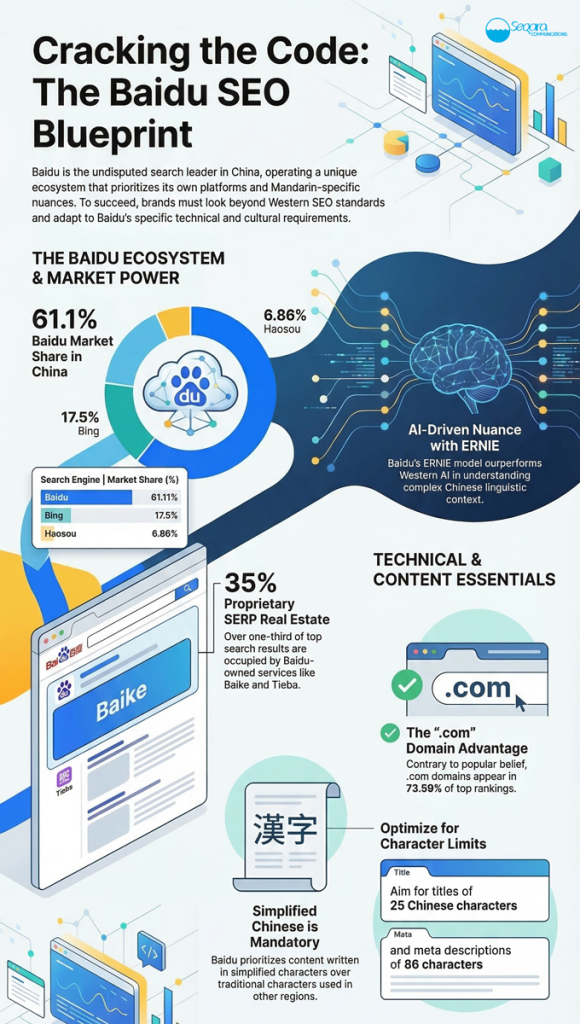
Baidu isn’t just China’s biggest search engine—it’s the backbone of how people in the mainland discover information, brands, and answers. While Google rules much of the world, Baidu commands China’s SERPs, steering the majority of organic visibility for B2B and consumer queries alike. For global marketers, that means SEO playbooks need a China-first remix: language, platforms, speed, and signals all shift in Baidu’s universe.
Global vs. China: Who Leads Search?
- Worldwide market share (approx.): Google 91.47%, Bing 3.42%, Yandex 1.78%, Yahoo 1.10% (Bing crawler), Baidu 0.83%, DuckDuckGo 0.54%
- USA: Google 87.48%, Bing 7.85%, Yahoo! 2.34%, DuckDuckGo 1.87%, Yandex 0.17%, AOL 0.09%
- China: Baidu 61.11%, Bing 17.5%, Haosou 6.86%, Sogou 5.58%, Yandex 3.13%, Shenma 2.88%
Baidu’s share translates into outsized opportunity: B2B brands often see ~70% of their organic traffic from Baidu alone, far eclipsing Bing China. The implication is simple—optimize for Baidu first if China is your target market.
Inside the Baidu Ecosystem
Baidu keeps users “in-network” through a tightly interlinked family of products that frequently rank on page one:
- Wenku – document library;
- Baijiahao – publisher platform;
- B2B – wholesale/business listings;
- Video & Image search – rich media surfaces;
- Baike – encyclopedia;
- Zhidao – Q&A;
- Tieba – forums;
- Jingyan – how‑to/experiences;
- Wen – expert answers;
- Mbd – deals/coupons;
- Haokan – short/video platform;
- Baobao – parenting;
- Hanyu – learn Chinese;
- Fanyi – translation.
Up to 35% of top‑10 results can be Baidu‑owned properties (vs. ~25% in 2020), tightening the flywheel for content discovery and retention.
Language and Cultural Fit
- Prioritize simplified Chinese (Mandarin) for mainland users.
- Traditional Chinese (HK/TW) is a different audience and signal space.
- Local idioms, search intent, and query framing matter more than literal keyword translation.
Domains, URLs, and Site Identity
- .com domains dominate (~73.59% of top results), with .cn growing (from ~3.8% in 2020 to ~14.06% in 2023) but not required.
- Chinese characters in URLs are rare (~0.8%) and not recommended by Baidu.
- Keep slugs clean, short, and descriptive; avoid excessive parameters.
Technical Baselines That Win
- Average ranking URL length: ~48 characters; ~2.3 directory levels.
- Title tags: ~25 Chinese characters;
- Meta descriptions: ~86 characters.
- Implement hreflang or language signals for Chinese variants; ensure correct charset (UTF‑8), robust robots directives, XML sitemaps, and canonical tags.
Ranking Drivers: Beyond Keywords
Baidu aligns with modern SEO: relevance, structure, and user experience. Several signals consistently correlate with stronger visibility:
- Content quality: topical depth, clear headings, and intent coverage.
- Backlinks: a higher number of referring domains from reputable Chinese sites is strongly positive.
- Internal linking: reinforce topical clusters and crawl paths.
- Media enrichment: images and video lift engagement and rankings.
- Freshness: update key pages to reflect current facts and offerings.
Key moves:
- Create authoritative, useful content in simplified Chinese.
- Optimize titles, slugs, and meta descriptions to Baidu display limits.
- Earn backlinks from trusted, contextually relevant Chinese domains.
- Consider an ICP license for trust and speed, but it’s not mandatory.
- Prioritize performance—especially if hosting outside mainland China (use edge/CDN, CN‑optimized routing).
AI Acceleration: ERNIE vs. BERT
Baidu’s ERNIE family is built for Chinese linguistic nuance and has tested ahead of Google’s BERT on several Chinese understanding benchmarks. The payoff for SEO: better intent matching and context awareness in SERPs, rewarding semantically rich, structured content.
Baidu’s Ernie Bot surpassed 100 million users months after launch, hinting at an interface shift where conversational search blurs with traditional query-result navigation.
Licensing, Hosting, and Speed
- ICP: Often viewed as a credibility and delivery advantage; only ~48% of top pages display it, so it’s helpful but not a ranking requirement.
- Hosting: Sites outside mainland China can rank, but latency hurts. Use CN‑proximate hosting, smart CDN, image compression, and minimal JS to reduce TTFB and layout shift.
Black‑Hat Cautionary Tale
A training firm hired a black‑hat agency to “own” its Baidu SERPs; the agency built 24 doorway sites. Baidu’s long‑running anti‑spam updates (e.g., Blue Sky, Hurricane) de‑indexed the network. The dispute escalated to court, where Baidu engineers outlined relevance- and quality‑based ranking logic. The judge found both parties harmed consumer interests; the case was dismissed. The lesson: doorway schemes don’t just fail—they can backfire legally and reputationally.
Practical Checklist for Baidu SEO
- Language and intent: simplified Chinese, native phrasing, query classes (navigational, informational, transactional).
- Information architecture: shallow, logical hierarchies; strong hub pages.
- On‑page: exact‑match keywords in titles where natural; Hx structure; descriptive alt text; schema where applicable.
- Content length: cover topics comprehensively without fluff.
- Media: compress images; consider Haokan or Baijiahao embeds for discoverability.
- Off‑page: PR and partnerships for high‑quality backlinks; avoid private networks.
- Monitoring: Baidu Webmaster Tools, log‑file analysis, rank and crawl anomaly alerts.
Conclusion
Baidu’s supremacy stems from market fit, ecosystem gravity, and language-native AI. Winning in China requires more than porting Google tactics—you need a localized strategy grounded in simplified Chinese, technical fit for Baidu’s crawl and rendering, and a clean link profile. Follow the signals, respect the ecosystem, and you’ll meet the market where it searches.

Writer: Aditya Wardhana