

Rooted in Purpose: B. Braun Indonesia’s 500-Tree Push to Rewild Sanggabuana
Byline: Karawang, West Java — August 9, 2025
When more than a hundred people in matching green shirts spill out of minibuses at the foot of Sanggabuana, you can almost hear the forest breathe a little easier. We’re here for something simple and stubbornly hopeful: put 500 young trees into the ground and give a slice of West Java a nudge back toward balance.
I arrive to the earthy perfume of wet soil and the kind of chatter that only happens when colleagues trade laptops for mud-caked boots. It’s B. Braun Indonesia’s annual nod to the planet—this time synched with Indonesia’s National Nature Conservation Day on August 10. It’s CSR in action, sure, but it’s also a field trip with a mission: restore habitat, clean up a mountain path, and leave more life in our wake than we found.
• What we planted (and why it matters)
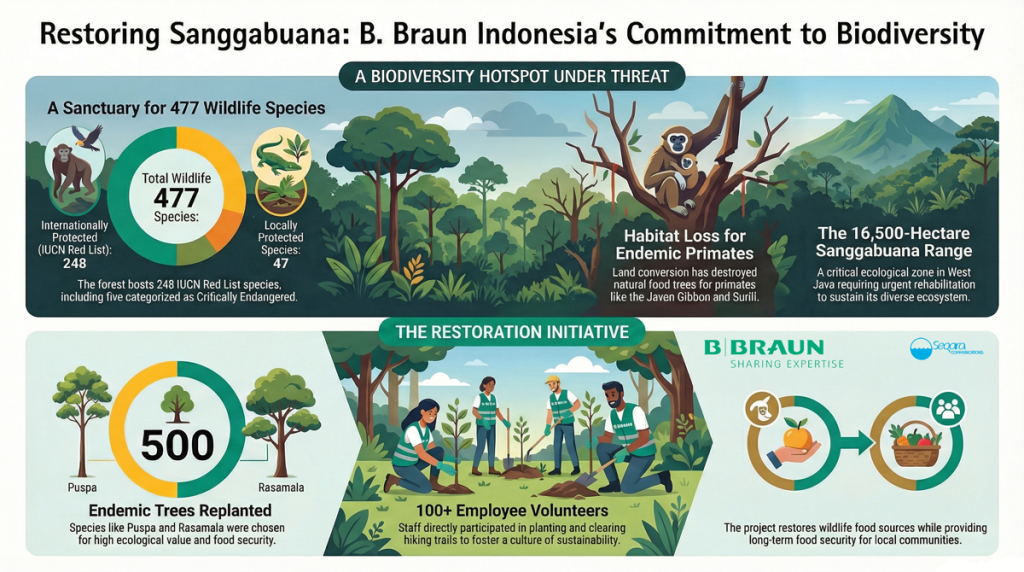
Let’s talk trees. The team put down a diverse lineup—puspa, rasamala, beringin, salam, picung, afrika, aren, durian, petai, jengkol, kecapi, trembesi—each chosen for its ecological superpower. Some feed wildlife. Some stitch soil together, slowing erosion. Some bear fruit that feeds families. All of them, collectively, help knit a fragmented forest back into a working ecosystem.
Rainer Ruppel, B. Braun Indonesia’s President Director, frames it plainly when I catch him between saplings: we share the duty of keeping nature in balance, and change starts with hands in the dirt. He sees volunteerism as muscle memory—the more you practice, the stronger the culture of care becomes. Today’s turnout makes his case for him: sleeves rolled, hands muddy, spirits high.
• Why Sanggabuana—and why now
Sprawling over roughly 16,500 hectares, the Sanggabuana range is not just pretty scenery; it’s a refuge that shelters around 477 wildlife species. Forty-seven of those are protected by law, and 248 sit on the IUCN Red List, a global barometer for species at risk. At least five here are critically endangered, with ten more officially endangered. That’s not a statistic to admire—it’s a call to act.
One of the mountain’s beating hearts is the Dindingari Block, a stronghold for five Javan primates: the Javan gibbon, Javan lutung, silvery surili, Javan slow loris, and the long-tailed macaque. They’re agile, social, and dependent on a reliable pantry of native trees—many of which have disappeared as land use shifted. Replanting isn’t a photo op here; it’s a lifeline that replaces lost food sources and reconnects the forest’s missing links.
• The locals who know the land best
“Five hundred trees isn’t just a number—it’s a promise we intend to keep alive,” says Bernard Triwanarta Wahyu Wiryanta, founder of the Sanggabuana Conservation Foundation. His team has mapped the microhabitats, matched species to slopes and soils, and lined up long-term monitoring. It’s the unglamorous follow-through—the watering schedules, the weeding, the survival counts—that decides whether today’s seedlings become tomorrow’s canopy.
• Boots, bottles, and a cleaner trail
Between planting rounds, volunteers fan out along the hiking route, fishing out plastic bottles, food wrappers, and the odd sandal that never found its owner. It’s humbling to realize how quickly a trail can accumulate what a forest never asked for. By midday, sacks of trash stack up beside neat rows of bamboo stakes marking newborn trees. Small acts, visible gains.
• The bigger picture for a health-tech company
If you’re wondering why a medical technology company is neck-deep in forest soil, the answer is refreshingly direct: public health rests on healthy ecosystems. Cleaner air, steadier water cycles, secure food sources—these are upstream determinants of well-being. For B. Braun, headquartered in Germany with a deep footprint in Indonesia—from a high-tech pharmaceutical manufacturing facility in Karawang to the Aesculap Academy training center in Bali—environmental stewardship slots neatly into the company’s long-game vision for better health and quality of life.
• What success looks like a year from now
Survival rates. Birdsong. Primate sightings. Cooler ground under a thicker shade. A trail that stays intact through the rainy season. Farmers who can gather fruit without pushing farther into the forest. Success isn’t a ribbon-cutting; it’s a slow accumulation of signs that life is getting a little easier—for wildlife, for water, for people.
• The spirit that carries
There’s a moment, late afternoon, when the sun loosens its grip and the hills soften to gold. A circle of volunteers leans on shovels, quiet in that way you get after shared labor. Someone cracks a joke about how none of us will recognize our trees next time because we’re all terrible at tying the same knot. Laughter breaks, and with it, the reminder: conservation isn’t only science and policy—it’s community, humility, and a willingness to return.
This is how a company plants more than trees. It plants continuity. It plants the idea that caring for forests is not extra credit but baseline responsibility. And it plants the hope that, one season at a time, Sanggabuana will once again be a place where primates feast, rivers run clear, and people breathe a little easier.
—
About B. Braun
With a global team of over 64,000, B. Braun is a leading medical technology company dedicated to protecting and advancing health worldwide. For more than 180 years, B. Braun has helped shape healthcare with an innovative spirit and contributions to critical breakthroughs. In Indonesia, the company provides smart healthcare solutions and partners with customers through comprehensive care models, supported by a high-tech pharmaceutical manufacturing facility in Karawang, West Java, and the Aesculap Academy medical training center in Tabanan, Bali.
Learn more at https://www.bbraun.co.id