
How to Restore Reputation After a PR Nightmare: A Field Guide for When Everything Goes Sideways
Why PR Nightmares Happen—and Why Some Brands Survive
Every brand is one bad headline away from a trust deficit. You can’t child‑proof the internet or bubble‑wrap human judgment, but you can out‑prepare chaos. When leaders hesitate, the vacuum fills with critics, screenshots, and speculation. A two‑day pause can turn a fixable stumble into a full‑blown scandal. The difference between companies that bounce back and those that crater is crisis communication: own the frame, or be framed by everyone else.
What Counts as a PR Nightmare?
A PR nightmare is a reputational shock—sudden, public, and sticky. It can start with an offensive remark, a product failure, a governance lapse, or a viral customer video that hits a cultural nerve. Social platforms accelerate the pile‑on; emotion outruns facts, and perception hardens fast. That velocity is exactly why effective response begins inside the building, not at a podium. If your employees learn about the crisis from a push alert, you’ve already fractured trust. Confusion inside leaks outside: mixed answers, tone‑deaf posts, partners wobbling, and your brand’s competence wobbling with them.
So we begin with alignment. A living crisis plan tells people what happened (as you know it), what you’re doing now, who is authorized to speak, and where to escalate new information. When your internal signals are clear, your external voice sounds coherent and human.
The Five‑Step Recovery Playbook
- Step 1: Damage Assessment and Crisis Containment (First 24–48 Hours)
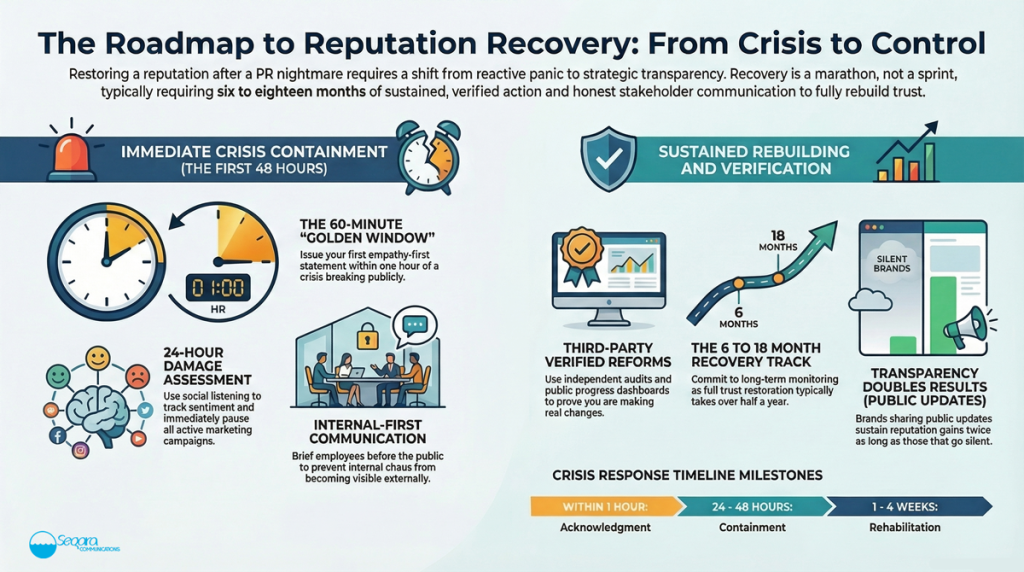
Find the edges of the problem—quickly and honestly. Spin is not strategy. Use social listening and media monitoring to map conversation drivers, sentiment, and misinformation. Convene your cross‑functional crisis cell (communications, legal, HR, product, security, operations). Freeze or adapt scheduled campaigns that could clash with public mood. Build a single source of truth: facts confirmed, facts in review, rumors identified. The first news cycle decides whether you’ll steer the narrative or chase it.
- Step 2: Transparent Acknowledgment and Empathy‑First Response (Golden Minutes)
Issue an initial statement within the first hour of public breakout. Speak plainly: “We made a mistake.” Avoid hedged non‑apologies. Lead with the people impacted and the harm caused. If appropriate, have the chief executive deliver a short video—unscripted in tone, precise in facts. Share what you know, what you don’t, and what happens next. Promise updates on a predictable cadence. Over‑explain process; under‑promise outcomes.
- Step 3: Stakeholder Alignment and Internal Cultural Reset (Days 2–7)
Synchronize every touchpoint. Hold daily internal briefings; provide approved talking points and an escalation pathway. Meet directly with affected customers, employees, regulators, and investors. Diagnose root causes and make visible corrections—policy changes, leadership accountability, training, product fixes. Internal alignment prevents unforced errors that become secondary headlines.
- Step 4: Actionable Demonstrations and Trust Rebuilding (Weeks 1–4)
Prove change, don’t proclaim it. Commission independent audits, publish their scopes, and commit to timelines for fixes. Launch third‑party verified controls (compliance upgrades, safety checks, data governance). Stand up a public progress dashboard with clear milestones and owners. Partner with credible community voices, not celebrity gloss. Prioritize depth over volume; people can spot reputation theater.
- Step 5: Long‑Term Monitoring, Measurement, and Prevention (Months 1–12+)
Track sentiment, share of voice, employee engagement, NPS/CSAT, regulator posture, inbound talent quality, and partner retention. Expect a six‑to‑eighteen‑month rebuild curve depending on severity. Share regular, honest updates—wins and setbacks—so progress compounds rather than decays. Codify lessons into playbooks, tabletop exercises, and scenario libraries; prevention is the dividend of pain well‑processed.
Inside‑Out Mechanics: How to Communicate Under Fire
- Sequence beats speed. Tell employees first, then customers and partners, then the public. That order signals respect and reduces contradictions.
- One voice, many messengers. Centralize messaging; decentralize delivery. Provide templated answers for frontline teams.
- Facts > adjectives. Replace “deeply committed” with numbers, timeframes, and owners.
- Empathy with agency. Acknowledge harm and immediately describe the next concrete step.
- Legal is a partner, not a muzzle. Precision lowers risk; opacity invites backlash.
- Cadence creates confidence. Publish an update schedule and meet it, even if the update is “no new changes.”
What to Prepare Before Anything Breaks
- A named crisis team with backups; 24/7 contact sheet
- Pre‑approved response templates for common scenarios
- Social, search, and newsroom “kill switches” to pause scheduled content
- Executive media training focused on unscripted clarity
- Data maps and log access so forensics can start within minutes
- Vendor and partner notification protocols
- A dark site or dedicated status page, ready to go live in one click
Metrics That Matter During Recovery
- External: sentiment trend, misinformation volume, message pull‑through, earned media tone, search interest decay rate
- Customer: churn, refund/return rates, inbound complaints, resolution time, cohort retention
- Internal: engagement survey deltas, regretted attrition, whistleblower activity, policy compliance
- Financial: revenue run‑rate, CAC changes, cost of concessions, insurance impacts
Define thresholds that trigger stage transitions—for example, three consecutive neutral/positive news cycles, or sentiment sustained above baseline minus 5% for four weeks.
Common Failure Patterns (And Fixes)
- Delay masked as diligence → Publish a time‑boxed preliminary update; label unknowns.
- Non‑apologies → Use direct agency language: “We did X. It caused Y. We’re doing Z by [date].”
- Over‑delegated ownership → Put a visible leader out front; empower teams behind them.
- Activity theater → Replace volume metrics with outcome metrics tied to stakeholder harm.
- Silence after week two → Set a 30‑, 60‑, 90‑day update drumbeat now.
A Simple Template You Can Adapt
- Opening: “Here’s what happened as we understand it.”
- Impact: “Here’s who was affected and how we’re supporting them.”
- Accountability: “Here’s what we did wrong and who is responsible.”
- Action: “Here’s what we’re changing now, with dates.”
- Follow‑up: “Here’s when we’ll update you next and where to find details.”
Reputation isn’t restored by declarations; it’s earned back through decisions, delivered consistently over time. You can’t control the spark, but you can absolutely control the firebreaks.
Writer: Aditya Wardhana