
The Best Data Discovery Tools in 2026: Find, Trust, and Govern What Matters
Why data discovery matters right now
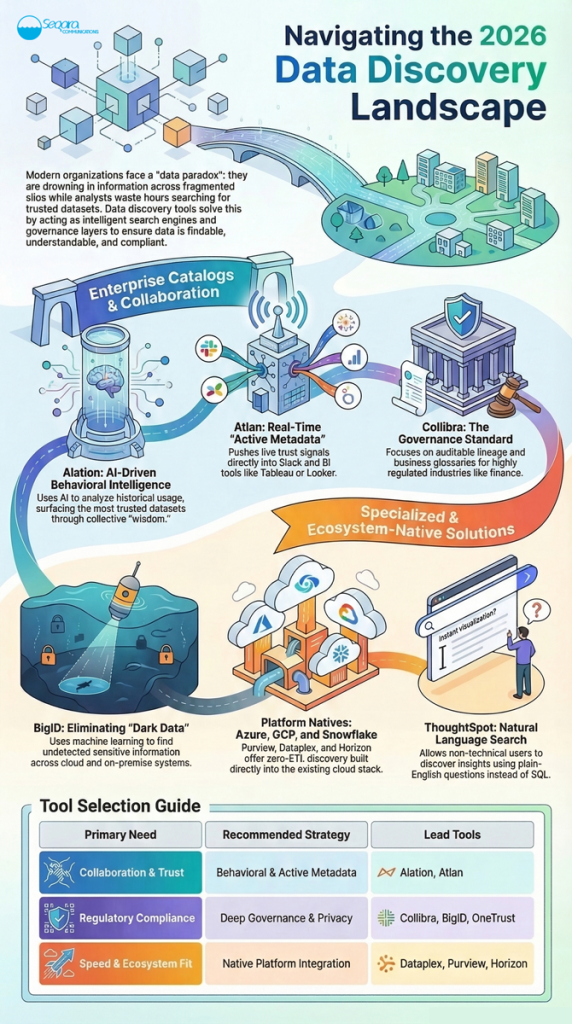
Data is only as valuable as your ability to find it, understand it, and trust it. In most modern organizations, data sprawls across warehouses, lakes, SaaS apps, cloud storage, and legacy systems—multiplying faster than any single team can track. The paradox is brutal: we’re swimming in data while analysts burn hours hunting for the right table, questioning freshness, and chasing down owners and definitions.
That’s the job of data discovery tools. They blend cataloging, search, lineage, and governance so people can actually use what they’ve collected. Analysts find relevant datasets fast. Compliance teams surface sensitive information before auditors do. Executives trust that the numbers behind decisions are consistent and accurate.
Here’s the catch: “data discovery” means different things depending on your role and stack. For data engineers, it’s metadata, lineage, and automation. For privacy officers, it’s PII detection and data mapping. For business users, it’s intuitive search and exploration without writing SQL. This feature breaks down the best tools across major categories so you can match capabilities to the problem you’re actually solving.
How to choose a data discovery tool
- Start with your system of record. If you’re standardized on Snowflake, GCP, or Azure, a native option can reduce integration overhead and accelerate time to value.
- Map stakeholders to outcomes. Engineers need lineage and metadata modeling; analysts need relevance ranking and quality signals; compliance needs classification and policy workflows.
- Favor active metadata. Look for platforms that push context—freshness, ownership, incidents—into the tools where people work (BI, notebooks, chat), not passive catalogs that go stale.
- Automate trust. Built‑in quality checks, incident propagation, and “verified” badges prevent broken dashboards and silent data drift.
- Consider extensibility. Open APIs, plugin architectures, and open source let you adapt as your stack evolves.
The best data discovery tools in 2026
Below, I group leaders by their superpower—catalog and lineage, privacy and compliance, cloud‑native ecosystems, and business‑led exploration—so you can zero in on what matters for your team.
Catalogs and lineage powerhouses
Alation
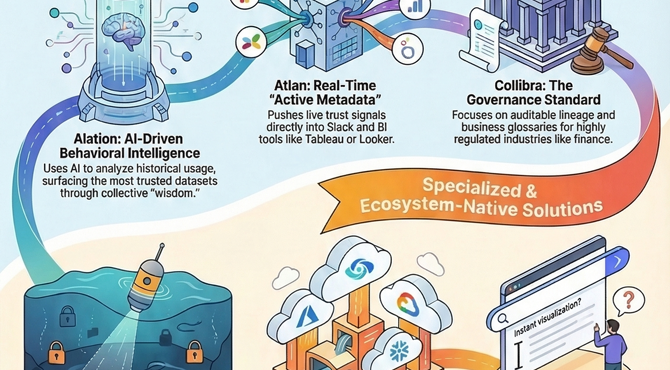
Alation essentially invented the modern data catalog and remains a staple for enterprise discovery. Its AI assistant, Allie, learns from query patterns, endorsements, and usage to prioritize trusted datasets in search. That “wisdom of the crowd” helps newcomers and veterans land on reliable sources without tribal knowledge. If you’re building a shared data culture, Alation provides the foundation where definitions, ownership, and trust live together.
Amundsen
Born at Lyft, Amundsen is an open‑source catalog focused on speed and usability. It highlights table descriptions, usage stats, quality cues, and owners in a clean, search‑first interface that non‑technical users can navigate. It integrates with major warehouses and processing frameworks, making it a pragmatic, lightweight portal for teams that want control without heavy infrastructure.
Atlan
Atlan leans into collaboration and “active metadata.” It pushes live context—verified, deprecated, or broken—directly into tools like Slack, Teams, Tableau, and Looker. Rather than asking users to visit a catalog, Atlan brings trust signals to wherever work happens. For fast‑moving teams, that shift from passive documentation to live, operational metadata is a game‑changer.
DataHub
Originally developed at LinkedIn and now a widely adopted open‑source project, DataHub offers robust metadata modeling, automated lineage, and an extensible plugin architecture. Engineering‑led teams choose it to avoid vendor lock‑in while still getting enterprise‑grade capabilities and strong community momentum.
Collibra
For highly regulated industries, Collibra ties discovery to governance. It enforces business glossaries, ownership, policy workflows, and audit‑ready lineage from source to report. It’s not the fastest to roll out, but when accountability and compliance are non‑negotiable, Collibra sets the bar.
Privacy and compliance specialists
BigID
BigID finds the data you didn’t know you had. Its ML‑driven scanning inventories cloud, on‑prem, SaaS, and file systems to surface “dark data,” with unique identity resolution that links sensitive data back to individuals. That powers GDPR/CCPA requests, minimization, and risk assessments at scale—essential for privacy engineering teams.
OneTrust
OneTrust’s discovery centers on legal and privacy workflows. It automates data‑flow mapping—what personal data comes in, where it goes, how it’s processed—supporting RoPA, consent, and breach response. If you’re formalizing a privacy program, OneTrust turns manual audits into always‑on compliance infrastructure.
Spirion
Spirion specializes in sensitive data across structured and unstructured content—Word docs, PDFs, spreadsheets, email. Combining pattern matching, ML, and context, it delivers high precision with low false positives, making it a favorite for regulated sectors that need an accurate, comprehensive sensitive‑data inventory.
Cloud‑native discovery (meet people where they work)
Google Cloud Dataplex
For GCP‑first organizations, Dataplex automates scanning, cataloging, and classification across BigQuery, GCS, and related services. With native ties to Google’s Data Catalog and DLP, it keeps inventories current with minimal manual work—ideal for large GCP data lakes.
Microsoft Purview
Purview unifies discovery and governance across Azure Data Lake, SQL, Power BI, and Microsoft 365. Native integration with Microsoft security and compliance centers makes policy enforcement operational, not theoretical. If your world is Azure and M365, Purview is the practical default.
Snowflake Horizon
Horizon brings discovery and governance natively into Snowflake—no ETL, no separate platform. Teams catalog, classify, and manage data across accounts and the Marketplace within the same environment they query. For Snowflake‑centric organizations, it’s the most seamless path to trusted discovery.
Business‑led exploration and insight
Qlik Sense
Qlik’s Associative Engine enables true, non‑linear exploration. Click anywhere to see how everything else relates—including the values that don’t match, where outliers and blind spots live. It’s built for discovery when you don’t yet know the exact question.
Tableau (with Data Management)
Tableau remains the BI standard, and its Data Management add‑on adds certification, lineage, and a centralized catalog. Analysts can find, preview, and trust sources without leaving the environment they already use to build.
ThoughtSpot
ThoughtSpot replaces SQL with natural‑language search and pushes proactive insights via agentic analytics. Business users can ask questions in plain English and get instant, accurate charts—dramatically reducing analyst bottlenecks and broadening access to answers.
Quick comparison by primary strength
- Enterprise catalog and culture of trust: Alation, Collibra
- Open‑source flexibility: Amundsen, DataHub
- Active metadata and collaboration: Atlan
- Cloud‑native, minimal overhead: Dataplex (GCP), Purview (Azure/M365), Horizon (Snowflake)
- Privacy and sensitive‑data mastery: BigID, OneTrust, Spirion
- Business‑first exploration: Qlik Sense, Tableau, ThoughtSpot
Implementation pitfalls to avoid
- Stale metadata. Without automation and ownership, catalogs become graveyards. Assign stewards, wire quality checks, and surface freshness where users work.
- Tool sprawl. Pick a system of record. Integrate, don’t duplicate.
- No change management. Train users, codify certification rules, and socialize “one source of truth.”
- Ignoring lineage. You can’t fix broken dashboards if you can’t trace them back to source.
The bottom line
In 2026, discovery is no longer a shelfware catalog—it’s an operational nervous system. The right tool doesn’t just help you find data; it embeds trust into every analysis, automates compliance in the background, and gives every role—from engineer to executive—a clear path from question to answer.
Writer: Aditya Wardhana