
The “Secret” Metric Protecting Top Sites: Why Brand Authority is Outranking Backlinks in 2024
The SEO industry is currently witnessing a silent execution. For years, the playbook for ranking was a transparent arms race: aggregate as many high-authority backlinks as possible, inflate your Domain Authority (DA), and claim your territory at the top of the SERPs. But in 2024, that playbook has been set on fire. We are now seeing a “Ranking Mystery” where massive, link-heavy sites are cratering overnight, while leaner competitors with a fraction of the backlink profile are thriving.
The reality is that SEO has evolved from a technical game of link acquisition into a sophisticated, entity-based reputation game. Google is no longer satisfied with seeing who is linking to you; the algorithm is now obsessively evaluating who you are. The “secret” metric protecting the sites that survived the recent volatility isn’t a hidden technical tag—it is Brand Authority (BA). If you aren’t building a brand that exists independently of search engines, you are building on a foundation of sand.
The Danger of the “Link-to-Brand” Imbalance
With the finalization of the Helpful Content Update (HCU) on September 3, 2024, Google sent a clear signal: a high Domain Authority is no longer a shield. In fact, if your technical authority is significantly decoupled from your real-world brand recognition, your backlink profile actually becomes a liability. This is an “Entity-based SEO” shift where Google looks for a balance between your links and your brand’s actual footprint.
Analysis of approximately 2 million keywords reveals that the most penalized sites suffered from a “Link-to-Brand” imbalance. When link-building strategies far outpace brand strength, it triggers a red flag for manipulation rather than genuine E-E-A-T (Experience, Expertise, Authoritativeness, and Trustworthiness).
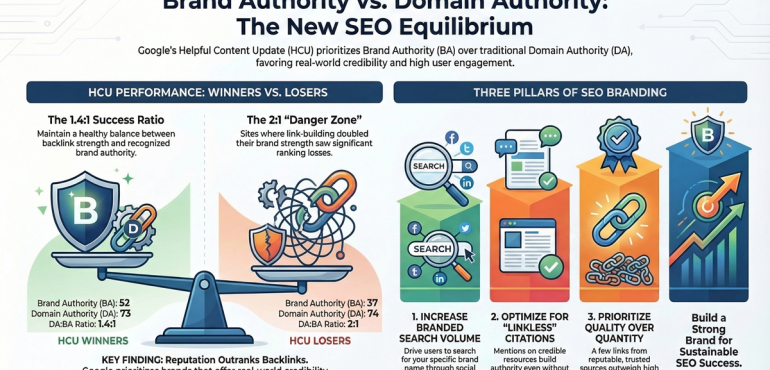
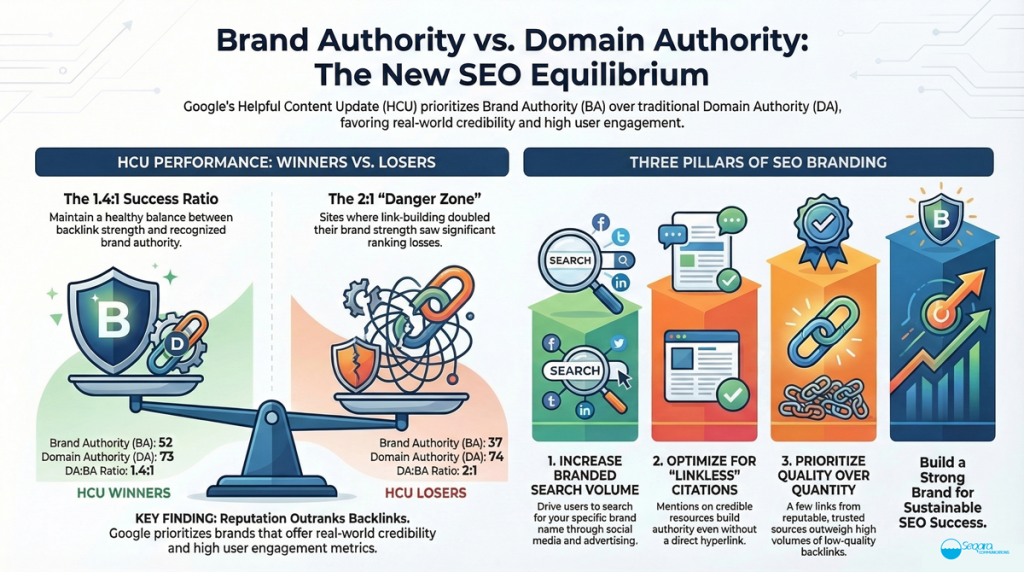
- HCU Losers: Average DA of 74, but a BA of only 37 (A glaring 2:1 ratio).
- HCU Winners: Average DA of 73, with a much higher BA of 52 (A healthy 1.4:1 ratio).
- Neutral Sites: Average DA of 71, with a BA of 50 (A stable 1.39:1 ratio).
“Research shows that websites affected negatively by the HCU often had lower BA compared to DA, meaning their link-building strategies outweighed their brand strength.”
From a strategist’s perspective, this data suggests that an over-optimized link profile without a corresponding “brand buzz” signals to the algorithm that your authority is manufactured. Google is essentially penalizing “ghost authorities”—sites that look important on paper but have no soul in the eyes of the consumer.
Link Building Without Links (The Power of Citations)
The new currency of credibility isn’t just the clickable link; it is “Citation and Co-citation.” Often called “brand pollination,” this is the process of having your brand mentioned on high-tier resources and news platforms alongside other established entities. Even without a direct link, these mentions act as a verification signal that your business is a legitimate player in its industry.
The ultimate signal of brand authority is “Type-in traffic”—when a user navigates directly to your URL without a search engine’s help. This is followed closely by “Brand traffic,” where users search for your company by name. These metrics prove to Google that you have achieved “knowledge of brand without a hint,” moving you from a mere website to a recognized entity. Mentions and citations serve as the connective tissue that search engines use to map your brand’s existence in the real world.
Trust is a Technical Signal
While brand trust may seem like a “soft” marketing concept, search engines have successfully converted human sentiment into “hard” technical data. A recognizable brand name acts as a psychological shortcut for users, influencing behavioral signals that the algorithm tracks in real-time.
Human trust serves as the precursor to user engagement; when users choose a brand in the SERPs, they provide the behavioral signals that search engines use to validate and reward that site’s authority.
This bridge between human psychology and algorithmic reward is direct: high trust leads to higher Click-Through Rates (CTR), lower bounce rates, and increased dwell time. Since search engines were designed to surface the “best”—defined as the most credible and reliable—answer, branding is effectively the ultimate shortcut to proving your site is the safest bet for the user.
The Holistic SEO Toolkit (Beyond Keywords)
In a post-HCU landscape, a professional first impression is no longer a luxury; it is a prerequisite for SEO survival. Non-technical branding elements are now essential tools to prevent “brand doubt” and the high bounce rates that kill rankings.
- Mission Statement: A clear, passionate statement builds an emotional bridge. In high-stakes industries like residential assisted living, a mission reflecting empathy and care is essential for establishing the E-E-A-T required to rank.
- Website Design: Google prioritizes user experience. A clean, mobile-responsive design ensures that users stay on the site, signaling to the algorithm that the destination is high-quality.
- Content Creation: Beyond keywords, content must position you as a thought leader. This earns high-tier, organic backlinks that purely technical SEO cannot buy—such as a local newspaper linking to your site after you host a community event.
- Logo and Visual Identity: Professionalism breeds credibility. An amateur or outdated visual identity creates immediate friction, leading users to doubt your expertise and abandon the site.
Conclusion: The Brand-First Future
The era of manipulating search results through sheer link volume is over. To safeguard your digital assets against future algorithm shifts, you must pivot your focus to the brand-to-link ratio. Sustainable SEO now requires that your brand authority grows in lockstep with your domain authority.
As search engines continue to refine their ability to measure reputation, the winners will be those who stop chasing the algorithm and start building an entity.
Is your website a digital authority, or just a collection of links waiting for the next update to find out the difference?
Writer: Aditya Wardhana