
Stop Reading and Start Seeing: Why Your Brain Processes Pictures 1,500x Faster Than Text
The 0.013-Second Window
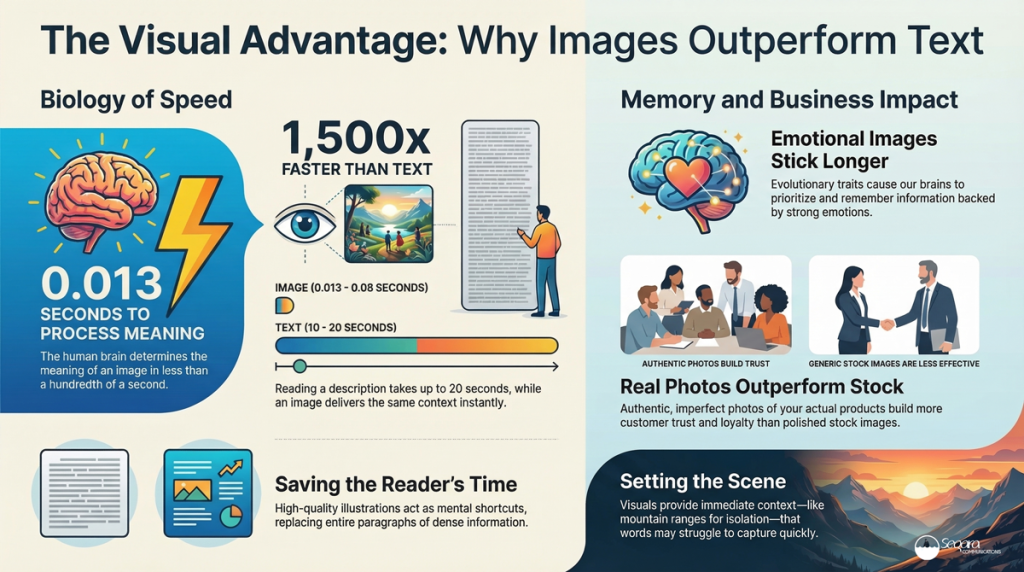
In an era of relentless information noise, high cognitive load has become the default state for the modern consumer. Dense blocks of text create a friction-filled user experience, forcing the brain to laboriously decode symbols while the clock is ticking. Yet, research from MIT (Massachusetts Institute of Technology) US confirms that the human brain can identify the meaning of an image in as little as 0.013 seconds.
To put that in perspective, 0.013 seconds is approximately ten times faster than a human blink. Even when processing a complex scene—such as two girls in swimsuits running toward the ocean—the brain requires only 0.013 to 0.08 seconds to register the context, the motion, and the underlying positive emotion of a seaside vacation.
If time is our most precious commodity, why do we continue to architect our communication around “walls of text”? Every second spent decoding a sentence is a second of attention you risk losing to a competitor who chooses to show rather than tell.
The 1,500x Efficiency Gap
The disparity between visual and textual processing isn’t just a slight edge; it is a massive neural bandwidth advantage. While an image is identified in milliseconds, it takes the average reader 10 to 20 seconds to process a written description of that same visual.
The mathematical reality is staggering: text takes 125 to 1,500 times longer to process than an illustration. This is due to the mechanical bottleneck of symbolic processing; the brain must decode syntax, grammar, and vocabulary before it can even begin to synthesize meaning. Even if your copy is “laconic, accurate, and interesting,” it cannot bypass the physical limits of reading speed.
“If an illustration can convey the meaning of a paragraph, it’s best to use a picture.”
When authors prioritize character counts over visual hierarchy, they often produce long, dull texts that fail to maintain engagement. By the midpoint of a text-heavy document, the average reader has already disengaged, their cognitive resources exhausted by the effort of translation.
The “Fresh Bread” Effect: Cutting Through Information Noise
Consider the “Fresh Bread” analogy from a strategic perspective. In a grocery store filled with hundreds of visually saturated packages, the visual channel becomes overloaded, leading to sensory blindness. In this state, the scent of fresh bread acts as a powerful shortcut, bypassing the visual noise to trigger an immediate, pre-attentive response.
The current digital landscape is identically saturated—but with text. Because the internet is a sea of letters, a high-quality or unusual image acts as the “scent of fresh bread,” cutting through the symbolic noise with visceral speed.
This explains the meteoric rise of visual-first platforms like Instagram and YouTube. These channels offer a lower-noise environment where content can be delivered with minimal friction, making it easier to capture and hold the viewer’s neural processing bandwidth.
Why Your Brain Chooses Feeling Over Facts
Our neural architecture is hardwired to prioritize information associated with emotion—an evolutionary survival trait that helps us retain vital experiences. The brain naturally filters out extraneous, non-essential details, focusing instead on the “essence” of a moment backed by a feeling.
Cognitive studies reveal that positive emotions are more easily remembered than negative ones. Our memory has a built-in bias toward enhancing pleasant experiences while discarding the unpleasant.
Even if a reader fails to recall the specific nuances of your technical copy, a bright and positive illustration will remain embedded in their memory. By leading with visuals that evoke a specific emotional state, you ensure your brand is filed under “positive” long after the text is forgotten.
The Power of Imperfection: Real Photos vs. Stock Imagery
Many business owners treat professional photography as a secondary luxury, opting instead for polished, generic stock images. This is a technical failure in brand strategy. High-gloss stock imagery often creates a “trust gap” when the actual product or experience fails to match the artificial perfection of the photo.
Authenticity is a primary driver of consumer trust. Real, genuine photos—even those with minor imperfections—build more credibility than sanitized stock assets. The success of global platforms like AliExpress proves this: even a photo of a “crooked design” or a flawed sneaker can drive sales because it establishes realistic expectations.
Investing in a professional photoshoot of your actual inventory or office is not self-indulgence; it is an investment in customer loyalty. A satisfied customer is one who receives exactly what they saw in the image—nothing more, and certainly nothing less.
The Four Pillars of Visual Narrative Architecture
Visuals must be viewed as functional components of your communication framework, not as aesthetic decoration. To build a high-impact narrative, pictures must serve one of four strategic roles:
- Setting the Scene: Instantaneous context (e.g., a mountain range) establishes the “where” and “how” of a story without a single word of exposition.
- Conveying Emotions: A visual of a crying child bypasses intellectual analysis to trigger immediate empathy and sadness.
- Showing Action: Complex movements, such as a car crash, utilize the brain’s ability to process chaos and spatial relationships faster than a play-by-play description.
- Supporting the Narrative: Subtle cues, like a broken watch, act as visual metaphors for complex themes like the passage of time, loss, or impermanence.
For service-based or digital businesses, this strategy requires the creation of “corporate image banks.” Move beyond amateur PR photos and instead utilize designer-led posters, memes, and conceptual collages to define your brand’s unique visual voice.
The Future of Your Content is Visual
The shift toward high-quality graphic content is no longer a trend; it is a requirement for survival in a low-attention economy. Images are high-speed communication tools that reduce user friction, boost sales, and increase customer satisfaction by providing clarity at a glance.
As you audit your current content strategy, remember the 0.013-second window. In the time it takes for your customer to blink, they have already decided if your message is worth their time.
If you had only 0.013 seconds to make your point, what image would you show?

Writer: Aditya Wardhana