
The End of the Middleman? 5 Surprising Truths Shaping the New Era of DTC Marketing
The Death of the Warehouse Trudge
For decades, the American shopping experience was defined by the “warehouse trudge.” Consumers spent hours navigating cavernous department stores and massive big-box retailers, often settling for products that didn’t quite hit the mark because there was simply no alternative. This clunky, time-wasting reality was the baseline of commerce.
Today, Direct-to-Consumer (DTC) marketing has dismantled that model. This isn’t a fleeting trend; it is a fundamental shift in purchasing psychology. By bypassing traditional wholesalers to sell directly through digital storefronts, brands have replaced operational friction with a level of comfort and directness that modern consumers now view as a requirement, not a luxury.
1. Your Product is Secondary to Your Personality
In a saturated digital landscape, the “what” of your business is rapidly losing ground to the “who” and the “why.” Because the barriers to entry in the DTC space are at an all-time low, we have entered a “commoditization trap” where product features are easily mirrored. In this environment, brand personality becomes your only true moat.
Modern consumers are “voting with their wallets,” prioritizing brands that offer a sense of affinity. Success is no longer dictated by “how it looks,” but rather “how it feels.” This requires radical brand transparency—communicating the “ins and outs” of your operations and maintaining integrity even when things go awry.
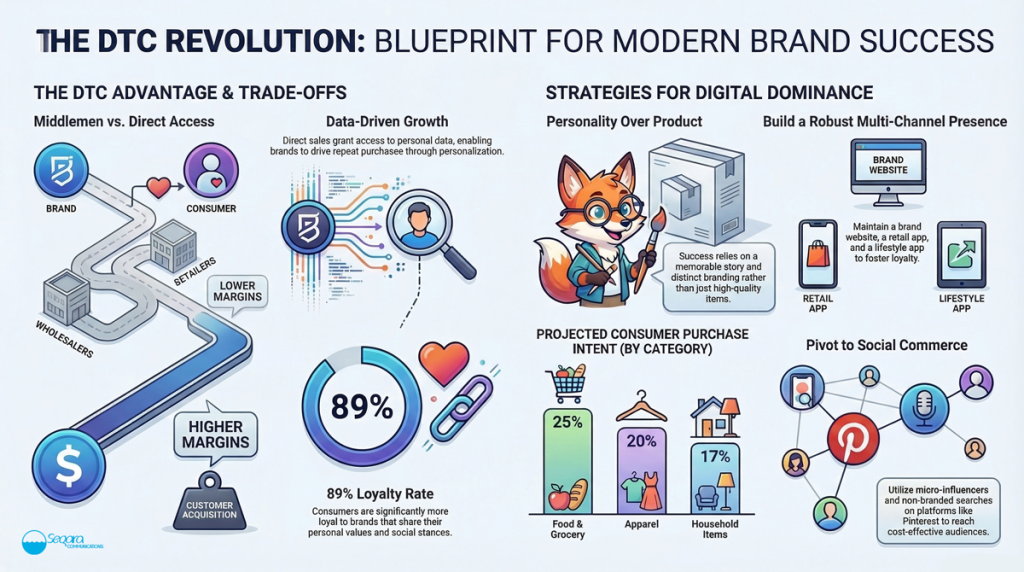
“89% of consumers are more loyal to a brand that shares their values.” — Modern DTC Marketing Strategies
2. Social Media is the “New Middleman”
The founding promise of the DTC movement was the elimination of the middleman to secure better margins. However, a strategic irony has emerged: while brands have successfully bypassed wholesalers, they have been “re-intermediated” by social platforms. With 87% of eCommerce shoppers admitting that social media helps them make purchasing decisions, platforms like Meta have become the new gatekeepers.
As advertising costs on Instagram and Facebook skyrocket, many brands are facing significant margin compression. The “savings” once gained by cutting out the distributor are now being swallowed by rising Customer Acquisition Costs (CAC). To protect their bottom line, senior strategists are pivoting toward micro-influencers—a move that cuts expenses while fostering more authentic, niche-driven engagement.
3. Beyond the Duopoly: The Discovery Engine of Non-Branded Search
While the Facebook/Instagram duopoly focuses on interruption-based marketing, savvy DTC brands are looking toward Pinterest to harness the power of “intent.” Pinterest is a unique animal in the digital ecosystem because of its dominance in non-branded searches.
When users engage with these platforms, they are often in a “discovery” mindset rather than searching for a specific label. This offers “no limit to choice” for the consumer and provides a vital escape hatch for brands struggling with the high costs of traditional social ads. By shifting from “pushing” products to “enabling” discovery through inspirational content, brands can capture high-intent users at the very start of the buying journey.
4. Stop Selling to “Customers” and Start Serving “Users”
To foster long-term loyalty, you must stop viewing people as one-off “customers” and start treating them as “users” of an ongoing experience. A customer transaction is a finale; a user relationship is a collaborative partnership.
To transition from a transactional model to a service-oriented mindset, brands should implement the following:
- Implement Intentional Personalization: Move beyond basic demographics to create experiences tailored to individual user behavior.
- Remove Friction in High-Stress Times: Audit your checkout and support systems to eliminate any “hurdles” that might frustrate a user when they need assistance or guidance.
- Integrate Social Proof: Constantly feature and celebrate customer reviews within your core marketing collateral.
- Co-Create the Future: Develop your product roadmaps based directly on user feedback, making your audience feel like stakeholders in the brand’s evolution.
“When your customers are feeling heard, they are more likely to become potential long-time users.” — Modern DTC Marketing Strategies
5. The $4.5 Trillion Wellness Gold Rush
The most significant market shift we are witnessing is the explosion of the Health Tech and Wellness sector. This isn’t a temporary spike; it is a permanent lifestyle shift. In 2020, the number of consumers who ranked wellness as “very or extremely important” hit 77%. Now valued at $4.5 trillion, this category is the primary frontier for DTC expansion.
This “Wellness Gold Rush” is being fueled by DTC brands using their “secret weapon”: an intimate, data-driven knowledge of target demographics. This allows them to steal market share from “legacy retail silos” that are often too slow to adapt to niche needs. Other key growth sectors include:
- Food and Grocery (25% intent): One of the fastest-growing global eCommerce categories.
- Apparel (20% intent): Where 52% of consumers now demand sustainable practices.
- Household Items (17% intent): Maintaining momentum following a 318% traffic spike in 2020.
Conclusion: Navigating the Trillion-Dollar Future
The scale of this shift is historic; 2022 is projected to be the first-ever trillion-dollar year for U.S. commerce. As traditional retail giants begin to aggressively fund their own direct-to-consumer channels, the landscape will only grow more competitive.
In this post-pandemic reality, survival belongs to the agile. Success is no longer just about having a digital storefront; it’s about delivering the right message to the right audience at the exact moment they are in the right mindset. Is your brand thinking on its feet and streamlining for the future, or are you running the risk of falling into irrelevance?

Writer: Aditya Wardhana