
TikTok Brand Voice & Linguistic Integration Guide
1. Strategic Executive Overview
In a global digital ecosystem exceeding one billion active users, TikTok has evolved into a dominant socio-cultural force where communication is governed by a sophisticated linguistic framework. For the modern enterprise, mastering this platform is not merely an exercise in content production but a strategic imperative to adopt a lexicon that fosters deep-seated community and emotional resonance. The unique language of TikTok is not a transient trend; it is a primary tool for professional communication that facilitates platform-native resonance.
As a “shared language,” TikTok acronyms serve as vital semiotic shortcuts that bridge the gap between corporate entities and organic users. The adoption of this lexicon is driven by three primary strategic imperatives:
- Efficiency within Time-Limited Formats: In an environment where narratives are compressed into short-form video, acronyms allow for high lexical density, transmitting complex sentiments with minimal temporal investment.
- Emotional Expression: These terms provide a streamlined shorthand for conveying nuanced affective states, ensuring the creator’s emotional intent is immediately decoded by the viewer.
- Community Building: The use of this shared vocabulary serves as a semiotic signal of in-group status, reducing the friction between the brand and the user base while fostering a sense of mutual belonging.
Mastering this socio-linguistic framework is the foundational prerequisite for achieving corporate digital authenticity and transitioning from transactional messaging to meaningful social participation.
2. The Core Lexicon: Navigating General Platform Terminology
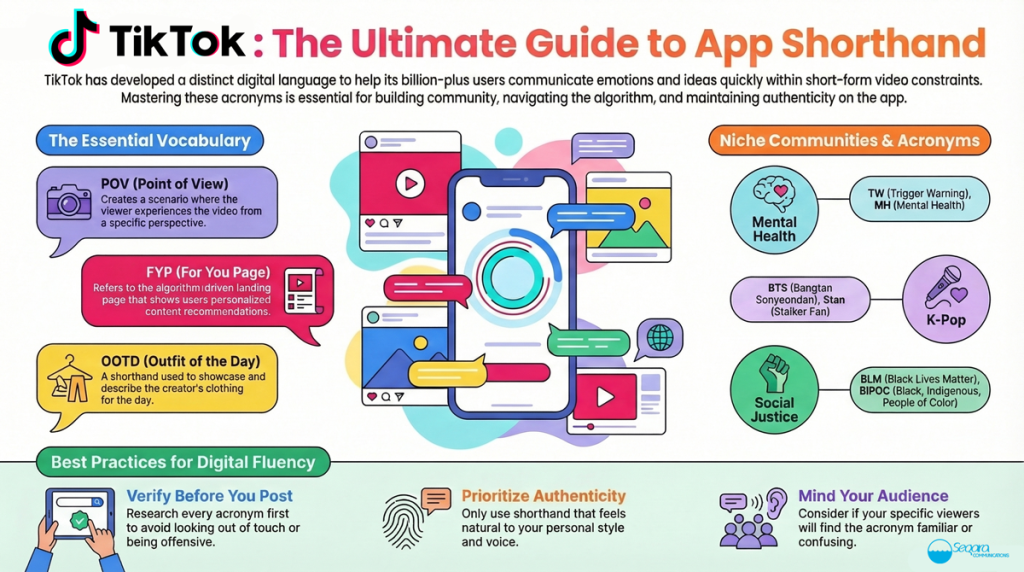
Understanding foundational acronyms is critical for navigating the “For You Page” (FYP) and ensuring that brand content aligns with the established behaviors of a global audience. These terms act as the structural pillars of TikTok communication; their correct application ensures that content feels integrated rather than intrusive.
| Acronym | Linguistic Origin/Meaning | Strategic Application |
|---|---|---|
| POV | Point of View | Transforms the viewer from a passive observer into an active participant by creating an immersive, first-hand experiential scenario. |
| FYP | For You Page | References the platform’s discovery algorithm; strategically used to signal content relevance and the intent to engage with a broader, non-linear audience. |
| OOTD | Outfit of the Day | Shifts the viewer’s experience into that of an “aesthetic curator” or “virtual stylist,” centering the content on brand identity and visual storytelling. |
| TBH | To Be Honest | Functions as a marker of radical transparency; it recalibrates the viewer’s experience by signaling “behind-the-scenes” sincerity and brand vulnerability. |
| TFW | That Feeling When | Acts as an empathetic bridge, identifying and validating a shared emotional reaction to establish a common bond with the viewer. |
| IRL | In Real Life | Differentiates between digital artifice and physical reality, grounding the brand’s persona in tangible, relatable human experiences. |
| SMH | Shaking My Head | Provides a relatable socio-cultural marker for expressing performative disapproval or disappointment in a low-stakes, informal manner. |
| LOL | Laugh Out Loud | A foundational indicator of humor; signals intended amusement to validate the comedic value of a specific moment. |
| LMAO | Laughing My Ass Off | Indicates high-intensity amusement; brands should utilize this to validate extremely funny or absurdist content, signaling cultural alignment. |
| ROFL | Rolling on the Floor Laughing | Communicates extreme amusement; serves as a high-energy signal for content intended to provoke peak engagement through humor. |
While these foundational terms facilitate broad engagement, a brand’s digital strategy must become increasingly nuanced when interacting with specialized sub-communities, where language serves as a marker of identity and cultural safety.
3. Community-Specific Engagement & Cultural Sensitivity
TikTok serves as a critical safe space for niche communities, each maintaining rigorous cultural standards and specific terminologies. Professional presence within these digital enclaves requires a high degree of cultural literacy; an imprecise or performative presence risks appearing “out of touch” or culturally insensitive.
- LGBTQ+ Community: Utilizing identifiers such as LGBTQ, LGBTQIA, or LGBTQQIP2SAA is mandatory for celebrating diverse identities. The Strategic “So What?”: Correct usage is not just about inclusion; it is about signaling the brand as a safe ally in a space dedicated to acceptance and identity celebration.
- Black Lives Matter (BLM) Community: This community utilizes acronyms like BLM, ACAB (All Cops Are Bastards), and BIPOC (Black, Indigenous, and People of Color) to drive awareness regarding racial inequality. The Strategic “So What?”: Precise deployment of these terms demonstrates a brand’s informed respect for social justice movements and an understanding of the gravity behind the discourse.
- Mental Health Community: Discussions regarding personal struggles utilize terms such as TW (Trigger Warning), MH (Mental Health), and OCD (Obsessive-Compulsive Disorder). The Strategic “So What?”: Using “TW” is a critical risk mitigation strategy; it prevents the alienation of vulnerable demographics and ensures content is not flagged or perceived as insensitive to psychological safety.
- K-pop Community: One of the platform’s most potent fanbases, fans use terms like BTS (Bangtan Sonyeondan), ARMY (Adorable Representative MC for Youth), and stan (defined as a “stalker fan”). The Strategic “So What?”: Authentically engaging with these specific socio-cultural markers is the only way to convert high-energy fandoms into brand advocates rather than detractors.
Adhering to these community-specific nuances is non-negotiable for maintaining a safe and respectful digital environment. This leads to the operational parameters required to maintain a professional brand voice.
4. Operational Guidelines for Authentic Communication
Brand authority on TikTok is constructed through authenticity, not merely technical accuracy. To safeguard a brand’s professional reputation, representatives must adhere to the following operational mandates:
Prioritize Comprehension Absolute certainty regarding the meaning and origin of an acronym is required before deployment. Misusing a term carries severe risks of reputational damage, as the TikTok community is quick to penalize brands that demonstrate a lack of foundational linguistic understanding.
Strategic Parsimony While acronyms enhance efficiency, they must be used sparingly. An over-saturation of digital shorthand can lead to cognitive overload, making communication confusing or off-putting. Acronyms should only be utilized when they contribute naturally to the context.
Audience Mapping Strategic leads must consider the varying degrees of fluency among their target demographics. Some users find specific acronyms offensive if used out of context or by the wrong entity. Mapping the demographic’s familiarity with sub-culture shorthand is essential to avoid accidental provocation.
The Authenticity Mandate The “forced” adoption of trends or acronyms is strictly prohibited. If a linguistic style does not align with the brand’s established identity or the representative’s natural voice, it must be avoided. Insincere communication is easily detected and will result in a failure to build community trust.
These guidelines serve as the necessary guardrails to ensure that while a brand speaks the language of the platform, it maintains the professional integrity required of a global entity.
5. Implementation and Conclusion
Navigating the complex socio-linguistic landscape of TikTok is a prerequisite for any modern digital strategist. A comprehensive understanding of this digital culture—ranging from foundational discovery terms like POV and FYP to the identity-driven language of niche communities—is the key to moving through the platform with authority and purpose.
In conclusion, brands must recognize that they operate as guests within a vibrant, user-driven ecosystem. When an organization masters the language of the community correctly and authentically, it successfully transitions from a mere advertiser to a valued community participant. This mastery is the bridge to long-term platform success and sustainable consumer connection.

Writer: Aditya Wardhana