
Inside the Inbox: What Journalists Really Want From PR Pitches in 2026
In an era dominated by algorithmic feeds, paid placements and influencer partnerships, one truth holds stubbornly firm: earned media is still the most trusted form of brand communication. A mention in a respected publication carries a weight no sponsored post can replicate. But the path from pitch to publication has grown longer, narrower and far less forgiving. For every story that lands, dozens—sometimes hundreds—of pitches vanish without a trace. Understanding why, and what the gatekeepers actually want, has become the defining challenge of modern media relations.
The Great Silence
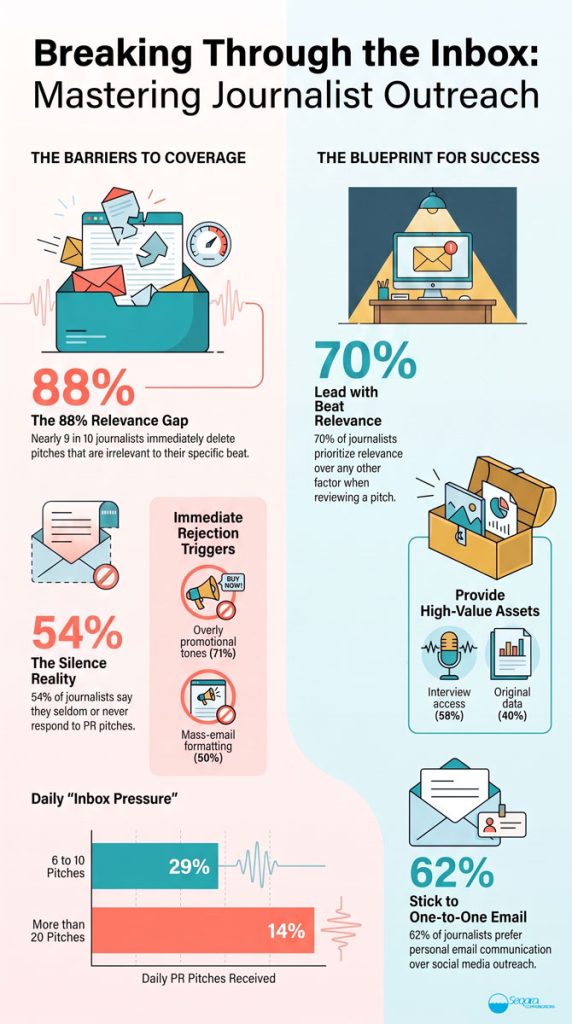
Perhaps the starkest figure in the current landscape is this: 54% of journalists say they seldom or never respond to PR pitches. That is more than half the profession, effectively operating behind a wall of silence. The reason is not malice or laziness; it is volume. On any given workday, 29% of journalists receive between six and ten PR pitches. A further 14% are staring down more than twenty. When the inbox is a firehose, even the most conscientious reporter learns to skim, delete and move on with brutal efficiency.
This reality reframes the PR challenge entirely. The question is no longer “how do I craft the perfect pitch?” but rather “how do I earn even a moment of attention from someone drowning in noise?” The answer, as the data reveals, lies less in clever subject lines and more in a fundamental respect for what journalists actually do.
Relevance Is Everything
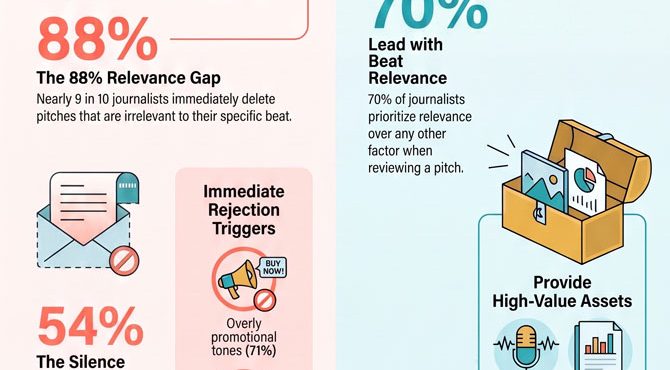
When asked what matters most in a pitch, 70% of journalists point to one thing above all others: clear relevance to their beat. It sounds obvious, yet 88% of journalists say they immediately disregard or delete a PR pitch precisely because it is irrelevant to their coverage area. The gap between what practitioners think is relevant and what journalists actually cover appears to be vast.
Beyond relevance, journalists want substance. Fifty-eight percent prioritize interview access to relevant sources—real people with real expertise, not a pre-approved quote sheet. Meanwhile, 40% want original data or research they can mine for insight. Compare that to the tactics that still populate many a PR playbook: pre-written quotes, valued by just 14% of journalists, and social media copy, which barely registers at 3%. The message is clear: journalists are not looking for a story served on a platter. They are looking for the raw materials to build their own.
The Instant Rejection Trio
If irrelevance is the cardinal sin, it does not travel alone. The second most common reason for instant deletion is promotional excess—71% of journalists say overly promotional pitches get tossed without a second glance. The third is the unmistakable whiff of a mass email, cited by 50% of respondents. Together, these three factors—irrelevance, hype and impersonality—form a near-perfect filter. A pitch that fails on any one of these counts is likely doomed. One that fails on all three never stood a chance.
The lesson is both simple and demanding: every pitch must demonstrate genuine familiarity with the journalist’s work, a clear understanding of their audience, and a restraint that puts information ahead of enthusiasm. It is not about being boring; it is about being useful.
Email Holds the Fort
Amid talk of new platforms and channels, the data is unequivocal: 62% of journalists prefer to be pitched via one-to-one email. The medium is direct, private and asynchronous—qualities that suit a profession built on focus and deep work. Social media, for all its ubiquity, has not displaced the inbox.
That is not to say social platforms lack value. Journalists still find utility in Facebook, which 28% rate as the most valuable social network, and LinkedIn, cited by 20%. But the nuance lies in trust. LinkedIn stands apart as the platform journalists trust most to treat journalistic content fairly, with 58% expressing confidence in it. That trust gap matters. A pitch that arrives via a trusted channel, or references content discovered there, benefits from an implicit credibility transfer.
Social Media’s Quiet Retreat
For years, the story was one of social media’s inexorable rise as a reporting tool. That trend appears to have stalled, and then some. Only 21% of journalists now say social media is very important to their reporting work—a drop of 12 percentage points since 2024. The platforms that once promised real-time access to sources and stories are increasingly seen as noisy, unreliable and algorithmically hostile to news.
Yet distribution tells a different story. Social media remains very important for promoting published work, with 45% of journalists citing its role in getting stories seen. The platforms may be losing ground as discovery engines, but they retain power as broadcast channels. For PR professionals, this suggests a dual approach: do not pitch on social, but do make it easy for journalists to share what they write after the fact.
The New Playbook
What emerges from these numbers is not a set of hacks or shortcuts. It is a discipline. The journalists most worth reaching are those buried under the largest wave of noise, and the only reliable way through is precision. That means reading a journalist’s recent work before writing to them. It means offering access rather than assets, data rather than decoration. It means respecting the inbox as sacred space and treating every pitch as a small exercise in service.
The trust earned media commands has not diminished. If anything, in a media environment increasingly polluted by synthetic content and undisclosed sponsorships, editorial endorsement has become more valuable than ever. What has changed is the cost of earning it. The journalists who hold the keys are busier, savvier and less patient than at any point in the past. Meeting them on their own terms is no longer optional. It is the only game in town.
Writer: Adit
