
The AI Inflection Point: What the 2026 Data Reveals About the Future of Public Relations
In early 2025, the conversation around AI in public relations still carried the nervous energy of experimentation — teams were dabbling, testing the waters, wondering whether generative tools would prove to be a fleeting novelty or a structural shift. By mid-2026, that question has been answered decisively. AI has not only arrived in PR; it has become the operational backbone of the profession.
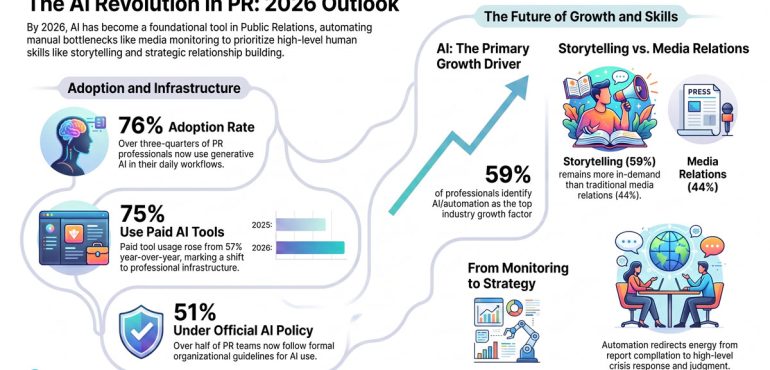
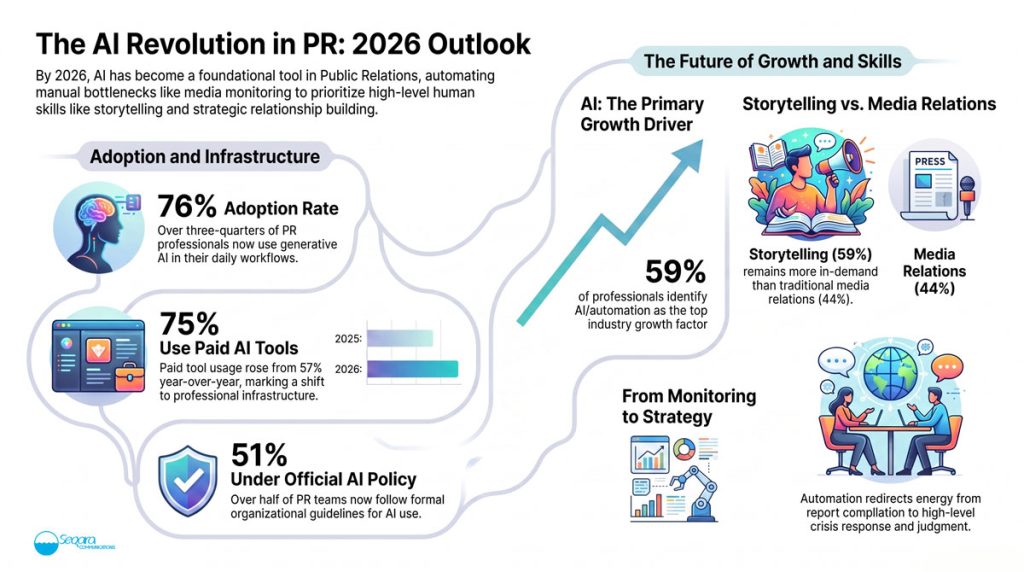
The numbers tell a story of an industry crossing a genuine inflection point. According to Muck Rack’s State of AI in PR 2026 report, based on a survey of over 500 communications professionals, 76% of PR pros now use generative AI in their daily work . Perhaps more tellingly, 75% report using at least one paid AI tool — a sharp jump from 57% just one year prior . When professionals begin opening their wallets for software, the experimental phase is over. AI has graduated from novelty to necessity.
From Tinkering to Infrastructure
The shift from free-trial curiosity to paid-subscription commitment signals something important about how deeply AI has embedded itself in PR workflows. Free tools invite casual exploration; paid tools indicate institutional buy-in. That 18-percentage-point year-over-year increase in paid adoption — from 57% to 75% — reflects communications teams securing budget lines, negotiating vendor contracts, and treating AI platforms the way they treat media databases or monitoring services: as non-negotiable infrastructure .
What are they paying for? The use cases have matured considerably. Muck Rack’s data reveals that 86% of AI-using PR professionals now deploy these tools to edit and refine their work, while 74% use them for writing and content creation . But the reach extends far beyond drafting: teams are using AI to summarize lengthy reports, analyze media coverage at scale, generate pitch angles, and identify emerging narrative opportunities before they surface in the broader media landscape.
Cision’s Inside PR 2026 report, which surveyed over 500 PR professionals, reinforces this picture of deepening integration. A striking 91% of respondents reported that AI is now integrated into their PR activities in some capacity — a figure that leaves little room for holdouts . The era of asking “should we use AI?” has given way to a far more nuanced question: “where should we use it, and where should we deliberately refrain?”
The Policy Tipping Point
One statistic captures the maturation of AI in PR more vividly than almost any other: 51% of PR teams now operate under an official organizational policy that dictates the permissible use cases of AI in client and public communications .
This is a remarkable threshold. When a majority of organizations feel compelled to codify rules around a technology, that technology has ceased to be peripheral. It has become powerful enough to require governance. These policies are not blanket bans — they are frameworks for judgment, distinguishing between tasks where AI accelerates without compromising quality (media monitoring synthesis, coverage reports, first-draft generation) and tasks where human oversight remains paramount (final messaging sign-off, sensitive stakeholder communications, crisis response).
The policy trend also reflects a growing awareness that AI adoption without guardrails invites risks that communications teams are uniquely positioned to understand. Reputational damage from an AI-generated misstatement, a poorly reviewed client email, or an unchecked factual error can unravel months of trust-building. That 51% of teams have formalized their boundaries suggests the industry is approaching AI with the seriousness it demands — neither rejecting it out of fear nor embracing it uncritically.
Efficiency Is the Prize — But Not the Whole Story
When Cision asked PR professionals to identify the greatest opportunity their teams face in 2026, 48% pointed to AI and automation’s ability to drive efficiency and deliver sharper insights . This aligns with what practitioners report on the ground: the fastest-moving communications teams are using AI to eliminate the manual bottlenecks that have historically consumed disproportionate time — media monitoring, report compilation, coverage summaries, transcript analysis — and redirecting that recovered energy toward the genuinely strategic work.
That strategic work — message development, relationship building, crisis preparedness — is where human judgment remains irreplaceable. AI can surface that a particular journalist has been writing extensively about supply chain disruptions; it cannot decide whether now is the right moment to pitch that journalist on behalf of a logistics client. It can flag that sentiment around a brand is shifting on social platforms; it cannot determine whether a response will calm the waters or escalate the situation.
This distinction — AI as accelerant, not replacement — runs through all the major 2026 industry reports. PR Week captured the sentiment succinctly: the organizations that win this year will be those that treat AI as an accelerant to the PR function, not a threat to it .
The Five-Year Horizon
If adoption statistics describe where the industry stands today, the forward-looking data reveals where it believes it is heading. Muck Rack’s survey asked PR professionals what they expect will be the single most critical factor in industry growth over the next five years. The result: 59% named AI and automation, outpacing both media relations and traditional strategic planning .
This finding is worth sitting with. For decades, media relations — the art and science of building productive relationships with journalists — was considered the irreducible core of public relations. That a majority of practitioners now see AI and automation as more critical to the industry’s growth trajectory than media relations itself represents a genuine paradigm shift. It does not mean media relations is becoming irrelevant; rather, it suggests that how media relations gets done — increasingly aided by AI-driven research, personalization, and timing optimization — is being fundamentally reconfigured.
The Cision data echoes this forward orientation. In a 2025 survey looking ahead to 2026 priorities, PR professionals ranked AI integration among their top concerns, alongside strengthening media relationships and proving measurable business impact .
The Human Skills That Matter Most
For all the emphasis on technology, one data point from the 2026 research provides a corrective to any narrative of AI determinism. When PR professionals were asked to name the most in-demand skills for 2026, the top answer — cited by 59% of respondents — was “storytelling and content creation,” followed by “media relations” at 44% .
This is the paradox at the heart of AI’s impact on PR: the technology is seen as the single most critical factor in industry growth, yet the skill most prized by practitioners is one that is fundamentally, irreducibly human. AI can draft, summarize, analyze, and suggest — but it cannot tell a story that resonates on an emotional level, that understands cultural nuance, that reads the room and adjusts tone accordingly. Those capacities remain squarely in human territory.
The interplay here is revealing. AI handles the volume and velocity work that would otherwise consume the hours a PR professional needs to develop the narrative instinct, the relationship intuition, and the strategic perspective that distinguish great communications work from merely competent output. In this sense, AI is not competing with storytelling — it is clearing the space for it.
Training and Organizational Readiness
Adoption is one thing; proficiency is another. Muck Rack’s 2026 report reveals that 43% of companies now offer AI training to their communications staff, an increase over the previous year . This is progress, but it also means that a majority of organizations have yet to formalize AI skills development — a gap that will likely narrow as AI tools become more deeply embedded in daily workflows and as governance policies make training not just helpful but necessary.
The training question matters because the quality of AI output correlates directly with the skill of the human directing it. Prompt craft, output evaluation, bias recognition, and knowing when to override an AI suggestion are all competencies that develop with practice and structured learning. Organizations that treat AI adoption as a software procurement exercise rather than a capability-building journey risk underinvesting in the human side of the equation.
What This Means for PR Leaders
Taken together, the 2026 data paints a clear picture of where PR stands — and where it is heading.
First, the adoption debate is settled. With 76% using generative AI and 75% paying for AI tools, there is no longer a meaningful “AI skeptic” camp in the PR profession. The question has shifted from “whether” to “how well.”
Second, governance is catching up to adoption. The fact that a majority of teams now operate under formal AI policies suggests the industry is maturing beyond the initial rush of experimentation and into a phase of structured, responsible integration.
Third, AI is reshaping career paths and skill priorities. When practitioners rank storytelling as their most valued skill even as they name AI as the top growth driver, they are describing a future in which technical fluency and human craft develop in tandem — neither sufficient on its own.
Fourth, the infrastructure investment is real and accelerating. The shift from free to paid tools, the rise of formal training programs, and the integration of AI into core workflows all point toward AI becoming as foundational to PR operations as media monitoring software was a generation ago.
The communications teams that thrive in this environment will be those that resist both extremes — neither dismissing AI as overhyped nor deferring to it uncritically. They will build the policies, invest in the training, and cultivate the judgment required to deploy AI precisely where it amplifies human capability without substituting for it. The data from 2026 makes one thing clear: that balance is no longer a theoretical ideal. It is the practical definition of competitive advantage in modern public relations.
Writer: Adit