
Bridging Worlds: Inside Indonesia’s First Diaspora Festival and 25 Years of Returnees Driving Change
Byline: Jakarta — December 1, 2021
Intro
I slipped into the Sheraton Grand Jakarta Gandaria City Hotel just as the doors swung open and the room filled with the low thrum of reconnection. Indonesia’s first-ever Diaspora Festival had arrived—four days not only to celebrate identity, but to turn it into momentum. Framed as a tribute to 25 years of migration and diaspora collaboration, the gathering carried a simple, urgent promise: make homecoming count for national development.
A Quarter-Century of Return and Resolve
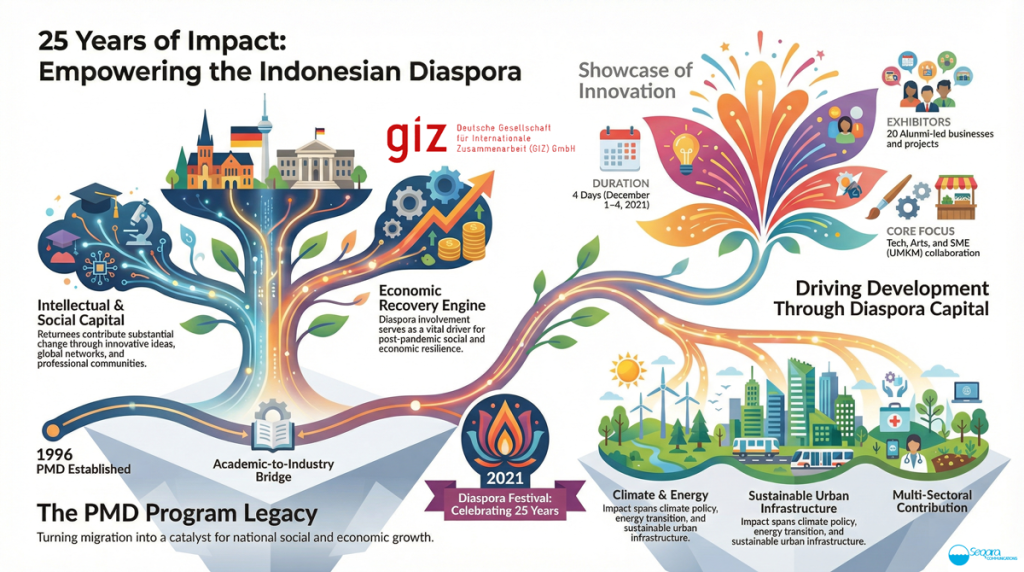
Launched in 1996, the Migration and Diaspora Programme (PMD) of the Deutsche Gesellschaft für Internationale Zusammenarbeit (GIZ) has followed the journeys of Indonesian students, professionals, and innovators who once left—and are now leading from home. The premise is clear: mobility need not equal brain drain. When shaped with intention, it forms a loop of knowledge, networks, and investment that strengthens Indonesia’s social and economic fabric.
Makhdonal Anwar, who leads GIZ Indonesia’s PMD team, reminded us that the mission has always been to ensure migration yields positive impact. That means enabling Indonesian talent in Germany and smoothing the pathway for returnees to apply hard-won skills across science, technology, and industry back in Indonesia.
Germany as a Classroom, Indonesia as a Canvas
For decades, Germany has been a favored destination for Indonesian students seeking rigorous study and research. The festival leaned into that reality. In talk sessions and hallway huddles, alumni relived labs that sparked ideas and studios that shaped craft—then compared notes on bringing those methods home. PMD’s role, several said, is the bridge: connecting people to opportunities abroad and then—borrowing a refrain heard often this week—helping “translate the degree into impact.”
Why Diaspora Engagement Matters Now
In the uneven recovery from the COVID‑19 shock, the stakes are high. Martin Hansen, GIZ’s Country Director for Indonesia, ASEAN, and Timor‑Leste, put it plainly: returnees and the wider diaspora bring three kinds of capital—intellectual (ideas and innovation), social (networks, cooperation, community), and economic. Each is essential fuel for a resilient rebound. Returnees become connectors, moving know‑how, market access, and partnerships across borders—right when the country needs it most.
A Festival of Making and Meeting
Beyond the speeches, the festival moved. Over four days (December 1–4, 2021) at Gandaria City Mall in South Jakarta, visitors flowed between:
- Workshops on entrepreneurship, social innovation, and research translation
- Public talks unpacking policy, financing, and collaboration models
- Music performances that turned shared nostalgia into shared purpose
- An exhibition showcasing works by 20 alumni of German universities—products and services spanning technology, creative industries, and Indonesian arts and heritage
The mix was deliberate: celebrate culture, spotlight solutions, and spark deals. Many exhibits sat at the intersection of the practical and the poetic—tools designed for local communities, software with export potential, and craft that preserves tradition while strengthening livelihoods. For MSMEs, academics, and innovators scouting collaboration, it felt like a marketplace of possibilities.
Who Showed Up—and Why It Matters
The doors were open to business leaders and MSMEs, researchers and makers, students curious about studying in Germany, and anyone eager to learn about the Migration and Diaspora Programme. A theme echoed across sessions: diaspora engagement isn’t a side project. It is a strategy—one that turns lived experience abroad into assets for Indonesia’s development agenda.
Looking Ahead
As the first edition wrapped, a quiet promise lingered. If the past 25 years proved that return is powerful, the next 25 will test how inclusive and scalable that power can be. The blueprint is taking shape: invest in people, strengthen networks, and keep the bridge two‑way. Homecoming, it turns out, works best when it stays connected to the world.
About GIZ and Its Work in Indonesia
GIZ is the German Government’s international cooperation enterprise for sustainable development and international education. In Indonesia and across ASEAN, GIZ has worked since 1975, partnering on climate policy and finance, economic and social development and employment, energy transition, governance, natural resource management, and sustainable urban infrastructure. Its Indonesia country office coordinates programmes on behalf of the German Federal Ministry for Economic Cooperation and Development (BMZ), the Federal Ministry for the Environment, Nature Conservation, Nuclear Safety and Consumer Protection (BMUV), the Federal Foreign Office, and the European Union, supporting the Governments of Indonesia and Timor‑Leste as well as regional ASEAN initiatives.
Writer: Aditya Wardhana