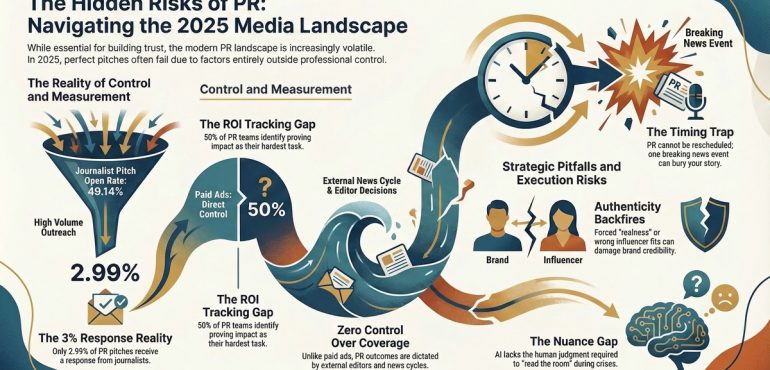

The Hidden Downsides of PR in 2025: Why Earned Media Still Backfires—and How to Plan Around It
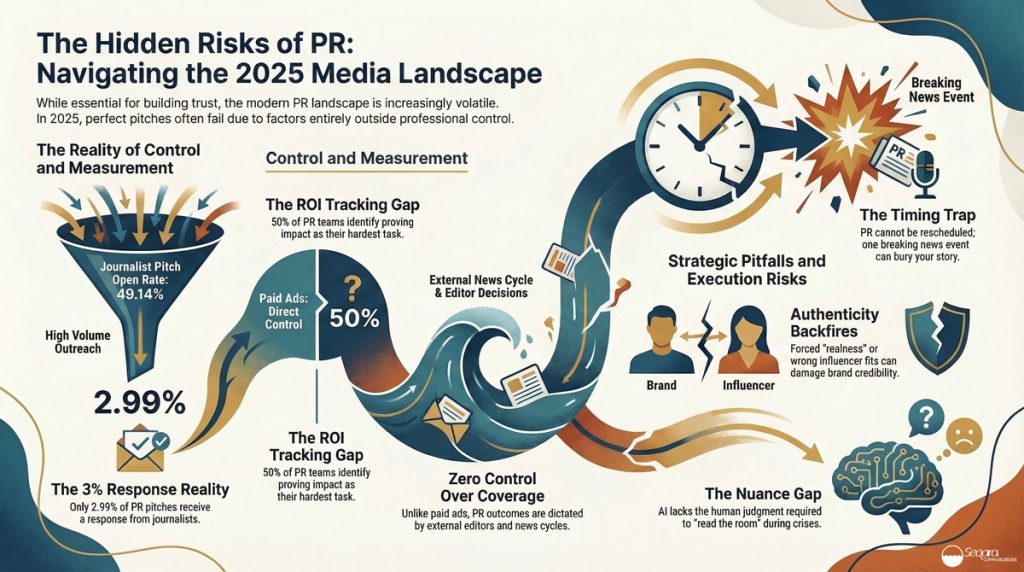
Public relations (PR) is often sold as a trust engine: get seen, get quoted, get believed. But here’s the quieter truth I’ve learned the hard way—PR can just as easily stall, misfire, or boomerang. In 2025, the discipline sits in a paradox: it’s indispensable and, at the same time, stubbornly unpredictable. Stories don’t get picked up. Messages get misread. Impact hides in indirect paths that dashboards can’t trace. If PR is on your roadmap, you need to understand the risks before you launch.
In this feature, I unpack the uncomfortable disadvantages of PR that rarely make the pitch deck—and share the trade‑offs teams should weigh to make campaigns less risky and more resilient.
The Main Drawbacks at a Glance
- Limited control over coverage and framing
- Measurement gaps and fuzzy ROI
- Timing dependencies you can’t fully manage
- No guarantees—ever
- Real risk of negative publicity and backlash
- Persistent pressure on lean teams
- Authenticity traps and oversharing risks
- Message dilution from information overload
- Influencer misalignment that erodes credibility
- AI’s limits on tone, timing, and judgment
- Small issues that can snowball into crises
1. Measurement Rarely Fits Neat Dashboards
Unlike paid channels, earned media doesn’t hand you a clean “cost in, revenue out” line. A tier‑one feature can nudge a prospect to Google you a week later, then convert after a LinkedIn touch—yet none of that attribution credits PR directly. Traditional marketing suites aren’t built for this. Without a tailored framework—think story reach, quality of mention, branded search lift, referral traffic, share of voice—it’s hard to make the case in a boardroom that lives on CAC and ROAS. Winning here requires bespoke PR KPIs and disciplined triangulation, not wishful screenshots.
2. You Don’t Control Editorial Decisions
You can craft the perfect pitch, nurture relationships, and still get bumped by a breaking story. That’s the physics of earned media: editors, producers, and hosts make the final call. Even with momentum, your news can vanish in a single news‑cycle swerve. Compared with owned and paid, PR’s timeline is elastic and, at times, indifferent to your launch calendar.
3. Timing Can Sink a Strong Story
Great narratives die on the wrong day. Pitch too early and the market yawns; too late and the trend has already peaked. PR teams now work like mini‑newsrooms—scanning headlines, reading sentiment, moving fast—but timing still blends instinct, speed, and luck. Unlike ads, you can’t just “extend flight dates.” Miss the window and the moment is gone.
4. There Are No Guaranteed Outcomes
Earned media is binary: you get picked up or you don’t. A sharp angle, right outlet, perfect follow‑ups—and still silence. When that happens, post‑mortems are murky. Was it the peg? The source? The audience fit? The ambiguity frustrates performance‑minded leaders and tempts teams to overcorrect rather than refine.
5. Negative Publicity Is a Constant Shadow
Awareness does not equal advocacy. Old narratives cling, especially if a brand has baggage. A single critical headline, clipped quote, or social pile‑on can unwind months of careful positioning. Consistency helps, but only when it’s paired with visible actions—policy changes, product fixes, leadership accountability. PR can steer; it can’t erase.
6. The Pressure Never Really Stops
News breaks after hours. Sources fall through. A “quick” weekend follow‑up isn’t optional if you want to stay in the story. Without guardrails, comms teams drift from strategic to perpetually reactive. Burnout dulls creativity and slows responses—the exact things PR depends on. Sustainable cadence, coverage plans, and escalation protocols aren’t luxuries; they’re risk controls.
7. Forced “Authenticity” Backfires
Audiences can smell performative sincerity. Chasing a trending tone, adopting a slangy voice, or weighing in on a cultural moment you haven’t earned invites eye‑rolls—or worse. Authenticity isn’t a costume; it’s a consequence of behavior. If the story isn’t aligned with how the company actually operates, trust cracks on contact.
8. Oversharing Creates Fresh Vulnerabilities
Transparency builds credibility, but unmanaged candor hands critics free angles. A well‑intended admission (say, a hiring pause) can get reframed as weakness. The antidote is message architecture—a clear purpose, boundaries, and proof points. Say the real thing, but say only what you’re prepared to defend and demonstrate.
9. Too Much Information Dilutes the Signal
Cramming five updates into one announcement blurs the angle and confuses gatekeepers. Attention is finite. If journalists can’t spot the headline in a glance, the email gets archived. Edit ruthlessly. Sequence news. Give each story air to land and be remembered.
10. Misfit Influencers Damage Credibility
Reach without relevance is a mirage. When the messenger and message don’t match—think a lifestyle creator reading a B2B script—audiences tune out or mock the effort. Prioritize domain credibility, audience overlap, and creative latitude. If it looks scripted, it probably reads inauthentic.
11. AI Can’t Read the Room
Generative tools accelerate drafting, but tone and timing still demand human judgment. A polished quote that ignores a sensitive context does more harm than good. Use AI for scaffolding—data pulls, briefs, first passes—but route anything reputational through humans who understand stakes, sentiment, and subtext.
12. Small Sparks Can Become Crises
Minor complaints, offhand posts, or misphrased replies can ignite when left unattended. Crisis readiness is about early detection, crisp approvals, and empathetic responses. Treat small signals as opportunities to clarify before they mushroom into narratives you don’t control.
How to Make PR Less Risky (Without Giving Up on It)
- Build a measurement spine: define PR KPIs, tag links, monitor branded search, and align analytics with comms cadence.
- Operationalize timing: maintain a rolling calendar, reactive commentary angles, and “go now” asset kits.
- Create message guardrails: what we’ll say, won’t say, and must prove—with owned proof points ready.
- Support the humans: on‑call rotations, recovery time, and clear escalation trees.
- Tighten narrative focus: one headline per announcement; sequence the rest.
- Choose influence for fit, not just reach: vet audience alignment and creative style.
- Keep AI in its lane: drafts, research aids, variant generation—final tone by humans.
- Invest in issues scanning: social listening, community monitoring, and weekly risk triage.
Bottom Line
PR still matters. It shapes how the world understands what you do. But it isn’t a vending machine where inputs guarantee outputs. Go in with eyes open: measure what you can, plan for what you can’t, and back your words with proof. That’s how earned media stops being a gamble and starts becoming a strategy.
Penulis: Aditya Wardhana