
Sustainability Communications: Strategy, Substance, and Staying Credible
I keep hearing the same quiet alarm in boardrooms and break rooms alike: the world is changing faster than our plans. Glaciers recede, storms intensify, and expectations for corporate responsibility climb in lockstep. In that tension sits a simple truth—brands that navigate uncertainty with sustainable action and clear communication will earn the trust to endure. This feature distills practical ways to shape sustainability communications that are strategic, human, and above all, authentic.
What We Mean by Sustainability Communications
Sustainability communications are the deliberate ways an organization explains its environmental and social priorities—what it’s trying to achieve, how it measures progress, and where it still needs to improve. That can look like one‑way disclosures (reports, dashboards, labels) and two‑way dialogue (surveys, town halls, open forums). The aim is to create a shared understanding of the challenges, align stakeholders on trade‑offs, and build durable trust.
But there’s a deeper purpose. Communication can embed values into the bloodstream of the business. When you consistently educate teams, listen to suppliers, and invite customers into the journey, sustainable choices become the default. Done well, communication doesn’t just broadcast progress—it accelerates it.
How it shows up in practice:
- Add concise explanations on product packaging about sourcing, processing, or recyclability.
- Hold facilitated sessions to surface tensions between teams and co‑design improvements.
- Run regular workshops to build literacy on climate, biodiversity, circularity, and human rights due diligence.
Why It Matters Right Now
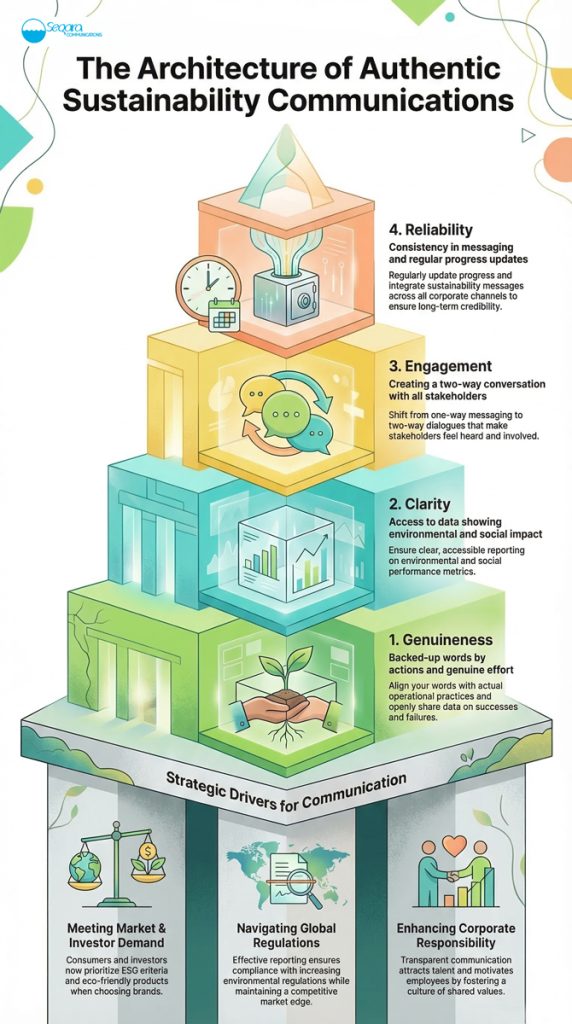
Sustainability communication is the connective tissue between organizations, policymakers, investors, and everyday people. Four pressures have made it mission‑critical:
1) Responding to demand for better products
- Consumers increasingly expect lower‑impact options. Clear, credible messages signal reliability, reduce confusion, and strengthen loyalty.
2) Keeping pace with regulation
- From reporting rules to product standards, requirements are tightening globally. Transparent communication helps demonstrate alignment and readiness while differentiating in crowded markets.
3) Meeting investor expectations
- Capital is flowing toward companies that manage environmental and social risks. Transparent goals, plans, and performance against ESG criteria help de‑risk the story and highlight opportunity.
4) Elevating corporate social responsibility
- Employees want to do meaningful work in trustworthy cultures. Strong internal communications build clarity, boost motivation, and help attract and retain talent.
All of this rests on trust. Without it, even the most impressive initiatives sound like spin. Trust thrives when people can voice concerns, see evidence, and watch words turn into actions over time.
The Four Levels of Effective Sustainability Communication
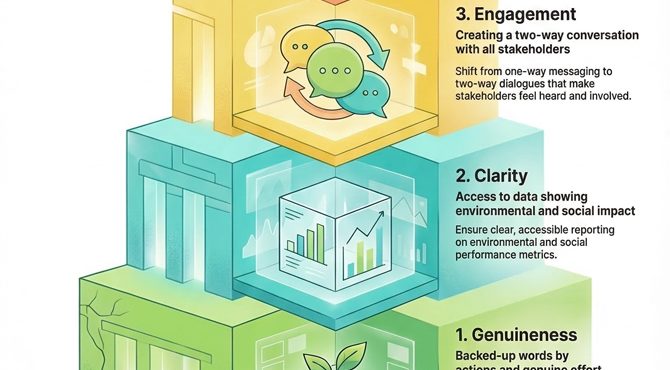
Level 1: Genuineness
- Align claims with real practices. If a parcel company touts lockers to cut emissions per mile, it should scale the network and publish the data. Words need receipts.
Level 2: Clarity
- Share complete, comprehensible information—wins, misses, and lessons. Offer access to methodologies and metrics so stakeholders understand impact and constraints.
Level 3: Engagement
- Make it two‑way. Invite employees, customers, investors, and communities into programs, feedback loops, and co‑creation. Use education, forums, incentive schemes, and volunteer events to deepen participation.
Level 4: Reliability
- Be consistent over time. Provide regular updates, expand initiatives rather than one‑off tweaks, and integrate sustainability into reports, product content, and social channels. Consistency turns messages into identity.
A Practical Playbook: From Intent to Impact
1) Anchor the narrative in material issues
- Identify the environmental and social topics that truly move the needle for your business and stakeholders. Map risks, opportunities, and dependencies across the value chain. Prioritize a short list and commit.
2) Set science‑aligned targets and define baselines
- Targets without baselines are wishes. Establish year‑zero measurements, document assumptions, and frame targets in plain language alongside the $latex Scope\ 1\ +\ 2\ +\ 3$ inventory where relevant.
3) Build a transparent data backbone
- Create a governance process for data collection, assurance, and improvement. Use dashboards for internal decision‑making and translate them into clear external disclosures.
4) Design for audience nuance
- Tailor depth and framing. Employees need context and “how this changes my job.” Consumers want clarity and comparability. Investors expect risk narratives, CapEx links, and transition plans.
5) Choose channels intentionally
- Pair evergreen formats (annual reports, webpages, packaging) with timely touchpoints (town halls, social posts, community meetings). Keep a single source of truth and link out from all channels.
6) Tell the whole story—trade‑offs included
- Share progress and problems. Explain constraints, unintended consequences, and what you’re testing next. Honest nuance earns credibility.
7) Close the loop with dialogue
- Establish recurring forums: AMA sessions with executives, supplier roundtables, employee councils, and community listening posts. Track feedback themes and show what changed as a result.
8) Incentivize participation
- Recognize contributors, fund green teams, and reward measurable actions (e.g., supplier scoring improvements, employee innovation challenges).
9) Prepare for scrutiny
- Anticipate tough questions. Maintain a claims register, keep substantiation files, and pre‑mortem campaigns for greenwashing risks.
10) Report rhythmically
- Set a cadence (quarterly updates, annual deep dives) and stick to it. Consistency compounds trust.
Avoiding the Greenwashing Trap
- Ban vague terms unless defined (e.g., “eco‑friendly,” “clean,” “net‑zero”).
- Avoid cherry‑picking metrics or comparing apples to oranges.
- Disclose boundaries: what’s in and out of the footprint.
- Use third‑party standards or assurance where possible.
- Don’t over‑claim on pilots; label them as trials and share learnings.
Internal Communication: Where Culture Changes First
- Leadership voice: Executives should share the why, not just the what. Tie sustainability to strategy, resilience, and innovation.
- Manager enablement: Equip line managers with talking points, FAQs, and scenario prompts so messages land in daily work.
- Micro‑learning: Offer short modules on topics like circular design or just transition, with practical checklists and office‑hours.
- Rituals and recognition: Bake sustainability into planning cycles, performance reviews, and celebration moments.
External Communication: Make It Useful
- Product‑level clarity: Use standardized icons and plain‑English labels that explain material composition, recyclability, and care.
- Local relevance: Tailor messages to regional infrastructure (e.g., actual recycling capabilities) rather than generic claims.
- Community partnerships: Co‑create initiatives with local groups and publish shared outcomes.
- Investor materials: Link targets to financials—CapEx, OpEx, payback periods, and scenario analysis.
Measurement, KPIs, and Proof
Think outputs, outcomes, and perception:
- Outputs: number of trainings, labels updated, suppliers onboarded.
- Outcomes: emissions reduced, waste diverted, injury rates lowered, living‑wage coverage.
- Perception: employee trust scores, customer understanding, investor confidence.
Use mixed methods—quant data plus interviews—to validate whether messages drive real behavior change.
Crisis and Issues Management
When things go wrong (and they will):
- Acknowledge facts fast; don’t speculate.
- Share what you know, what you don’t, and what you’re doing next.
- Put affected people first; communicate remedies clearly.
- Open a feedback channel and publish updates on a set schedule.
Case Sparks: Simple Moves with Outsized Impact
- Convert delivery routes toward consolidated pickup (e.g., parcel lockers) and publish per‑mile emissions deltas.
- Replace a single “sustainability page” with living documentation that tracks targets, progress, and blockers.
- Launch a supplier academy focused on energy efficiency and responsible sourcing, with tiered incentives.
- Run a quarterly “failure forum” to normalize learning from misses and retire underperforming initiatives.
The Mindset Shift
Sustainability communications aren’t a gloss on the brand—they’re the operating system for change. When we treat them as a long‑term relationship, not a campaign, we get better decisions, more resilient supply chains, and a community that believes us. The task is urgent, but the path is clear: be genuine, be clear, engage deeply, and stay reliably consistent. That’s how we earn the future together.
Writer: Aditya Wardhana