
Strategic Framework: Maximizing Credibility through Earned Media Integration
1. The Foundational Role of Earned Media in the PESO Model
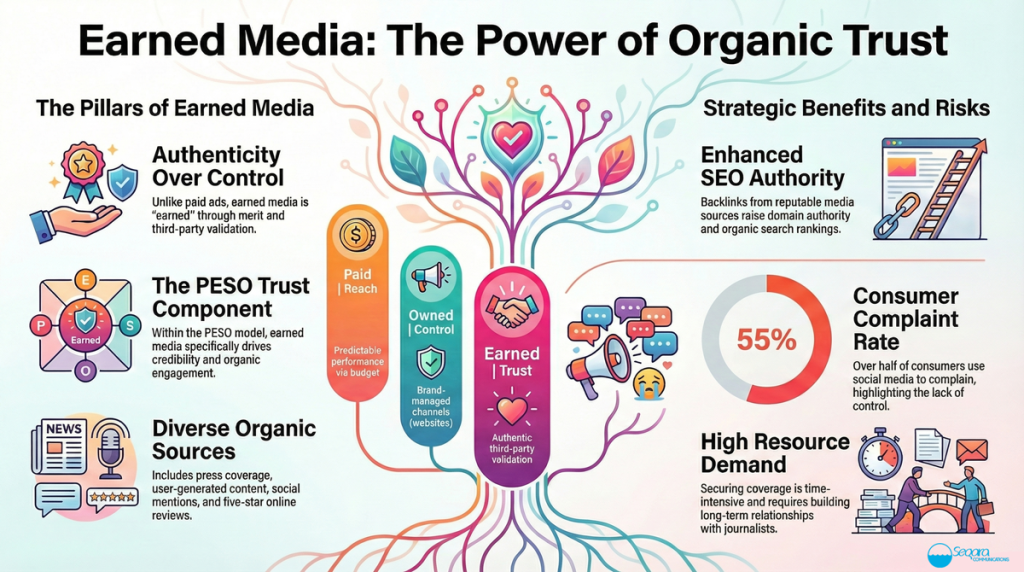
In a high-velocity communications environment, earned media is far more than a “free” alternative to advertising; it is the essential “trust” pillar of the PESO (Paid, Earned, Shared, Owned) framework. While paid and owned channels allow an organization to broadcast its internal narrative, earned media functions as an objective “seal of approval” from authoritative third parties. To succeed in a saturated market, brands must secure this external validation to convert passive awareness into deep-seated institutional trust.
The following table delineates the unique positioning of earned media within a sophisticated communications architecture:
| Media Type | Primary Focus | Key Characteristics | Strategic Role |
|---|---|---|---|
| Paid | Reach | Sponsored content and traditional advertising. | Driving immediate, controlled visibility. |
| Owned | Control | Brand-managed channels (websites, blogs). | Establishing a proprietary brand destination. |
| Shared | Interaction | Social media engagement and community exchange. | Facilitating bi-directional audience dialogue. |
| Earned | Trust | Unprompted and unpaid third-party validation. | Building institutional credibility and organic advocacy. |
To remain competitive, brands must bridge the “authenticity gap” between self-serving, brand-controlled media and external validation. Because consumers are increasingly skeptical of corporate messaging, they prioritize unprompted third-party endorsements over traditional advertising when making high-stakes decisions. This foundational requirement for trust has been fundamentally reshaped by the transition from legacy media to the digital-first era.
2. The Evolution of the Earned Media Landscape: Traditional to Digital
The earned media landscape has shifted from a top-down model dominated by legacy gatekeepers to a multi-channel, decentralized digital ecosystem. Historically, earned media was synonymous with securing space in print newspapers or broadcast television. Today, the digital revolution has democratized “the press,” enabling any credible platform—from industry blogs to high-authority social profiles—to generate organic buzz and brand equity.
This evolution is defined by several tactical shifts:
- Legacy Outlets: The move from a narrow reliance on broadcast and print journalists to a broader spectrum of digital newsrooms.
- Digital Catalysts: The emergence of influencer shoutouts, viral content, and unprompted social mentions as primary drivers of visibility.
- Organic Advocacy: The rise of digital review platforms and direct-to-consumer word-of-mouth opportunities.
This increased accessibility has made the earned media landscape hyper-competitive. Brands no longer compete merely for physical press space; they compete for the finite resource of consumer attention. Success in this environment requires the ability to drive word-of-mouth engagement that amplifies reach across diverse, unprompted networks. Navigating this complexity requires a clear understanding of the specific assets available to the modern practitioner.
3. A Taxonomy of Earned Media Assets
A sophisticated communications strategy avoids single-channel dependency, instead cultivating a diversified portfolio of earned media assets to maximize touchpoints of credibility.
- Press Coverage: Secured through strategic media pitches and newsworthy announcements.
- Example: A tech startup securing a feature in TechCrunch detailing its product’s differentiating attributes.
- Strategic Impact: Delivers high-level industry validation and broad reach via reputable publications.
- Social Media Mentions: Occurs when influencers or industry peers discuss a brand organically on platforms like LinkedIn or Instagram.
- Example: A tech influencer tagging a brand’s product in an unprompted recommendation post.
- Strategic Impact: Drives massive visibility and peer-to-peer credibility among specialized follower bases.
- User-Generated Content (UGC): Organic advocacy where customers create content featuring the brand by choice.
- Example: A coffee shop utilizing a branded hashtag to encourage customers to share their own drink photos on Instagram.
- Strategic Impact: Provides deep authenticity through unprompted customer choice and organic advocacy.
- Online Reviews and Testimonials: Public customer sentiment shared on platforms such as Yelp, Google, and Trustpilot.
- Example: A glowing five-star Google review mobilizing new customers without any associated ad spend.
- Strategic Impact: Provides essential social proof that directly dictates the purchasing journey.
- Media Interviews and Features: Journalists seeking out brand leadership for expert commentary.
- Example: A CEO featured in a top-tier tech outlet discussing industry trends.
- Strategic Impact: Establishes thought leadership and elevates the brand’s domain expertise.
- Event Coverage: Real-time social updates and articles generated during live activations.
- Example: Attendees posting LinkedIn updates and videos during a SaaS conference or industry summit.
- Strategic Impact: Creates a ripple effect of engagement that extends the lifecycle of physical events.
While these assets require resource-intensive relationship management to secure, the measurable impact they have on long-term growth and search visibility justifies the investment.
4. Quantifying Value: Credibility, SEO, and Organic Growth
The ROI of earned media provides a sustainable alternative to the transient nature of paid advertising. One of the most critical advantages is the direct link between earned media and search engine performance. When a brand receives mentions from reputable sources in the form of backlinks, its organic traffic measurably increases. These high-authority backlinks raise a site’s Domain Authority, ensuring potential customers find the brand organically through search rankings.
Furthermore, earned media serves as a “cost-free extension” of visibility. Unlike a paid ad, which ceases to exist once the budget is exhausted, a published article or influencer shout-out can go viral, reaching audiences far beyond the brand’s initial network. This is a critical equalizer for startups and small businesses; a single unprompted mention in a high-profile outlet can generate the same impression volume as a high-budget campaign without the associated financial burden. However, leveraging these benefits requires a rigorous approach to the risks and resource demands inherent in the model.
5. Mitigating Constraints: Risk, Resource Intensity, and Measurement
Managing earned media requires acknowledging a fundamental lack of control. Unlike paid or owned media, which are meticulously curated, earned media is generated by third parties, necessitating a strategy focused on crisis mitigation and active monitoring.
- The Constraint of Control: Because the message is unprompted, brands cannot dictate the final narrative. Negative reviews can significantly backfire; notably, 55% of consumers use social media to complain about brands. This is where “Shared” media (a complaint) can rapidly transform into “Negative Earned” media, requiring robust crisis management.
- Unpredictability and Timing: Success depends on external factors like journalist relevance and news cycles. A media pitch, regardless of its quality, may never be read. This inherent unreliability means earned media should not be the sole source of brand exposure.
- Resource-Intensive Management: Securing earned media is not “free” in terms of labor. It requires significant time, effort, and expertise to build and maintain relationships with journalists and influencers.
- Measurement Hurdles: Unlike the clear-cut click-through rates of paid media, earned media metrics like brand sentiment and awareness are more “convoluted” to quantify. However, strategic practitioners must use specialized tools for sentiment analysis and media monitoring to provide a data-driven view of impact.
These challenges highlight why earned media must be part of a balanced media mix, where the stability of owned channels complements the high-reward validation of external voices.
6. Strategic Conclusion: Forging Long-Term Brand Authority
Earned media remains the ultimate validator within a professional communications architecture. It is the only channel capable of forging the deep trust and long-term relationships necessary for sustained brand authority in a digital-first world.
The Strategic Mandate: PR and marketing managers must treat earned media not as a low-cost shortcut, but as a resource-intensive investment in institutional credibility. While it demands high levels of consistency and offers no guarantees, its role as a third-party validator makes it indispensable. To thrive in an era of consumer skepticism, brands must prioritize the enduring power of the external voice over the echo chamber of brand-led content. Success belongs to those who can turn visibility into unprompted advocacy.

Writer: Aditya Wardhana