
Strategic Implementation Plan: Orchestrating the Owned Media Ecosystem for Brand Equity
1. The Foundation: Defining Owned Media in the Modern PR Landscape
In the contemporary public relations (PR) landscape, the shift from third-party dependence to a brand-owned ecosystem represents a critical strategic pivot. Owned media serves as the primary site where brand equity is created, offering an organization total control over its narrative. By migrating away from a heavy reliance on volatile external platforms, brands establish a clear, singular voice and connect directly with their target audiences, effectively insulating the organization from the unpredictability of earned or paid channels.
Core Definition and Scope
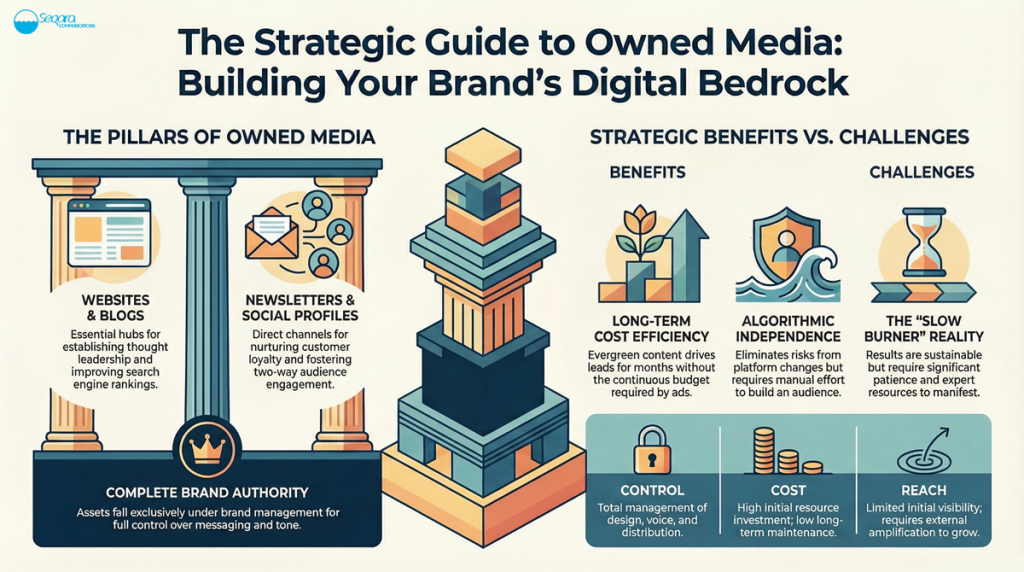
Owned media comprises the content and platforms that a brand manages exclusively, ensuring total authority over messaging, tone, and delivery. Based on the current media landscape, these assets include:
- Websites: The central repository for core brand information and products.
- Blogs: Platforms for detailed storytelling, brand journalism, and expertise.
- Email Newsletters: Direct, measurable channels for audience nurturing and updates.
- Mobile Apps: Specialized tools for direct brand interaction and utility.
- Social Media Profiles: While hosted on external platforms, these profiles serve as brand-managed vehicles for engagement and community building.
The Transformation of Media
Owned media has evolved from static “paper brochures” into sophisticated “interactive hubs.” This transformation has fundamentally shifted the brand-public relationship; these platforms are no longer passive information repositories but active environments for fostering engagement and building trust. This evolution allows brands to cultivate deep loyalty and establish authority through consistent, high-quality interaction.
Connective Tissue
The total control afforded by these foundational assets acts as the catalyst for broader integration. By establishing a firm base in owned media, an organization creates the “grounded messaging source” necessary to power a comprehensive and resilient PESO strategy.
2. The Core Assets: Functional Analysis of Owned Media Channels
A successful ecosystem is built on the realization that owned channels are not interchangeable; they must be surgically aligned with distinct business objectives. As a media architect, one must deploy specific platforms to achieve varied goals, ranging from top-of-funnel education to bottom-of-funnel conversion.
Comparative Asset Framework
| Channel Type | Strategic Function | Value Proposition |
|---|---|---|
| Websites | Core Info & Conversion | First introduction to brand personality; SEO authority; direct sales driver. |
| Blogs | Deep Education & Expertise | Strengthens authority via “brand journalism”; generates linkable content for earned media. |
| Email Newsletters | Audience Nurturing | High measurability (CTR/Open rates); drives traffic to other owned assets; direct updates. |
| Social Media Profiles | Community & Two-Way Relationships | Real-time customer support; inspires engagement; expands reach through visual storytelling. |
The “So What?” Layer
Each asset type exerts a unique influence on brand authority. For instance, a website is often the first touchpoint where a consumer encounters the brand’s “personality.” Conversely, a blog serves as a laboratory for “industry insights”—such as an AI firm detailing emerging technological shifts—and “case studies” that demonstrate tangible value. These assets transform the “brand voice” into a credible industry authority. Specialized applications further illustrate this: a telecom company might utilize Twitter (X) specifically for customer support, while a SaaS company uses its owned ecosystem to distribute downloadable whitepapers and webinar invites, capturing high-intent leads.
Connective Tissue
Individual assets reach their full potential only when they function as a cohesive unit. This internal synergy ensures that the brand’s message remains consistent as it radiates outward into the broader marketing ecosystem.
3. Synergistic Integration: The PESO Model as an Operational Framework
The PESO model (Paid, Earned, Shared, and Owned) is the bedrock of sustainable marketing. Treating owned media as an isolated silo is a strategic failure that limits the ROI (Return on Investment) of high-quality content. In a sophisticated architecture, owned media is the “anchor” or destination where value is captured, while the other three channels serve as conduits.
The Integration Lifecycle
The workflow of a single content piece demonstrates this interlinked power:
- Owned: A high-value industry insight article is published on the brand Blog, creating “linkable content.”
- Shared: This content is adapted and distributed across Social Media profiles to spark engagement and two-way dialogue.
- Paid: The content is amplified through Paid Advertising to target specific demographics beyond the current reach.
- Earned: Because the content provides genuine value and data, it is picked up by the press or cited by industry influencers, resulting in Earned Media that points back to the owned anchor.
Reducing Platform Dependency
The primary strategic benefit of this model is the mitigation of risks associated with algorithm changes and third-party constraints. By using owned media as the “grounded messaging source,” a brand ensures its voice reaches its audience with the least distortion, regardless of fluctuating trends or platform shifts.
Connective Tissue
Moving from this theoretical framework to a functional reality requires a transition into the resource-heavy requirements of infrastructure and long-term scaling.
4. Operational Phasing: From Infrastructure Setup to Authority Building
Owned media is a “slow burner” that demands patience. Organizations must adopt a phased approach that prioritizes the creation of assets that appreciate in value over time.
Phase I: Infrastructure and Capital Allocation
Launching an owned media ecosystem is a significant capital allocation challenge. It requires a non-negotiable infrastructure consisting of specialized talent. This puts immediate pressure on budgets, requiring investment in:
- Writers and Designers: To produce authentic, high-quality storytelling.
- SEO Specialists: To ensure technical discoverability from the outset.
- Platform Managers: To oversee the maintenance of websites, apps, and newsletters.
Phase II: Content Momentum and SEO Stability
The focus here is the creation of “evergreen content”—guides, how-to articles, and industry pillars that align with search intent. The strategic response to the “slow burner” nature of organic growth is building assets that drive traffic and leads for months with minimal updates. This long-term SEO (search engine optimization) benefit eventually reduces the need for ongoing ad spend as the owned platforms begin to “pay for themselves.”
Phase III: Authority and Thought Leadership
In the final phase, consistent storytelling through webinars and whitepapers transforms the brand into a “trusted source of information.” This level of authority enhances credibility and opens lucrative avenues for cross-selling and industry-leading impact.
Connective Tissue
Maintaining this momentum requires a clear-eyed strategy for navigating the inherent friction points of the owned media journey.
5. Strategic Optimization: Overcoming Implementation Challenges and Measuring Impact
Successful implementation requires a proactive response to the disadvantages inherent in building an independent media presence.
Mitigation Strategies for Operational Challenges
- Resource Intensity: Demands significant time, money, and expertise.
- Strategic Response: Prioritize evergreen content to ensure long-term cost-effectiveness.
- Slow Burner Effect: Results take months to materialize.
- Strategic Response: Establish long-term KPIs and maintain consistent publication to build search engine momentum.
- Limited Reach: Owned content lacks an inherent audience at launch.
- Strategic Response: Utilize Paid and Shared media as conduits to drive traffic back to the Owned anchor.
- Dependence on Audience Building: This is a painstaking, creatively demanding process.
- Strategic Response: Commit to fresh, non-repetitive content to prevent audience disengagement and “creative fatigue.”
- Challenges in Measuring ROI: Difficulty in connecting dots between specific content and revenue.
- Strategic Response: Utilize sophisticated tracking for brand perception and loyalty metrics to supplement direct conversion data.
Defining PR Metrics
Refining the ecosystem depends on analyzing measurable data points:
- Email Metrics: Open rates and click-through rates (CTR) to gauge nurturing success.
- Search Metrics: Rankings and organic traffic growth to measure SEO health.
- Engagement Metrics: Comments, feedback, and usage of interactive features like polls or reels.
Closing Summary
Investing in owned media is a painstaking and time-consuming process, but it is the only viable path to creating true brand equity. By establishing total control over the narrative and reducing dependence on third-party platforms, organizations build a foundation for long-term growth and authentic authority. In an era of digital volatility, a robust owned media ecosystem is not just a marketing asset—it is a strategic imperative.

Writer: Aditya Wardhana