

PR vs. Advertising: How to Balance Credibility and Visibility for Real Brand Growth
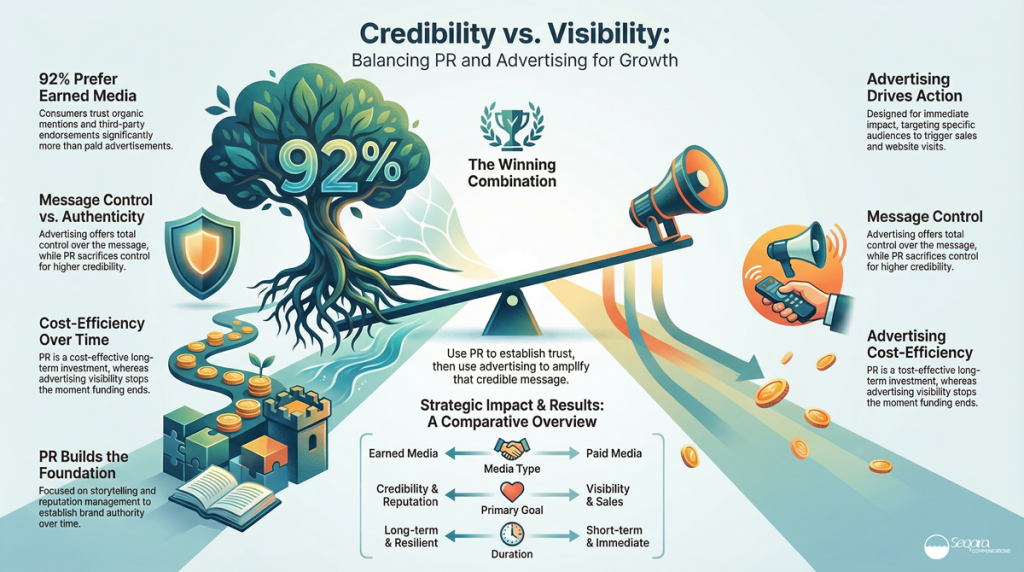
Many people lump public relations and advertising together, assuming they do the same job. They don’t. While both are designed to amplify brands, they operate with different mechanics, timelines, and outcomes. In this feature, I unpack their shared ground and their sharp distinctions—and show how each discipline fuels brand credibility and visibility in different, complementary ways.
I keep coming back to a telling tension: customers overwhelmingly trust earned media more than paid media, yet brands still invest heavily in ads. There’s a logic here. Advertising creates instant visibility; PR earns lasting trust. The real skill isn’t choosing one over the other, but knowing how—and when—to use each.
PR vs. Advertising: What They Are and Why They Matter
- What is public relations?
PR is the practice of shaping perception and reputation through earned credibility. Instead of buying space, PR secures it—via news coverage, expert bylines, thought leadership, partnerships, and influencer collaboration. Think of a startup featured in a tier‑one publication for a real innovation: that third‑party validation reassures investors and customers far more than a self‑promotional ad ever could.
- What is advertising?
Advertising pays to place a message across channels—search, social, TV, out‑of‑home, podcasts, you name it. Because it’s paid, brands enjoy full control over creative, frequency, placement, and targeting. The trade‑off? People tend to treat ads as promotional by default. Ads are exceptional at accelerating awareness and demand; they’re not built to confer the same kind of trust that independent coverage can.
Both matter. PR compounds reputation; advertising scales reach and conversion. Treating them as rivals is a false choice. The most resilient brands orchestrate them together.
Key Differences—and How to Use Them
1) Nature of control
- PR relies on earned media. You influence, but you don’t dictate. Journalists, editors, creators, and communities interpret your story. That loss of control often yields greater authenticity—and with it, credibility.
- Advertising offers total control: message, format, placement, and cadence. You decide the promise and the call to action. Control preserves consistency, but it can feel less trustworthy to audiences.
2) Budget dynamics and efficiency
- PR is typically more cost‑efficient over time. One high‑impact story can generate compounding awareness via social shares, search visibility, and syndication. The catch: coverage isn’t guaranteed. You need a real story and relationships.
- Advertising runs on ongoing spend. Turn off the budget, and the traffic stops. It’s ideal for short‑term lifts, launches, promos, and seasonal pushes—so long as you fund it and optimize.
3) Credibility and trust
- Earned mentions from respected outlets and subject‑matter experts carry social proof. They mitigate skepticism and reduce perceived risk.
- Ads can feel invasive or purely persuasive. They shine when they amplify proof you’ve already earned—e.g., using a strong press quote or award in creative to extend reach.
4) Role in communication strategy
- PR crafts narrative: origin stories, category POV, expert commentary, and reputation management. It forges emotional connection and long‑term goodwill.
- Advertising drives action: click, sign up, add to cart, book a demo. It’s built around clear offers, benefits, and calls to action.
5) Impact on brand image
- PR shapes how people talk about you over time. It’s cumulative and resilient.
- Advertising creates spikes of attention. It’s perfect for product drops, limited‑time offers, and moments when speed matters most.
6) Time horizon
- PR is a long game: trust accrues, relationships deepen, and your brand becomes the credible voice people expect to hear.
- Advertising is a short‑to‑mid game: immediate reach and measurable performance, with diminishing effects once spend pauses.
7) Audience reach and engagement
- PR earns organic reach through shares, citations, community chatter, and search discovery. Virality is possible without incremental spend when the story resonates.
- Advertising provides precision: you can target by intent, interest, persona, geography, and behavior to guarantee exposure among the right people.
When to Use PR vs. Advertising
Use PR to:
- Establish authority in a category or new market
- Launch thought leadership and executive visibility
- Build credibility before fundraising, enterprise sales, or partnerships
- Manage issues and shape sentiment during sensitive moments
Use advertising to:
- Accelerate awareness during launches and promotions
- Drive trials, sign‑ups, or sales with compelling offers
- Retarget high‑intent audiences who already know you
- Control frequency and message for brand‑lift campaigns
Working Together: A Practical Playbook
- Start with substance. PR needs a real story—data, product innovation, community impact, or a contrarian POV. Without substance, there’s nothing credible to earn.
- Turn earned trust into paid reach. Once you’ve secured coverage or social proof, repurpose it inside ads—headlines, quotes, star ratings, or third‑party logos (with permission). This fuses credibility with scale.
- Sequence for momentum. Lead with PR to establish the narrative, then follow with ads to reinforce recall and drive action. In launches, run them in parallel: PR for story, ads for conversion.
- Measure distinctly, optimize together. Track PR with share of voice, sentiment, domain authority, and branded search. Track ads with reach, CTR, CAC, ROAS, and incrementality. Make joint decisions based on blended outcomes, not siloed vanity metrics.
- Use the PESO model. Integrate Paid, Earned, Shared, and Owned channels so messages are consistent and mutually reinforcing across the brand ecosystem.
Mini Case Scenario
A climate‑tech startup lands a feature in a respected business magazine for its battery breakthrough. That credibility boosts inbound interest from investors and enterprise buyers (PR at work). The team then runs a targeted LinkedIn and search campaign highlighting the third‑party coverage, driving qualified demos at a lower cost per lead (advertising at work). Over the next quarter, the brand invests in more expert commentary and data reports while always‑on ads keep the pipeline warm. Trust compounds; reach scales.
Conclusion: Choosing Confidently
PR and advertising are two sides of the same growth engine. PR earns belief; advertising delivers controlled scale. Blend them intentionally. Lead with proof, amplify with precision, and keep refining the mix as your category, audience, and goals evolve. That’s how brands build both credibility and visibility—and turn attention into durable loyalty.

Writer: Aditya Wardhana