
Social Media and Public Relations: The Statistics Shaping Brand Reputation in 2026
Social media is the live ecosystem where brand reputation is continuously built, evaluated, and defended. The conversations happening across platforms like Instagram, TikTok, X, and LinkedIn shape how audiences feel about your brand long before your press release ever lands. In 2026, the data paints a picture of an environment that is more fragmented, more scrutinized, and more demanding than ever — and the organizations that grasp these dynamics are the ones that will thrive.
Governance Is Finally Catching Up to the Risk
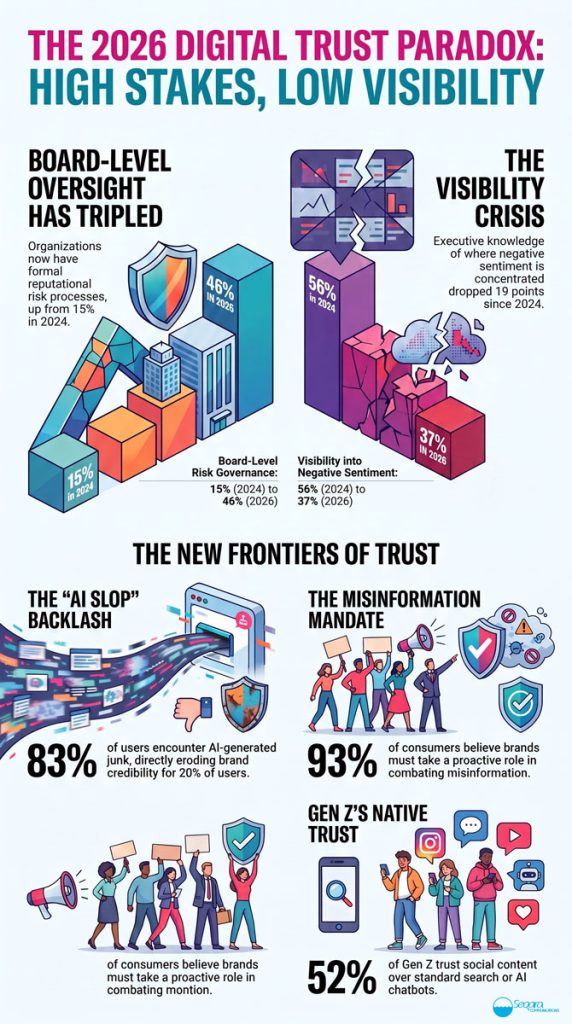
For years, reputation risk was something boards acknowledged in principle but rarely governed in practice. That is changing rapidly. According to WTW’s 2026 Reputational Risk Readiness Report, 46% of organizations now have formal, board-level processes to update directors on reputational risks — more than double the 15% reported in 2024 . This is not an incremental shift; it represents a fundamental recalibration of how seriously leadership teams are taking the threat of reputational damage.
The driver behind this urgency is clear: the cost of a reputation crisis has never been higher. A single viral moment can erase years of brand equity, and boards are finally treating that reality with the governance rigor it deserves. Regular boardroom briefings on sentiment trends, emerging narrative threats, and social listening data are becoming standard practice rather than a differentiator.
The Visibility Gap: Knowing Less While Facing More
Here is the paradox at the heart of modern reputation management: as governance tightens, visibility is actually shrinking. The same WTW report reveals that only 37% of respondents said they knew where negative sentiment around their brand was most concentrated — a dramatic decline from 56% in 2024 . That 19-point drop should stop every communications leader in their tracks.
What accounts for this erosion? The social media landscape has splintered. Audiences are dispersing across an ever-expanding array of platforms, each with its own cultural norms, algorithmic logic, and conversation dynamics. A brand might face criticism on a niche subreddit, a TikTok comment section, or a private Discord server, and never know where the fire started. This fragmentation makes real-time listening infrastructure not a nice-to-have but a strategic imperative. The organizations that cannot locate their reputational risk cannot manage it — and the data suggests many are struggling to do either.
PR and Marketing: The Integration Imperative
The silo between public relations and marketing has been shrinking, and the numbers confirm it. Sixty-five percent of communications professionals now report being at least somewhat aligned with their marketing team on strategy and goals, with 30% specifically stating they are “very closely aligned.” A further 26% note that they are either on the exact same team or do not have a separate marketing function at all.
This convergence makes intuitive sense. In an era where earned media and owned content feed into the same social pipelines, maintaining a wall between PR and marketing is operationally unsustainable. The brand narrative must be coherent across every touchpoint — and that coherence requires teams that plan together, execute together, and measure together.
Transparency as a Competitive Advantage
Consumers are not asking brands to be perfect. They are asking them to be real. Sprout Social’s Social Intelligence Report underscores that consumers prioritize authentic brand behavior: when brands openly acknowledge their shortcomings and take accountability for the customer experience, it builds trust that translates into stronger retention and sustained growth .
This is a strategic insight that runs counter to the traditional crisis playbook of silence and carefully lawyered statements. The brands winning on social media today are the ones that respond to criticism with candor, admit mistakes promptly, and demonstrate — not just declare — their commitment to doing better. In a landscape saturated with curated perfection, vulnerability and accountability cut through the noise.
Gen Z and the Rise of Niche Trust
Perhaps the most consequential shift for PR professionals is where younger consumers are placing their trust. According to the Sprout Social Q3 2025 Consumer Pulse Survey, 52% of Gen Z consumers trust brand information found natively on social channels more than results surfaced by standard search queries or AI chatbots . This represents a fundamental reordering of the information hierarchy.
For Gen Z, a brand’s TikTok presence, its Instagram comments section, and the user-generated content around it carry more weight than its position on a search engine results page. This has profound implications for PR strategy. It means that managing brand reputation is less about optimizing for Google and more about cultivating an authentic, responsive, and engaged presence across the social platforms where Gen Z actually lives. It also means that brand narratives are increasingly co-authored with consumers rather than broadcast from the top down.
The AI Backlash and the Slop Problem
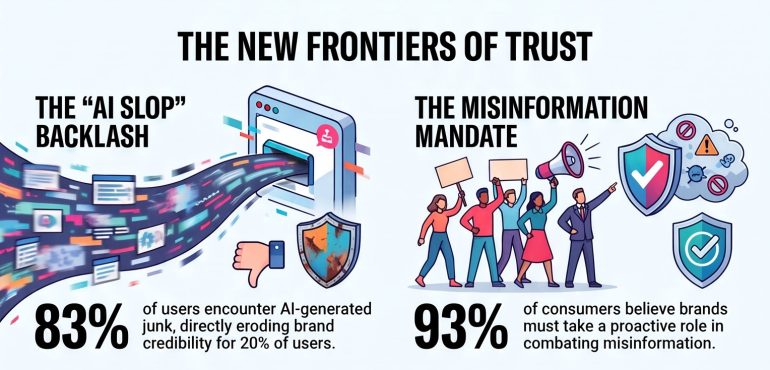
Generative AI has given brands powerful new tools for content creation — but it has also unleashed a wave of low-quality, mass-produced content that users have come to despise. The numbers are stark: 83% of users report seeing AI-generated “slop” on social media, and 20% of users who have lost trust in social platforms over the last year cite unregulated AI slop as a primary driver .
The message for PR and communications teams is unambiguous. Using AI to accelerate workflows and generate insights is smart; using it to flood channels with synthetic, impersonal content is reputationally destructive. Audiences are developing a sharp instinct for detecting inauthentic content, and brands that contribute to the slop problem risk guilt by association. The strategic response is to lean into human-generated, human-curated content that demonstrates genuine understanding and empathy — precisely the qualities AI-generated material so often lacks.
Misinformation and the Trust Deficit
The erosion of trust on digital platforms has reached a critical threshold. Thirty percent of social media users report that their overall trust in digital platforms has decreased in the last 12 months due to the unchecked spread of misinformation, according to the Sprout Social Q1 2026 Pulse Survey . The consequence is a consumer base that is increasingly skeptical of everything it encounters online — brand messaging included.
This skepticism has created a mandate for action. A remarkable 93% of consumers now think brands need to combat misinformation more than they are today . This is not a passive expectation; it is a demand for active participation in cleaning up the information environment. Forward-thinking PR teams are responding by positioning their brands as reliable sources — publishing fact-based content, correcting misinformation in their own comment sections, and refusing to engage in the tactics that fuel the problem in the first place.
The Clock Is Always Ticking
If there is one statistic that should shape daily operations for every social media and PR team, it is this: nearly three-quarters of consumers expect a response to their customer service questions within 24 hours or sooner . That number has remained remarkably consistent across surveys, and it encodes a simple truth — silence on social media is interpreted as indifference.
The brands that meet this expectation are rewarded with loyalty and advocacy. Those that leave customers waiting in public view suffer compounding reputational damage: every unanswered question is visible to every other customer, and the impression it leaves is lasting. Speed is not the only variable that matters — accuracy and empathy matter enormously — but it is the threshold requirement. A thoughtful response delivered three days late has already lost the battle.
What These Numbers Mean for Communications Leaders
Taken together, the data from 2025 and 2026 tells a coherent story about the state of social media and public relations. Governance is improving but visibility is declining. In SEQARA Communications‘ opinion, AI offers efficiency but threatens authenticity. Trust is fragile and misinformation is pervasive. Consumers expect transparency, responsiveness, and accountability — and they reward the brands that deliver.
The path forward for communications leaders is not about doing more of everything. It is about doing the right things with greater precision: investing in listening infrastructure that restores visibility, integrating PR and marketing to deliver a unified narrative, using AI judiciously and transparently, and treating every consumer interaction as a reputation-defining moment. Social media is not merely a distribution channel for press releases. It is where your brand’s reputation is won or lost, one post at a time.
Writer: Adit