
Back Home, Forward Together: Inside Day Three of the Indonesia Diaspora Festival 2021

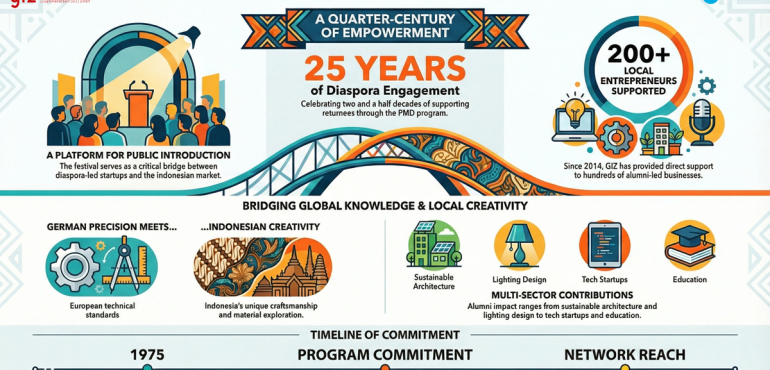
Jakarta, December 3, 2021 — The Indonesia Diaspora Festival 2021 hit its stride on day three, turning the Piazza at Gandaria City Mall into a lively junction of stories, ideas, and sounds. Curated by Deutsche Gesellschaft für Internationale Zusammenarbeit (GIZ), this year’s edition proudly carries the theme “Celebrating 25 Years of Returnees and Diaspora Engagement in Indonesia,” spotlighting alumni from German universities who have returned to contribute at home.
A Quarter-Century of Bridges
Staged from December 1–4, the festival honors GIZ’s Migration and Diaspora Program (PMD) and its long-standing partnership with Indonesia. Since 2014 alone, PMD has supported 200 local entrepreneurs—many of whom now anchor high-impact ventures across creative industries, education, technology, and social innovation. The festival is both a showcase and a homecoming—a place where experience abroad meets the urgency and opportunity of Indonesia’s development.
Conversations That Travel Well
Day three’s public talk shows traveled across two big terrains:
- Education and Ausbildung in Germany: A practical walkthrough of pathways for Indonesian students and professionals—how dual vocational tracks work, where cultural agility matters, and what it really takes to translate German rigor into Indonesian relevance.
- Designing Public Facilities in Indonesia: An exploration of people-first design—lighting, accessibility, and climate-aware material choices—pushing for public spaces that are inclusive, beautiful, and maintainable.
Between sessions, live music rolled through the atrium, giving the day both cadence and warmth. The result felt less like a trade fair and more like an open studio—ideas in progress, laughter in the margins, and business cards changing hands with purpose.
Returnees at the Helm
Architect and founder of Atelier Larassati (AT-LARS), Stephanie Larassati, framed the creative edge of Indonesian design. A graduate of Technische Universität Berlin, she sees Indonesia’s architectural scene as uniquely free-form—nimble with materials, expressive in craft, and energized by climate. “We may be slightly behind in precision tools,” she noted on stage, “but we outpace in creativity and craftsmanship.” AT-LARS positions architecture as a positive lever for social and environmental impact.
Lighting specialist Agust Danang Ismoyo, co-founder of Pavilion Sembilanlima, echoed the festival’s momentum. GIZ trainings, he said, helped the studio grow from an idea to a market-recognized practice. With roots in seven formative years in Germany and a 2005 founding by four University of Indonesia lecturers, Pavilion Sembilanlima treats lighting design as urban pedagogy—teaching cities to glow responsibly through architecture.
From the stage, Makhdonal Anwar, PMD Team Lead at GIZ Indonesia, reaffirmed a clear throughline: the program will continue backing Indonesian diaspora and German-educated returnees to channel their expertise into public benefit—festivals like this one are a conduit, not a culmination.
A Mosaic of Initiatives
Across the floor, the exhibitor mix traced the breadth of diaspora enterprise: Atelier Larassati (AT-LARS) and Pavilion Sembilanlima alongside peers such as Malikal Zentrum Institute (MZI), Lula Pasta, Gaya Bahasa Institut (GBI), JARI Foundation, Germany Indonesia Professionals (GIP), Feedloop, Logos, Business Innovation Center (BIC), Mak Rah Pireng, Viu, Athlimah, and Olah Kebaikan Bersama (OKB). The range was the message—tech to tastebuds, research to resilience—each booth mapping a different return journey.
Spaces for People, Programs with Purpose
Workshops, public talks, live performances, and portfolio showings flowed from morning to evening, open to everyone at no cost. Health protocols were in place throughout the December 1–4 run, 10:00–21:00 WIB, making the Piazza in South Jakarta feel both festive and safe.
Why It Matters
What does a festival change? Sometimes the quiet things: a student discovers a path to a German Ausbildung; a city official rethinks lighting specs; a founder meets a collaborator; a craftsperson sees their work differently. After twenty-five years, the PMD story reads like a relay—knowledge passed hand to hand, across borders, returning with more to give. Day three reminded us that coming home isn’t the end of a journey. It’s when the journey starts to matter to more people.
—
About GIZ
Deutsche Gesellschaft für Internationale Zusammenarbeit GmbH (GIZ) is a federal enterprise of the German government operating worldwide. GIZ supports the German Government in international cooperation for sustainable development and also engages in global education activities.
About GIZ Indonesia
Operating since 1975, GIZ Indonesia—and across ASEAN—works in Climate Policy and Climate Finance, Economic Development, Social Affairs and Employment, Energy Transition, Governance, Natural Resource Management, and Sustainable Urban Infrastructure. GIZ delivers programs on behalf of Germany’s Federal Ministry for Economic Cooperation and Development (BMZ), the Federal Ministry for the Environment, Nature Conservation, Nuclear Safety and Consumer Protection (BMUV), the Federal Foreign Office, and the European Union. The Jakarta office coordinates activities supporting the governments of Indonesia, Timor-Leste, and the ASEAN region.
Writer: Aditya Wardhana