

From Soil to Supply Chain: How BIPOSC Is Helping Smallholders in North Sumatra Grow Regeneratively
Introduction
When I first stepped onto a smallholder oil palm plot in Labuhanbatu, North Sumatra, I noticed the quiet—no heavy machinery, just the low rustle of cover crops and a compost heap humming with life. This, I thought, is what transition feels like: a field shifting from extractive routines to a regenerative rhythm. It’s also the pulse of BIPOSC—the Biodiverse & Inclusive Palm Oil Supply Chain program—a long-term collaboration launched in 2021 by Musim Mas Group, the Livelihoods Fund for Family Farming (L3F), SNV Indonesia, and World Agroforestry (ICRAF).
At its heart, BIPOSC is a bet on people and on soil. It aims to build a deforestation-free, biodiversity-rich palm oil supply chain by equipping independent smallholders with regenerative agriculture know-how, locally adapted agroforestry models, and ecosystem protection tools. In a sector often reduced to polarized headlines, BIPOSC invites us to look closer—at the hands that tend the palms, the microbes that knit the soil, and the market signals that can reward both.
Why Regeneration, and Why Now
Regenerative plantation practices are more than a buzzword here; they’re a climate and livelihoods strategy. Healthy soils sequester more carbon, buffer floods, curb erosion, and reduce nutrient leakage. Diverse understories cool the microclimate and welcome back insects and birds. For growers facing volatile input prices and climate shocks, regeneration is practical resilience.
As Rob Nicholls, General Manager Project & Program at Musim Mas, frames it, independent smallholders are pivotal to the industry’s future. Musim Mas has run Indonesia’s largest smallholder empowerment program since 2015, but BIPOSC takes the next step: pooling expertise from L3F, SNV, and ICRAF to scale technical capacity, open market access, and diversify incomes along a supply chain that values both inclusion and biodiversity.
How the Model Works on the Ground
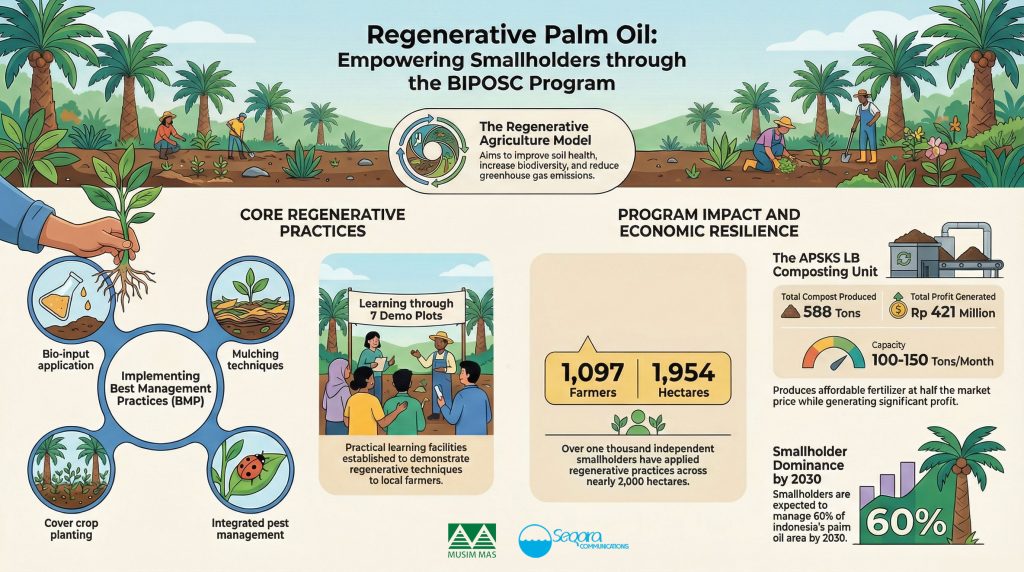
BIPOSC operates with the Asosiasi Pekebun Swadaya Kelapa Sawit Labuhanbatu (APSKS LB), a Musim Mas–mentored association that supports smallholders pursuing RSPO and ISPO certification. The program standardizes non-profit training and technical assistance around regenerative Best Management Practices (BMP). In plain terms, that means:
- Bio-inputs to stimulate soil biology and reduce dependence on synthetic fertilizers.
- Mulching with pruned fronds to conserve moisture and protect soil structure.
- Cover crops to fix nitrogen, suppress weeds, and feed the soil food web.
- Integrated pest management to minimize chemical use while keeping pests in check.
- Compost application to recycle nutrients and build long-term fertility.
To date, 1,097 independent growers have trained under BIPOSC and implemented these practices across 1,954.41 hectares. Twenty-five village facilitators coach farmers through adoption, while seven demonstration plots act as living classrooms—places to test, compare, and build confidence over seasons rather than weeks.
Compost: The Quiet Workhorse
A recurring pain point for smallholders is access to affordable, quality fertilizer. BIPOSC’s institutional support tackles this head-on. APSKS LB now runs a Composting Unit with a capacity of 100–150 tons per month. In its first operating year (2023), the unit produced 588 tons of compost—sold at roughly half the market price—generating IDR 421 million in profit and, more importantly, putting a circular nutrient loop in motion. With a profit-sharing model and lower prices, APSKS LB reports that all member smallholders have shifted to using compost, a milestone with tangible soil and cost benefits. Replication sites are already on the drawing board.
L3F’s lens is instructive here. As Bernard Giraud, Co-founder and President of Livelihoods, notes, farmers initially voiced fears about fertilizer access while lacking tools to protect their soils from long-term degradation. BIPOSC addresses both sides: near-term yield and input stability, and long-term soil health. Early signals from participating growers suggest gains on each front.
The Bigger Picture: Scaling Inclusion
The stakes are large. In 2023, independent smallholders managed about 41% of Indonesia’s oil palm area—some 6.77 million hectares. Projections suggest that share could reach 60% by 2030. If true, the country’s sustainability trajectory hinges on whether smallholders can access knowledge, finance, and markets that reward better practices. Programs like BIPOSC matter because they stitch together these threads—technical training, institutional capacity, and certification pathways—into a system that farmers can actually use.
SNV’s role reinforces this systemic view. Operating in Indonesia since 2013, SNV applies a deforestation-free supply chain approach to palm oil while delivering capacity-building across agriculture, energy, and WASH. Within BIPOSC, SNV and partners integrate regenerative agronomy with locally adapted agroforestry, keeping soils fertile and diverse—benefits that compound over time for both ecosystems and household economies.
What Success Looks Like
Not all progress shows up in spreadsheets, but some does. Training milestones and compost output are quantifiable. So is farmer engagement: 25 facilitators embedded in villages, seven demo plots, rising adoption rates. Less visible—but central—are the ecological signals: thicker mulch layers, richer soil aggregates, fewer erosion gullies after heavy rain, a cooler understory alive with legumes and pollinators. These are the precursors to durable yields and lower emissions.
The Coalition Behind the Change
- Musim Mas Group is among the world’s largest integrated palm oil companies, operating across 13 countries with core activities in Indonesia. It aims to lead on responsible practices by exceeding industry sustainability standards and innovating across the value chain.
- Livelihoods Funds convene public and private actors to restore ecosystems and build sustainable supply chains. Established in 2015 with partners including Mars Incorporated and Danone—and joined by Firmenich and Veolia—the Livelihoods Fund for Family Farming (L3F) mobilizes long-term financing (targeting €85 million over 10 years) to scale regenerative practices and strengthen smallholder livelihoods.
- SNV is a Netherlands-based non-profit development organization working in Indonesia since 2013 across agriculture, energy, and WASH, with climate and gender as cross-cutting priorities. In palm oil, SNV advances deforestation-free supply chains and supports smallholders to improve productivity and market access.
- World Agroforestry (ICRAF), a CGIAR center, generates science and field insights on how trees enhance farm resilience, inform policy, and improve rural livelihoods at multiple scales.
Where BIPOSC Goes Next
The playbook is clear: deepen farmer training, expand facilitation, replicate composting hubs, and advance RSPO/ISPO certification readiness. As more growers adopt regenerative BMPs and agroforestry, the program can anchor a supply chain that is measurably lower in emissions, richer in biodiversity, and fairer in returns. For buyers and brands seeking deforestation-free sourcing, this is not a side project but a pathway.
Standing again on that Labuhanbatu plot, I think about time. Regeneration isn’t a campaign—it’s a practice that compounds. The palms don’t hurry. The soil, when fed, doesn’t forget. And when smallholders are given the tools, trust, and markets to farm with the future in mind, the supply chain starts to look less like an extractive line and more like a living system.This transformation requires patience, collaboration, and sustained investment—but with each step, North Sumatra’s smallholders move closer to a thriving, resilient future for their land and communities.
Writer: Aditya Wardhana