
Inside Indonesia’s First Modular Robotic Hernia Center: How Tzu Chi Hospital Is Redefining Surgical Care
When I step into the second floor of Tzu Chi Hospital in North Jakarta, I can feel the quiet hum of anticipation. This is where the hospital’s newly launched Hernia Center has taken shape—a purpose-built hub that promises to change how Indonesians understand and treat hernias. It’s not just another clinic; it’s a statement about where surgical care is heading, and how fast.
Tzu Chi Hospital’s new center brings the full arc of care under one roof: early detection, comprehensive diagnostics, tailored treatment planning, and state-of-the-art surgical options. The goal is deceptively simple: give patients safer procedures, less pain, and faster recovery—without losing sight of comfort and dignity. It’s a meticulous approach to a condition that is often underestimated, or worse, ignored until complications arise.
• A modular leap forward
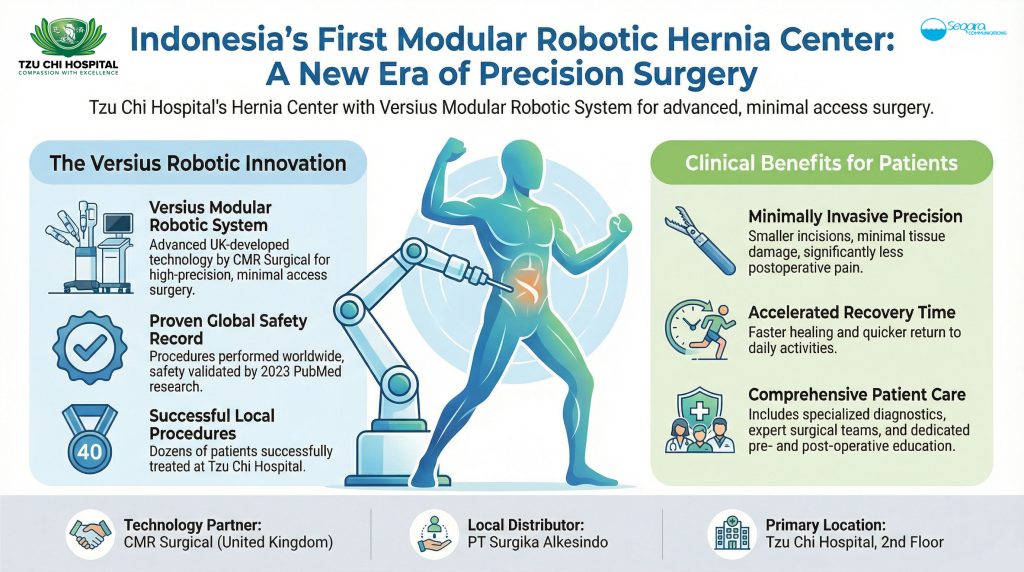
At the heart of the Hernia Center is a compact constellation of robotic arms: the Versius Modular Robotic System, designed in the United Kingdom by CMR Surgical and distributed in Indonesia by PT Surgika Alkesindo. Unlike monolithic surgical robots, Versius is built from separate, agile units that can be positioned with surgical precision around the patient. In the operating room, this modularity translates into finer control, smaller incisions, reduced tissue trauma, and a gentler recovery journey.
For patients, the promise is tangible: less postoperative pain, shorter hospital stays, quicker return to daily life. For surgeons, it’s an expanded toolkit—high-definition 3D visualization, wristed instruments that mimic human dexterity, and ergonomic design that reduces fatigue during complex repairs. It’s a convergence of engineering and empathy.
• What the evidence says
Safety and feasibility matter as much as innovation. A 2023 peer‑reviewed study indexed on PubMed reported that hernia repair using the Versius modular robotic platform is both safe and viable, reinforcing confidence in the system’s use for a range of hernia types. For a country eager to scale access to minimally invasive surgery, this matters: technology must prove itself not only in flagship hospitals abroad but also in everyday operating rooms at home.
• Crafting a modern hernia pathway
The center’s clinical workflow starts long before a patient enters the OR. Many Indonesians don’t immediately recognize the signs of a hernia—an intermittent bulge, discomfort when lifting, or a dragging sensation after a long day. At the Hernia Center, general surgeons conduct comprehensive evaluations and imaging when needed, then walk patients through options that span conservative management, conventional open repair, laparoscopic procedures, and now, robotic-assisted surgery.
The robotic approach isn’t a badge of novelty—it’s a decision grounded in case complexity, patient profile, and the likelihood of the best outcome. For complicated or recurrent hernias, or when precision mesh placement is crucial, the robot can offer the steadiness and reach that human hands sometimes can’t. And as operating teams become more fluent with the system, the benefits accumulate: consistent technique, reproducible results, and fewer postoperative setbacks.
• Voices behind the vision
“Healthcare providers must move with the times,” says Prof. DR. Dr. Satyanegara, Sp.BS(K), Senior Director at Tzu Chi Hospital. His message is practical: the right tools help physicians do their best work—and help more people. President Director dr. Gunawan Susanto, Sp.BS, frames the Hernia Center as a promise kept: comprehensive care that starts with education, includes attentive pre‑ and post‑operative counseling, and ends with patient satisfaction. The facility also doubles as a training ground for clinicians eager to deepen their skills in modern hernia management.
General surgeon Dr. dr. Barlian Sutedja, Sp.B, meets patients where they are—often unsure whether their symptoms are hernia-related at all. His team leans into clarity: careful examination, clear explanations, and preventative guidance to avoid complications. And when surgery is needed, the robotic option becomes a compelling choice, particularly for complex cases. By early October, the team had already performed dozens of robotic hernia procedures, a sign of growing confidence and demand.
• A broader ecosystem of care
The Hernia Center is rooted in a hospital with a service‑first mission. Tzu Chi Hospital—part of Yayasan Buddha Tzu Chi Medika—was built to expand access to quality healthcare at a cost more within reach for surrounding communities. Its journey from a small clinic in Cengkareng in 2003 to a fully accredited general hospital has been marked by steady upgrades: emergency services, operating suites, maternity and perinatal care, high‑care units, and more. Accreditation by the Indonesian Hospital Accreditation Commission (KARS) underscores its commitment to quality systems and safe patient care.
Around the Versius system is a global network. CMR Surgical, founded in 2014, set out to democratize minimally invasive surgery with a smaller, modular robot that fit more operating rooms and budgets. After CE approval in 2019, Versius has been deployed in over a hundred and forty hospitals across multiple continents, facilitating tens of thousands of procedures. In Indonesia, PT Surgika Alkesindo supports the technology’s rollout and training, linking hospital teams with robust after‑sales service and manufacturer expertise.
• What this means for patients—today
For someone living with a hernia, the center’s promise is straightforward: faster diagnosis, clearer choices, and treatments matched to lifestyle and needs. If surgery is on the horizon, the robotic route may offer fewer scars, less pain, and a return to normalcy in days, not weeks. And because the Hernia Center is designed as much for listening as for operating, patients don’t navigate the decision alone.
As the center opens its doors, Tzu Chi Hospital is offering special promotions for procedures using the Versius system. The message is an open invitation: come in, ask questions, and see whether robotic repair is right for you. For details, the hospital’s call center can guide patients to the next step.
• The future, assembled
Modular robotics has a way of turning bold ideas into everyday practice. Piece by piece—arm by arm—the technology adapts to the patient, not the other way around. In Jakarta, on the second floor of Tzu Chi Hospital, that future is already operating; the quiet hum you hear is the sound of surgery becoming gentler, smarter, and more human.
Writer: Aditya Wardhana