
Inside TOMORO COFFEE’s Big Bet: A Homegrown Roastery Roasting Up to 2,400 Tons a Year

Byline: Jakarta — April 29, 2024
When a coffee brand builds its own roastery, it’s not just shopping for shinier machines—it’s choosing control. On April 29, 2024, TOMORO COFFEE flipped the switch on its new roasting facility, a move that signals serious intent: own the flavor, own the consistency, and set the pace for rapid expansion across Indonesia and into Southeast Asia.
Why a Roastery, Why Now
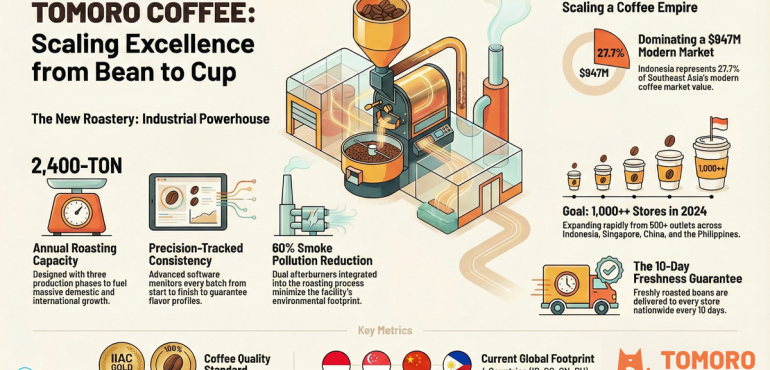
Indonesia’s modern coffee scene isn’t just buzzing—it’s booming. A 2023 Momentum Works report pegs Indonesia as the heavyweight in Southeast Asia’s modern coffee market, with an estimated annual turnover of US$947 million—about 27.7% of the region’s US$3.4 billion market. Local chains have been the growth engine, and TOMORO COFFEE is one of the names pushing that curve upward.
So the roastery isn’t a vanity project. It’s the operational backbone for a network that already counts 500-plus stores and is still multiplying. By bringing roasting in-house, TOMORO can fine-tune profiles, scale with discipline, and keep prices and quality steady even as it opens new doors in new cities.
Built for Scale—and Consistency
The facility is designed around three production phases and a headline capacity of up to 2,400 tons of roasted coffee per year. What does that translate to on the ground? Predictability. The roastery’s system tracks each batch from green to finished beans, logging key variables along the way. That transparency helps roasters keep every profile in the pocket, so the latte you love in Jakarta tastes like the latte you’ll grab in Makassar—or Manila.
Freshness is non‑negotiable here. TOMORO runs a tight resupply rhythm: freshly roasted beans are dispatched to stores nationwide on a 10‑day cycle. It’s part logistics, part ritual, and one big reason the brand talks about “fresh coffee” with something close to a straight face.
Taste First, Planet in Mind
Roasting is an art with an exhaust pipe, and TOMORO is trying to be a better neighbor. The plant is equipped with two afterburners that reduce roast-process smoke emissions by more than 60%. It’s not a finish line—sustainability never is—but it’s a tangible start that aligns with the brand’s push for a cleaner, longer-term coffee ecosystem.
The Beans and the Baristas
TOMORO leans into 100% Arabica, sourcing quality lots that can hold their own against international peers. Some menu staples are built on beans that earned an IIAC Gold Medal in 2023, a nod that underscores the brand’s quality intent. Inside the roastery, those beans get the precision they deserve; across the cafes, baristas translate those profiles into cups with character.
The company frames its consumer community as TOMMUNITY—a playful way of saying regulars matter. But the deeper story is upstream: partnering with local coffee actors and folding them into the supply chain as core collaborators. More café openings mean more jobs, more training, and more room for young Indonesian baristas to flex their creativity.
Building a Homegrown Ecosystem
From seed to sip, TOMORO is working toward an end-to-end model that keeps more value—and knowledge—circulating at home. The roastery strengthens the middle of that chain, the place where careful farming meets careful heat. With capacity to spare and data to guide it, TOMORO can keep flavors consistent while dialing in new profiles for new cities and tastes.
Eyes on 1,000 and Beyond
Ambition is baked into the brand’s timeline. With stores across Indonesia and in Singapore, China, and the Philippines, TOMORO is already testing its playbook outside its home turf. The goal now: pass the 1,000-store mark across Indonesia within the year, while continuing to plant flags around Southeast Asia. A big target needs a big engine; the roastery is that engine.
What This Means for Your Cup
Strip away the industrial romance and it comes down to this: better control equals better coffee, more often. If TOMORO pulls off what the roastery promises—tight quality control, fresher beans, cleaner roasting, and a stronger local network—then the average cup should taste a little brighter, a little more balanced, and a lot more consistent, no matter where you order it.
And if you’re on the TOMMUNITY train already, that next cup isn’t just a habit. It’s a small taste of a bigger bet on Indonesian coffee’s future.
Writer: Aditya Wardhana, AI