
Navigating 2024: How Authenticity, Social Consciousness, and AI Are Rewriting Business Communication
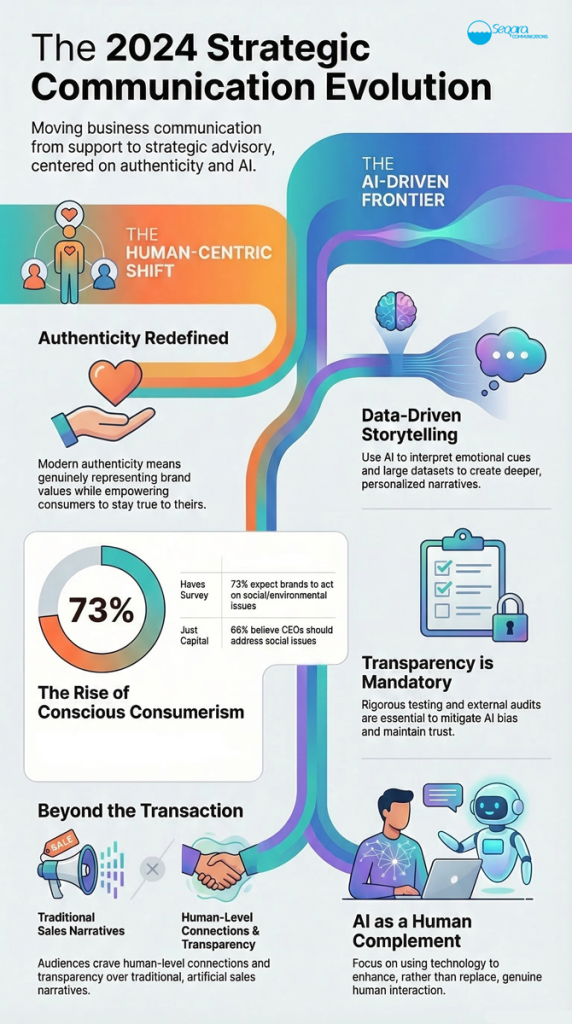
We are stepping into 2024 with a clear-eyed view of how communication is changing—and how those changes will shape the way businesses earn trust, spark action, and build communities. What began in 2023 as a wave of experimentation has settled into a new normal: consumers expect transparency, values in action, and smarter, data-informed storytelling. Authenticity isn’t a slogan; it’s a behavior. Social consciousness isn’t a side project; it’s a strategy. And AI isn’t a novelty; it’s a force multiplier for human connection. The task now is turning these themes into day-to-day practice without losing our moral compass or our voice.
Why Authenticity Now Means Courage, Not Consistency
For a long time, “authenticity” meant staying on script—repeating the brand story and avoiding surprises. That definition no longer fits. Today, authenticity is a live performance: it’s how a brand shows up, admits trade-offs, credits communities, and makes room for consumer agency. It’s the difference between using a cause as a campaign and integrating it into governance, product, and culture.
- Consumers are saturated with content and highly skilled at detecting dissonance. The brands that stand out speak plainly, share receipts, and own their learning curves.
- The job isn’t to avoid selling; it’s to sell with respect. That means acknowledging context, informing choices, and giving people something of value—even when they decide not to buy.
- Practically, this looks like clear product claims, accessible impact reporting, and leadership that is visible when it matters most.
Authenticity, then, is courage under scrutiny: the willingness to be specific, to change with new information, and to let your audience hold you accountable.
Social Consciousness as an Operating System
Conscious consumerism didn’t appear overnight; it has lineage. But the past few years have made it mainstream, turning values alignment into a daily filter for purchasing and employment decisions. What does that mean for communicators? It’s time to treat social consciousness like an operating system, not an app.
- Integrate, don’t bolt on. Tie social and environmental commitments to material business impacts, not just marketing moments.
- Create real feedback loops. Maintain open dialogue with employees, customers, suppliers, and communities—especially when perspectives clash.
- Be consistent across channels. If your hiring, lobbying, and sourcing contradict your messaging, people will notice.
- Educate before you activate. Equip internal teams with shared language and context so external messaging reflects real capability, not wishful thinking.
- Prepare for backlash. Establish protocols for listening, evaluating, and responding to criticism with transparency and care.
Done well, socially conscious communication deepens relationships and resilience. Done poorly, it accelerates mistrust. The difference lies in governance, measurement, and humility.
AI as a Force Multiplier for Human Storytelling
AI moved from the sidelines to the center of communication work. The win isn’t replacing humans; it’s amplifying them—processing complexity, spotting patterns, and personalizing at scale while preserving judgment and empathy.
- Data-driven storytelling: Use AI to surface signals from large, messy datasets—behavioral trends, sentiment shifts, and even emotional and verbal cues—to add depth and credibility to narratives.
- Hyper-personalization: Tailor content to individual preferences and contexts, delivering the right message, format, and channel at the right moment.
- Operational lift: Automate routine analysis and content assembly so teams can focus on strategy, creativity, and stakeholder dialogue.
But power invites risk. Bias, hallucinations, privacy gaps, and over-automation can erode trust fast. Guardrails are non-negotiable:
- Test and validate outputs, especially in high-stakes contexts; never publish without human review.
- Document where and how AI is used in communications; be transparent with audiences when it affects their experience.
- Conduct external audits, stress-test for bias, and prioritize cybersecurity to protect models and data.
- Build cross-functional governance with communications, IT, security, and legal to set policies, escalation paths, and accountability.
When AI augments, not replaces, human connection, it turns data into insight and content into meaning.
From Support Function to Strategic Advisor
Communications is graduating from order-taker to strategy shaper. The remit now includes market sensing, risk framing, stakeholder mapping, and narrative architecture that ties product, purpose, and performance together.
- Translate values into decisions: Help leaders weigh trade-offs and anticipate stakeholder reactions before they occur.
- Orchestrate personalization: Use audience intelligence to design cohesive journeys across owned, earned, and paid channels.
- Measure what matters: Move beyond vanity metrics to outcomes—trust, advocacy, retention, and reputation lift.
This elevation demands new skills: data literacy, issues management, experimentation, and the ability to write clearly under pressure.
A Practical 2024 Playbook
- Define your proof. List three concrete behaviors that demonstrate your values weekly. Ship the receipts.
- Map your risks. Identify where AI, social issues, or supply chain realities could undermine your message; set red lines and decision trees.
- Build the stack. Select AI tools with clear governance, human-in-the-loop workflows, and audit trails.
- Personalize with purpose. Align segmentation with real customer needs, not stereotypes; give users control over data and frequency.
- Train for turbulence. Run tabletop simulations for crises, value clashes, and AI failures; practice cross-functional response.
- Close the loop. Share learnings publicly—what changed, what didn’t, and what’s next.
Looking Ahead
The next chapter belongs to organizations that communicate like people: curious, accountable, and adaptable. Authenticity, social consciousness, and AI are not separate lanes; they’re a single, evolving system that rewards clarity and punishes performance. In 2024, the work is to operationalize that system—turning principles into habits, and habits into advantage. If we keep our promises and keep learning in the open, the stories we tell will be both credible and catalytic.

Writer: Aditya Wardhana