
The New Rules of Crisis Communications in 2026
In the early days of social media crises, speed was everything. The first brand to respond usually won. The one that stayed silent lost control of the story. PR teams learned to move fast, issue statements even faster, and “get ahead of the story” before it spread online.
That playbook is outdated.
By 2026, speed alone is no longer an advantage in crisis communications. In fact, moving quickly without a strategy is one of the easiest ways to make a bad situation worse.
Crises now unfold in an environment shaped by AI-generated misinformation, algorithm-driven amplification, activist audiences, and demands for radical transparency. A rapid but poorly judged response can spark legal risk, internal backlash, or a second, more damaging crisis. The brands that make it through aren’t the fastest. They’re the clearest, the most coordinated, and the most credible.
The rules of crisis PR have changed. Too many marketing teams are still playing by the old ones.
Rule #1: Prioritize the First Meaningful Response
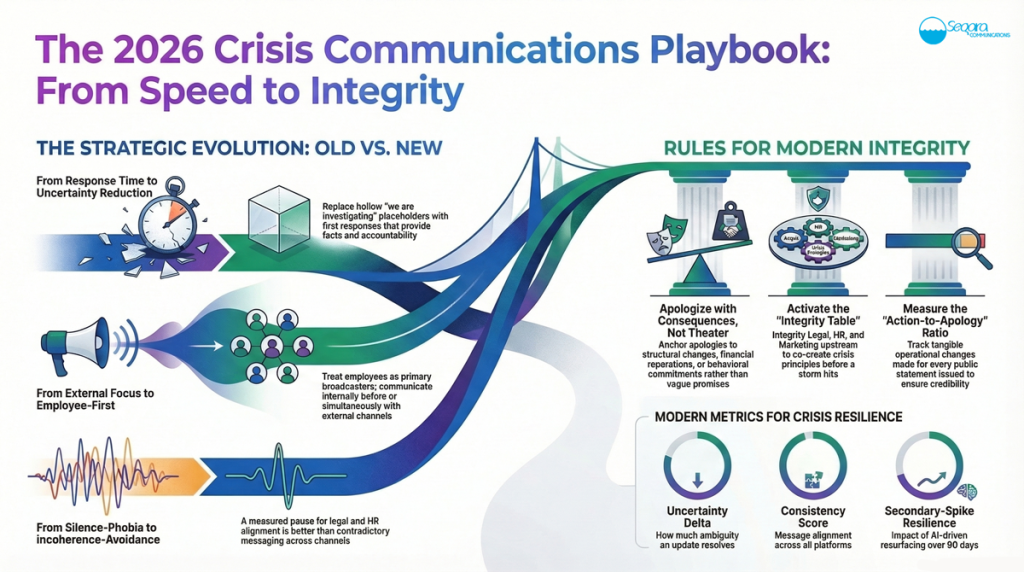
The old mantra—“get a statement out now”—has expired. The ritual “We’re aware and investigating” reads as hollow, evasive, and often legally engineered. Audiences can spot a stall. What matters is the first response that actually reduces uncertainty: the one with facts, clear accountability, and specific next steps.
- Shift the KPI: from response time to uncertainty reduction.
- Don’t delay for perfection—but don’t publish placeholders that add noise.
- Treat the first substantial update as the moment that sets the narrative arc.
Rule #2: Silence Isn’t the Villain—Incoherence Is
In a crisis, contradictory messages are costlier than a measured pause. When the blog, the CEO’s LinkedIn, a regional spokesperson on X, and leaked internal emails diverge, you don’t create transparency—you create chaos.
- Take a short alignment pause across legal, HR, communications, and customer support.
- Establish one source of truth and reiterate it across channels.
- New mantra: If you can’t speak with one voice, don’t speak yet.
Rule #3: Treat Employees as Your Primary Public
Employees aren’t a downstream audience; they’re real-time broadcasters with credibility and proximity to the facts. When they learn about a crisis on social media before they hear from leadership, the brand has already lost control.
- Communicate internally first or simultaneously with external channels.
- Use clear, empathetic updates in Slack/Teams and equip managers with FAQs.
- Respect breeds stability; blindsiding breeds leaks and public dissent.
Rule #4: Apologize With Consequences, Not Theater
People are fluent in the language of empty contrition. “We’re sorry” without “Here’s what changes and when” lands as insincere. Vague promises to “review processes” are recognized as stalling.
Anchor apologies to at least one of the following:
- Structural change: policy revisions, leadership accountability, governance shifts.
- Financial consequence: refunds, fines, reparations, tangible investments.
- Behavioral commitments: deadlines, owners, and transparent reporting.
Words don’t repair trust—actions do. Communications can’t fix what operations won’t change.
Rule #5: Design for Algorithms, Not Against Them
No crisis exists outside platform logic. Algorithms shape what surges, what stalls, and what resurrects weeks later. A “quieting” story may simply be idling before a fresh amplification cycle.
- Build literacy: which platforms reward outrage, video formats, or authoritative voices.
- Track velocity and framing, not just volume.
- Anticipate secondary spikes, creator reframes, and AI-driven resurfacing.
Treat platforms as active participants in the storyline, not neutral pipes.
Rule #6: Integrate Legal and Marketing Upstream
The legal–marketing standoff is obsolete. Over-lawyered statements hemorrhage trust; reckless transparency invites risk. The answer is integration before the storm.
- Co-create crisis language principles in peacetime.
- Pre-approve boundaries and define what accountability looks like.
- Replace template statements with adaptable, values-anchored guardrails.
Clarity and prudence are not opposites when you’ve planned together.
Rule #7: Know When Not to Lead the Resolution
Taking a stand doesn’t mean centering the brand in every controversy. Some issues demand independent audits, third-party experts, or community leadership. Trying to be the hero can boomerang—especially in matters of identity, culture, or systemic harm.
- Cede the microphone when your credibility is limited.
- Support credible process over performative control.
- Measure success by restoration and trust—not brand spotlight time.
Operational Playbook: From Reflex to Readiness
- Build a cross-functional “integrity table” (legal, HR, ops, comms, product, security) with defined thresholds for activation.
- Maintain a single source-of-truth newsroom and a dark site with modular content blocks.
- Pre-map your first meaningful response: fact pattern, responsible owners, decision rights, and update cadence.
- Run live-fire simulations that include employee comms, creator amplification, and algorithmic resurfacing scenarios.
- Instrument listening for speed and sensemaking: monitor velocity, narratives, and influential nodes—not just mentions.
Metrics That Matter in 2026
- Uncertainty delta: how much ambiguity your update resolves.
- Consistency score: message alignment across channels and spokespeople.
- Employee sentiment shift: pre/post internal confidence.
- Action-to-apology ratio: tangible changes per public statement.
- Secondary-spike resilience: impact of resurfacing events over 30–90 days.
The Bottom Line
Crisis communications is no longer a race to post—it’s a test of organizational integrity. Speed has ceded ground to clarity, credibility, and alignment. The brands that navigate storms with resilience don’t simply manage narratives; they demonstrate values, back words with consequences, and trust their people enough to tell the truth—once, clearly, and together.

Writer: Aditya Wardhana