
When a PR Fire Becomes Fuel: How to Turn Controversy into a Competitive Edge
Intro: The Rules Have Changed
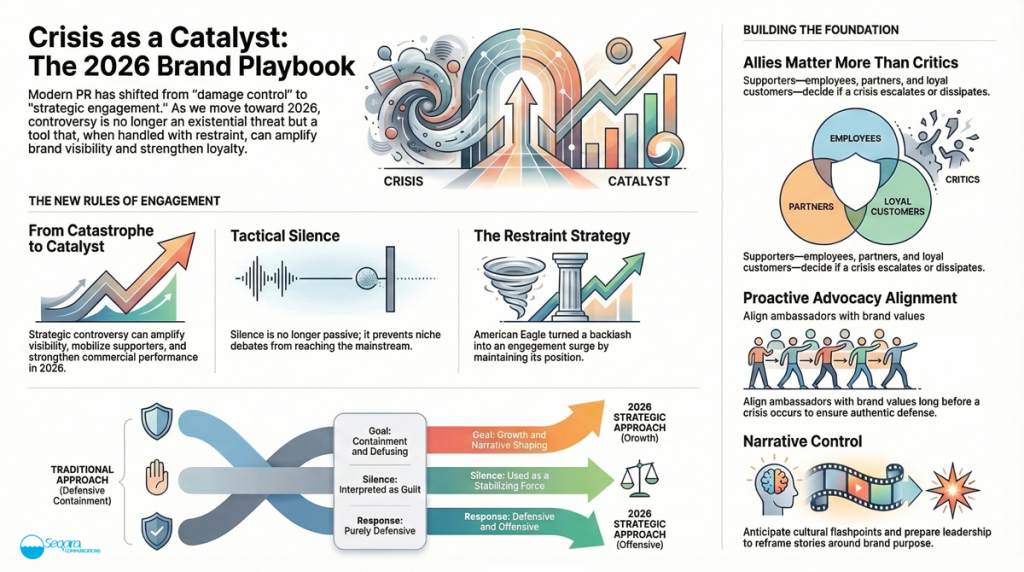
For years, the standard crisis drill was simple: douse the flames, apologize politely, and hope the headlines move on. But as we close in on 2026, that playbook looks dated. Backlash doesn’t automatically break a brand anymore. Handled with intent, controversy can boost visibility, galvanize loyalists, and even lift sales. The companies that prepare for turbulence aren’t just surviving it—they’re using it as thrust.
Controversy, done right, isn’t a catastrophe. It’s a catalyst.
Two Case Studies That Redrew the Map
- American Eagle x Sydney Sweeney: The campaign drew cultural criticism and calls for a retreat. Instead of scrambling, the brand issued a short, steady statement and held its ground. Supporters piled in, engagement spiked, and the conversation outran the original launch by miles. Reach expanded because the brand resisted the urge to overreact.
- The Coldplay “kiss cam” ripple: A surprise pop‑culture flashpoint pulled Astronomer into a global debate. After a few early missteps, the company stopped trying to appease every critic and flipped the narrative—turning the moment into creative that seized control of the story.
Different triggers, same lesson: strategic restraint can convert flare‑ups into growth moments. It’s not about courting outrage for clicks; it’s about knowing who you are and refusing to let the loudest hour on the timeline define you.
We don’t live in a pure cancel era—or a post‑cancel one. We live in a hybrid world where polarization is performance and controversy is part of the strategic equation.
Principle 1: Build for Allies, Not Just Detractors
The center of gravity has shifted. In the old model, crisis comms meant dueling with critics. Today, the real leverage sits with supporters—employees, partners, creators, ambassadors, and loyal customers. They carry more credibility than a press release ever will.
What that demands:
- Values‑aligned bench: Choose ambassadors who truly share your stance. Don’t rent alignment—build it.
- Ready‑to‑ship language: Messaging frameworks, FAQs, values statements, and tone guides that keep everyone on‑brand under pressure.
- Internal fluency: Train teams across HR, legal, product, and marketing on how to show up consistently when the heat rises.
- Pro‑brand signal tracking: Monitor where organic support forms, not just where negative sentiment spikes—and resource those communities.
When advocates are primed, they step up first—and often more persuasively than you can.
Principle 2: Silence Is a Move
Silence used to read as evasive. In 2026, it can be tactical. Jumping in too fast can oxygenate fringe fights or drag a niche debate into the mainstream. Used intentionally, quiet buys time, lowers temperature, and lets trusted third parties do the talking.
But silence isn’t a blanket strategy. Use it when:
- A reply would escalate a minor scuffle into a cultural war.
- Critics seek attention more than answers.
Break the silence when:
- Misinformation is spreading unchecked.
- Employees and core stakeholders need clarity.
- The vacuum invites speculation that could harden into “truth.”
Silence today isn’t the absence of strategy. It is strategy.
Principle 3: Play Defense and Offense
Containment alone won’t cut it. Modern crisis response blends corrective rigor with narrative ambition.
- Pre‑mortem the flashpoints: Map the cultural, political, and product‑related edges where controversy could catch.
- Scenario the outcomes: Draft decision trees and rough‑cut statements for likely arcs—so your first move isn’t improvised.
- Ready your leadership: Align on what you’ll stand for—and what you won’t walk back.
- Work the press proactively: Offer context, data, and alternative frames that sharpen nuance instead of feeding a pile‑on.
- Orchestrate cross‑functionally: HR, legal, comms, social, and marketing need a single playbook and shared dashboards.
- Activate community: Give supporters authentic ways to express their view in language that reflects your values—not corporate varnish.
Nike’s Kaepernick campaign remains the standout example: controversy anticipated, positioning embraced, allies activated, loyalty deepened.
A Simple Crisis Readiness Checklist
- Identity: A one‑page articulation of who we are and where we won’t bend.
- Allies: A vetted roster of creators, partners, and employee advocates—with contact trees.
- Messaging: Modular statements, FAQs, and proof points in plain English.
- Governance: Decision rights, legal guardrails, and escalation paths.
- Monitoring: Heat maps for negative sentiment and a separate dashboard for positive momentum.
- Cadence: War‑room rituals—standups, update windows, and after‑action reviews.
The Payoff: Turning Heat into Lift
Handled with clarity and discipline, crisis moments can:
- Reaffirm purpose and positioning.
- Rally loyalists and surface new fans.
- Expand reach far beyond planned media.
- Distinguish you in a crowded market.
Crisis will always be uncomfortable. But the brands that know who they are—and have rehearsed how they move—can shape the moment instead of shrinking from it. That’s not survival. That’s advantage.

Writer: Aditya Wardhana