
5 Reasons You Need Proper Brand Guidelines (And How to Build Them)
What Are Brand Guidelines?
I like to think of brand guidelines as a living playbook. Yes, they’re rules—but they’re also an agreement about how we want people to feel when they meet our brand, whether that meeting happens on a billboard, a website, a sales deck, or a support chat. Good guidelines don’t just say “don’t do that.” They show what “right” looks like—visually and verbally—so anyone can represent the brand with confidence.
Consider Nike. Named after the Greek goddess of victory, the brand’s voice and visuals are built to unlock that inner “you’ve got this.” The magic isn’t accidental; it’s strategic. Brand guidelines bottle that feeling and turn it into repeatable instructions so designers, writers, vendors, and partners can re-create it consistently.
When guidelines are clear, your sales team, your agency, your freelancers—even your CFO building a board slide—can communicate the same recognizable story. That consistency is the difference between a forgettable interaction and a brand moment.
5 Reasons Your Business Needs Proper Brand Guidelines
- Create Consistency
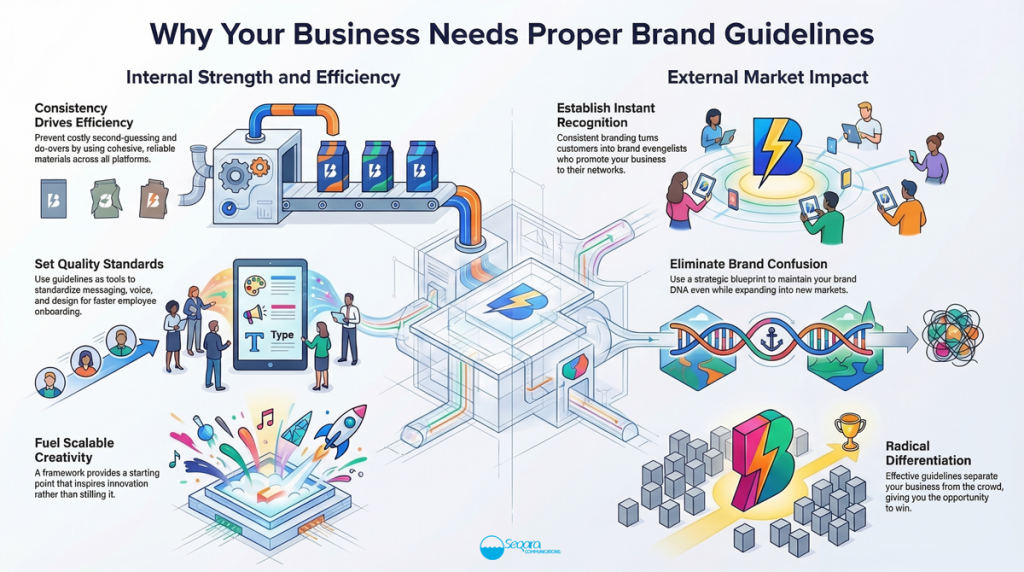
Consistency is the foundation of trust. When your voice, visuals, and experience align, customers stop guessing and start recognizing. Internally, consistency reduces rework and debate. Externally, it signals reliability. Uniformity isn’t boring—it’s how your values show up, again and again, without friction.
- Set Standards
Standards protect quality and integrity. Guidelines aren’t handcuffs; they’re calibration tools for your strategy, messaging, logo usage, web design, documents, and every visual element you deploy. With standards, new hires onboard faster, partners align sooner, and ideas scale without diluting the brand. Standards power culture by turning shared beliefs into shared behaviors.
- Eliminate Confusion
Brands drift when there’s no blueprint. Like architecture, creativity thrives with a plan. Decide the structure first; then customize rooms. Clear guidelines preserve your brand DNA as you grow—new products, markets, and teams can expand without breaking the house. Differentiation becomes intentional, not accidental.
- Establish Recognition
Recognition multiplies marketing. The more familiar your look and language, the less you pay in attention tax. Think about how Google’s simple shapes, color system, and motion cues create immediate recall. Pair that with consistent experiences and your customers graduate from buyers to evangelists, advocating inside their own circles.
- Inspire Brand Creativity
Paradoxically, constraints spark originality. Staring at a blank canvas stalls teams; a clear framework accelerates them. Strategy-backed rules give creators a starting line and room to riff—product by product, campaign by campaign—without breaking character. As markets shift, you can update the playbook while keeping the core recognizable.
What Belongs in Brand Guidelines?
Every business is different, but a strong baseline includes the following components.
- Brand Introduction
- A concise overview or elevator pitch that defines your values, identity, and intended use of the guidelines
- Strategic Pyramid
- Purpose: Why you exist beyond profit
- Mission: How you create long-term value over 5–20 years
- Vision: The world you’re trying to help create (aspirational and nearly unreachable)
- Immovable Goals: Commitments you’ll pursue over 5–20 years
- Brand DNA
- Personas: Who your customers are and how that informs product, marketing, and business choices
- Positioning: The unique, defensible space only your brand occupies
- Reasons to Believe: Evidence that makes your promise credible
- Core Values: Behaviors your brand must live every day
- Golden Circle: Your why, what, and how statements
- Brand Messaging
- Voice: Evergreen personality—how you sound on your best day
- Tone: How that voice flexes in different contexts
- Headlines & Living Lines: Reusable lines for web and marketing
- Editorial Guidelines: Grammar, format, and scenario-based guidance to ensure consistency across channels
- Look & Feel
- Wordmark and icon usage, spacing, sizing, color, and placement rules
- Design system components (packaging, print templates, brand touchpoints)
- Color
- Primary, secondary, and tertiary palettes with usage ratios and accessibility guidance (contrast, dark mode)
- Typography
- Type families, hierarchy, pairing, and rules for digital and print, optimized for readability
- Graphical Elements
- Patterns, shapes, illustration styles, motion principles, and rules for sizing, orientation, and usage
- Photography
- Art direction principles, lighting, composition, and quality standards
- Guidance for stock vs. original imagery and layout conventions
Get the Strategy and the Guidelines Right
Memorable is not the same as effective. A campaign can trend for the wrong reasons if delivery undermines intent. The safer bet: clarity first, then creativity. Outside experts can help pressure-test perception, simplify the system, and root every decision in strategy.
Whether you’re a startup or a legacy brand, the goal is the same: eliminate internal chaos, avoid reactive one-offs, and build a simple, scalable framework. That’s how you ship great work today—and again tomorrow.
How to Start (A Practical Checklist)
- Audit your current assets: logos, colors, type, voice samples, templates, and customer touchpoints
- Define or refine your purpose, mission, vision, and immovable goals
- Map 3–5 priority personas and their jobs-to-be-done
- Write your positioning statement and “reasons to believe”
- Draft your voice and tone guidelines with examples
- Establish your color palette, type system, and design tokens
- Document logo usage and core layout rules
- Create a starter component library (buttons, cards, email modules)
- Pilot the guidelines on one campaign and one sales deck
- Train the team, gather feedback, and version the guidelines quarterly
When your guidelines work, everyone can do their best work faster—and your brand stops whispering and starts resonating.

Writer: Aditya Wardhana