
Why Your Google Search Results Are Your New Resume (And How to Own Them)
The “Search Moment of Truth” and the Asymmetry of Information
Before a potential investor signs a term sheet, or a recruiter invites you to a final interview, they perform a ritual that has become the universal standard for professional due diligence: they type your name into a search bar. Within 0.5 seconds, a narrative of your professional and personal life is synthesized by an algorithm.
This is the “Search Moment of Truth,” and for many, it reveals a startling asymmetry of information. A stranger sitting in a boardroom miles away likely knows more about your digital “headlines”—the fragments of your past, your outdated profiles, and your uncurated mentions—than you are currently monitoring. If you are not actively architecting this narrative, you are effectively leaving your digital legacy to chance. In an era where perception precedes presence, mastering your digital identity is no longer a peripheral task; it is the cornerstone of narrative control.
Takeaway 1: Your First Page of Google is Your Publication Cover
In the economy of attention, the first page of search results serves as the “online equivalent of the cover page of a publication.” These results are your global headlines. They dictate whether a prospect decides to engage with you or moves on to a competitor with a more polished digital perimeter.
To audit your current standing, you must look at your results through the lens of a skeptical outsider. Perform a search of your own name today and confront the data:
- Would you do business with the person described in these links?
- Does this digital footprint inspire immediate trust?
- Does the information reflect who you are as a leader now, or who you were a decade ago?
“Take into consideration that first page of results, which is the online equivalent of the cover page of a publication – aka your ‘headlines’.”
If these headlines don’t align with your current trajectory, your professional story is being told by a ghostwriter you didn’t hire.
Takeaway 2: Reputation Management is No Longer Just for Celebrities
There is a lingering myth that reputation management is a defensive luxury reserved for the political and Hollywood elite. This is a dangerous misunderstanding of modern Social Recruiting. In reality, your reputation is your most liquid asset and your most resilient merit.
For the modern professional, digital negligence is a career liability. Issues that surface on social media can remain indexed for years, creating a “digital friction” that limits your social access and career velocity. Whether you are seeking a C-suite promotion or navigating a visa application, your digital footprint acts as a gatekeeper. To be opaque or unsearchable is to be viewed with suspicion; in a transparent world, the “neglected” profile is often equated with a lack of professional relevance.
Takeaway 3: Success Attracts Success Through Perceptual Equity
A strategically managed reputation functions as a form of “Security”—a psychological pre-vetting process that does the heavy lifting before you even enter a room. When the market perceives you as an authority, you naturally attract high-value opportunities and peer-level experts who want to align with your brand.
An elite digital reputation provides specific, high-impact levers for success:
- Strategic Social Capital: Converting digital respect into tangible influence and professional gravity.
- Economic Acceleration: Increased leverage in negotiations for partnerships, salaries, and investment.
- Curated Social Access: Entry into “closed-door” circles, high-level forums, and networks of power that are strictly off-limits to those with unverified or negative reputations.
- Pre-emptive Trust: Allowing your reputation to “take care of you” by establishing credibility before the first handshake.
Takeaway 4: You Are a Brand with a “UTP” (Unique Trading Proposition)
To dominate your search results, you must apply the same strategic rigor to your personhood that a CMO applies to a global brand. This begins with identifying your “UTP”—your Unique Trading Proposition—and defining your specific target audience.
Audit your digital perimeter by asking: What do you want to be “famous for”? Whether you want to be recognized as a visionary founder, a dedicated philanthropist, or a technical subject matter expert, your online presence must be curated to reflect that specific self-definition.
“What’s your ‘UTP,’ or what do you want to be famous for? Who is your ‘target audience’ or, what kind of people do you want to attract and communicate with in the future?”
Takeaway 5: The “Blue Badge” as a Credibility Shortcut
In an age characterized by digital fraud and identity theft, account verification—the “blue tick”—is the ultimate shortcut for trust. It is an immediate signal of authenticity that separates the signal from the noise.
The data is clear: follower growth and engagement metrics accelerate significantly following verification. This badge provides a default increase in interest and credibility, functioning as a third-party endorsement of your professional standing. It tells the world—and the search algorithms—that you are the definitive version of yourself.
Takeaway 6: The Strategy of Separation and the SEO Shield
Effective narrative control does not require total transparency; it requires strategic boundaries. Authenticity is not the same as oversharing. You must set limits on what is broadcasted while simultaneously building an “SEO Shield”—an offensive strategy of high-quality content creation that crowds out negative or irrelevant information.
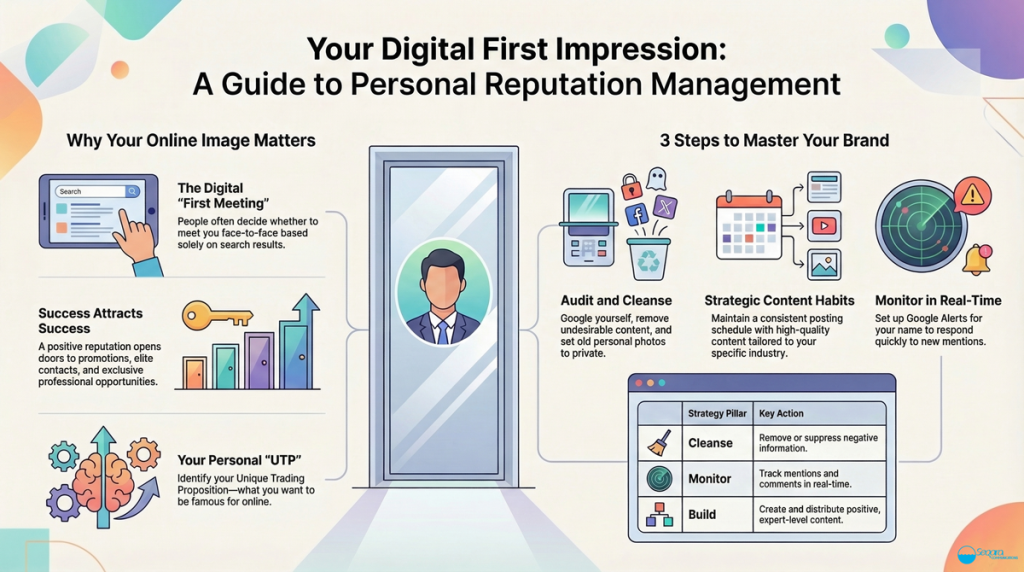
A professional reputation infrastructure is built on four pillars: Removal, Monitoring, Real-time Management, and Improvement.
To execute this strategy, adopt these prescriptive measures:
- Own the Assets: Claim your name across all relevant social platforms to ensure you own the high-ranking real estate on page one of Google.
- Automate Awareness: Utilize Google Alerts to monitor mentions of your name in real-time. This allows you to react to new data before it scales.
- The SEO Shield: Regularly publish high-quality, professional content. The more authoritative content you produce, the better you “protect” your name by pushing undesirable links off the first page.
- Digital Hygiene: Conduct a thorough “social media cleaning.” Audit old tags and photos that conflict with your current brand, and tighten privacy settings to disable untrusted tagging.
- Architect Professional Silos: Maintain a distinct separation between your personal life and your professional persona. A robust LinkedIn presence, for instance, should serve as your primary professional node, separate from private family interactions.
Conclusion: The Future of Your Digital Identity
Personal reputation management is a fundamental responsibility for every adult in a connected society. It is the ethical practice of claiming your own story and ensuring your digital image accurately reflects your true merits. By taking coordinated, proactive steps to manage your “perceptual equity,” you unlock doors to influence and opportunity that remain locked for the unmanaged.
Your reputation is your most valuable resource—more liquid than your home and more enduring than your current job title. Are you treating it with the same strategic care as your bank account?

Writer: Aditya Wardhana, AI