

The Best Risk Management Tools: Turning Uncertainty Into Strategy
Why Risk Feels Different Now
Risk never asked for permission to show up. It just did. But what’s changed is how fast risks compound, how tightly they connect, and how visible the consequences are. A ransomware blast radius isn’t confined to IT anymore; it halts revenue. A GDPR misstep can erase a quarter’s profit. One brittle third-party can open the door to your entire customer base. A biased AI decision doesn’t just invite regulatory review—it dents trust in broad daylight. Meanwhile, boards, auditors, and regulators are asking the same blunt question: can you prove you’re managing risk on purpose, not just surviving it by luck?
The Tooling Has Caught Up
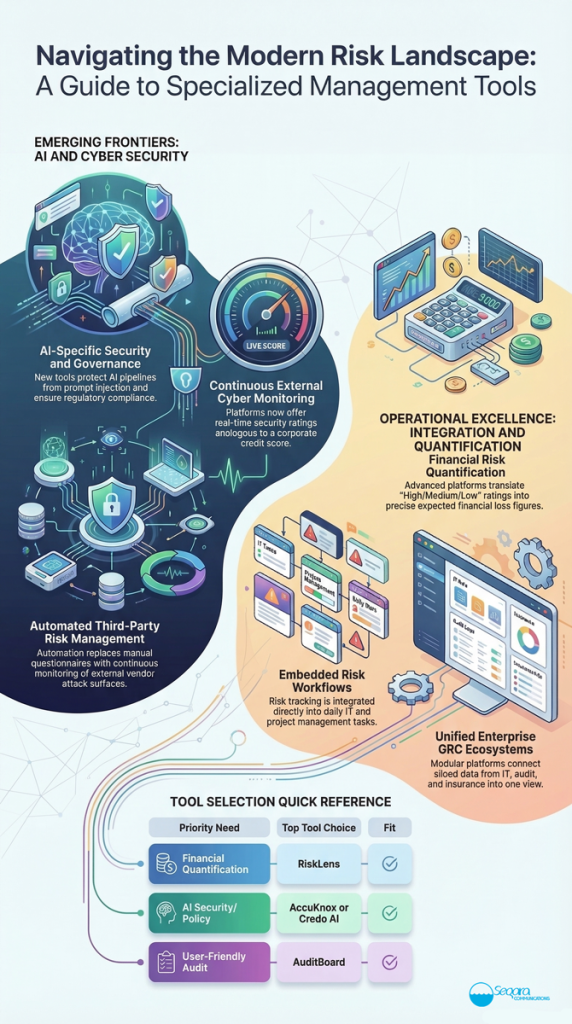
Modern risk management isn’t a single product—it’s a stack. Enterprise GRC suites pull operational, cyber, financial, and insurable risk into a single pane of glass so leaders can act with context. Cyber tools watch your perimeter and your partners in real time. AI governance platforms tame the novel dangers of generative AI—hallucinations, bias, data leakage, prompt injection. And quant platforms translate hand-wavy “High/Medium/Low” into dollar figures the board actually understands. Below is a pragmatic guide to the tools that help you turn uncertainty into strategy, from enterprise GRC engines to the humble (and crucial) project risk register.
AccuKnox AI‑SPM
If AI is a new superpower, it’s also a new attack surface. AccuKnox AI‑SPM secures the AI pipeline end-to-end with a Zero Trust mindset—from guarding training data integrity to hardening deployment infrastructure and policing inference-time interactions. Its standout strength: real-time protection against prompt injection, the sneaky technique that coaxes AI models to ignore their rules, leak secrets, or take actions they shouldn’t. As organizations roll out AI agents wired into internal systems, AccuKnox supplies the perimeter traditional security tools never anticipated.
Archer by OpenPages
A stalwart in regulated industries, Archer built its reputation on modularity. You don’t contort your program to fit the tool; you assemble the modules you need—IT risk, audit, business continuity, regulatory compliance, third-party risk—and they speak a shared data language. A finding in audit reshapes an assessment in IT risk without swivel-chairing. For financial services, healthcare, and public sector teams juggling multiple frameworks, Archer still offers uncommon depth and flexibility.
AuditBoard
Risk programs fail when people avoid the tool. AuditBoard wins by being the one practitioners actually enjoy using. Its interface is exceptionally approachable for auditors, control owners, and business users—not just GRC specialists. The SOX workflows shine, orchestrating documentation, testing, issues, and sign‑offs in a way that shrinks the annual compliance drag. If internal audit is your risk engine, AuditBoard is a strong fit.
Bitsight
Think of Bitsight as a credit score for cybersecurity, built from the outside in. Instead of periodic, internal snapshots, it continuously observes signals beyond your perimeter—misconfigurations, leaked credentials, unpatched software, risky behaviors—and rolls them into an objective rating. Benchmarking against industry peers becomes straightforward, giving CISOs a language the board understands. It’s especially useful for cyber insurance discussions and third‑party assessments where an external, standardized view carries weight.
Credo AI
AI risk isn’t only about exploits; it’s also about compliance and ethics at scale. Credo AI helps prove your AI systems are fair, transparent, robust, and aligned with evolving regulations such as tiered regimes like the EU AI Act. It produces the audit trails, model documentation, and defensible evidence you’ll need in high-stakes use cases—hiring, lending, healthcare, law enforcement—so you stay ahead of regulators rather than racing to catch up.
LogicManager
Under pressure, “show your work” matters. LogicManager’s superpower is accountability infrastructure. Every assessment, control change, and risk acceptance is logged with who, when, why, and with whose approval. For regulated enterprises where process evidence is as critical as outcomes, this is the documentation backbone that holds up in front of boards, auditors, and regulators.
MetricStream
MetricStream fuses enterprise GRC with AI acceleration, with notable strength in cyber and IT compliance. By automating data collection, analysis, and scoring, it can compress assessment cycles dramatically—freeing teams that operate on continuous cadences across large control sets. Its Cyber GRC feeds live threat intelligence into risk scoring, keeping posture aligned to what’s happening now—not what was true in last quarter’s review.
nTask
Big platforms aren’t always practical for the people closest to the work. nTask gives project managers, agile squads, and operations teams a simple risk register inside the task tool they already use. Log risks, assign owners, set probability and impact, and view them on a classic matrix—all without a GRC deployment. It’s the fastest way to graduate from “we should track this” to a living register with clear ownership.
OneTrust Tech Risk & Compliance
Privacy and tech risk are now inseparable. OneTrust extends its privacy heritage into broader IT risk, tying data processing, vendor diligence, consent management, and regulatory obligations together. For privacy leaders and CISOs navigating GDPR, CCPA, and a growing web of global requirements, OneTrust offers the operational lattice for continuous compliance—not just audit‑week heroics.
RiskLens
Boards ask, “What would a breach cost?” RiskLens answers with numbers, not adjectives. Built on the FAIR methodology, it turns qualitative labels into financial probability distributions—expected annual loss—so you can prioritize controls by return on risk reduction, identify over‑spend, and quantify specific scenarios. If you need to converse in the CFO’s language, this is the quant engine.
Riskonnect
Silos hide exposure. Riskonnect links operational risk, IT risk, safety incidents, insurance claims, and business continuity in one unified model. A safety event can instantly reveal implications for insurance and continuity in the same system. For sprawling enterprises with fragmented risk practices, this connectedness creates the first truly enterprise‑wide view.
SAS Risk Management
When the math gets heavy, SAS is built for it. Large banks, insurers, and asset managers use it to stress‑test portfolios across hundreds of macro scenarios, model credit risk at massive scale, and compute Basel capital requirements. The combination of deep statistical models and high‑performance infrastructure makes it a staple where calculations are regulatory obligations with capital on the line.
SentinelOne Singularity
The most common AI risk right now? Employees pasting sensitive data into public LLMs. SentinelOne’s Prompt Security monitors and governs those interactions, detecting risky submissions to external AI services and enforcing policies that prevent leakage without crushing productivity. It’s a pragmatic control for enabling responsible AI use across the workforce.
ServiceNow IRM
Don’t make teams jump tools to manage risk. ServiceNow IRM embeds risk into the workflows IT and security already use. A flagged vulnerability in a ticket auto-populates the risk register; resolving an incident updates risk in real time. For ServiceNow shops—many in the Fortune 500—this eliminates data lag and manual reconciliation. Risk management becomes part of doing the work, not an extra chore.
UpGuard
Third‑party security due diligence is a grind if you run it by hand. UpGuard automates vendor questionnaires, tracks responses, scores risk, and continuously monitors external attack surfaces between formal reviews. For organizations with sprawling supplier ecosystems, this shifts third‑party risk from an annual paperwork sprint to a continuous, scalable program.
How to Choose (Fast)
- Start with your drivers: compliance pressure, board reporting, third‑party sprawl, or AI adoption. Match the tool to the pain.
- Make it measurable: prefer platforms that quantify risk in financial or benchmarked terms.
- Fit the workflow: adoption beats features. Tools that meet people where they work win.
- Prove the audit trail: if you can’t show decisions with context, you’re one finding away from trouble.
- Think ecosystem: integration with tickets, asset inventories, HRIS, CMDBs, and data catalogs is the difference between live and stale.
Bottom Line
Risk isn’t going away. But with the right mix of GRC, cyber telemetry, AI governance, quantification, and project‑level discipline, you can convert uncertainty into an operating advantage—and walk into every review with evidence, not anecdotes.
Writer: Aditya Wardhana