
Thirsty Servers, Thirsty People: Batam’s Data Center Boom and the Coming Water Crisis
Batam has long been sold to the world as a story of staggering growth. A small island in Indonesia’s Riau Islands province, it sits a short ferry ride from Singapore, making it an irresistible landing pad for manufacturing, logistics, and—most recently—the infrastructure that powers the digital economy. In the span of a few years, hyperscale data centers have begun to rise from cleared jungle parcels, marketed as the region’s next digital gateway. Yet beneath the surface of this success narrative runs a quieter, more unsettling question: what happens when the machines that store the world’s information begin to compete with people for the most basic element of life?
The New Digital Frontier
The logic behind Batam’s data center boom is, on paper, difficult to dispute. Global cloud providers and regional operators are racing to build capacity across Southeast Asia, and Singapore—the region’s traditional hub—has grown increasingly wary of the enormous energy and land demands of hyperscale facilities. A moratorium and subsequent selective approvals pushed developers to look across the water, where land is cheaper, regulations more accommodating, and proximity to undersea cable landing points is excellent. Batam, just 20 kilometers away, became the natural overflow valve.
Entire industrial districts have been rebranded as “digital parks,” and investment figures touted in the billions of dollars have become a fixture of local economic announcements. Governments see jobs, tax revenue, and a future-proofed economy. Investors see low-cost power and abundant real estate. The residents of Batam, however, increasingly see something else: strain on the resources they rely on every day.
The Physics of Cooling
To understand the collision between data centers and water, one must first understand why these facilities need water at all. A data center is, in essence, a warehouse of heat. Servers process information around the clock, and the electricity that powers them is almost entirely converted into heat that must be removed. Cooling systems do this work through evaporative cooling towers, which rely on a continuous supply of water to shed heat into the atmosphere.
The scale is staggering. A single hyperscale facility can consume water at a rate comparable to a small town. Unlike electricity, where sites can negotiate dedicated power contracts or even build private generation, water is drawn from shared systems—reservoirs, rivers, and municipal supply networks that also serve households, hospitals, and schools. When an operator signs a long-term water allocation agreement, that water is no longer available to anyone else. The competition is direct, and it is zero-sum.
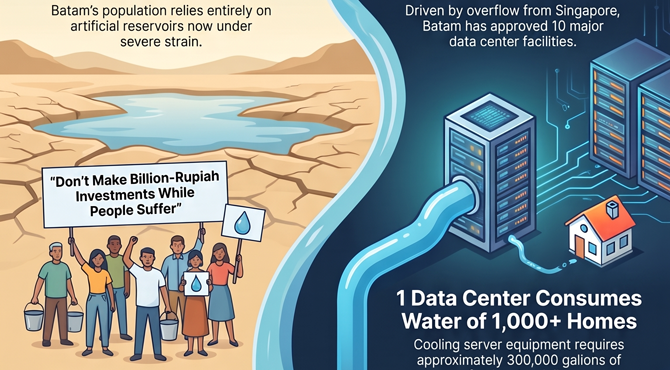
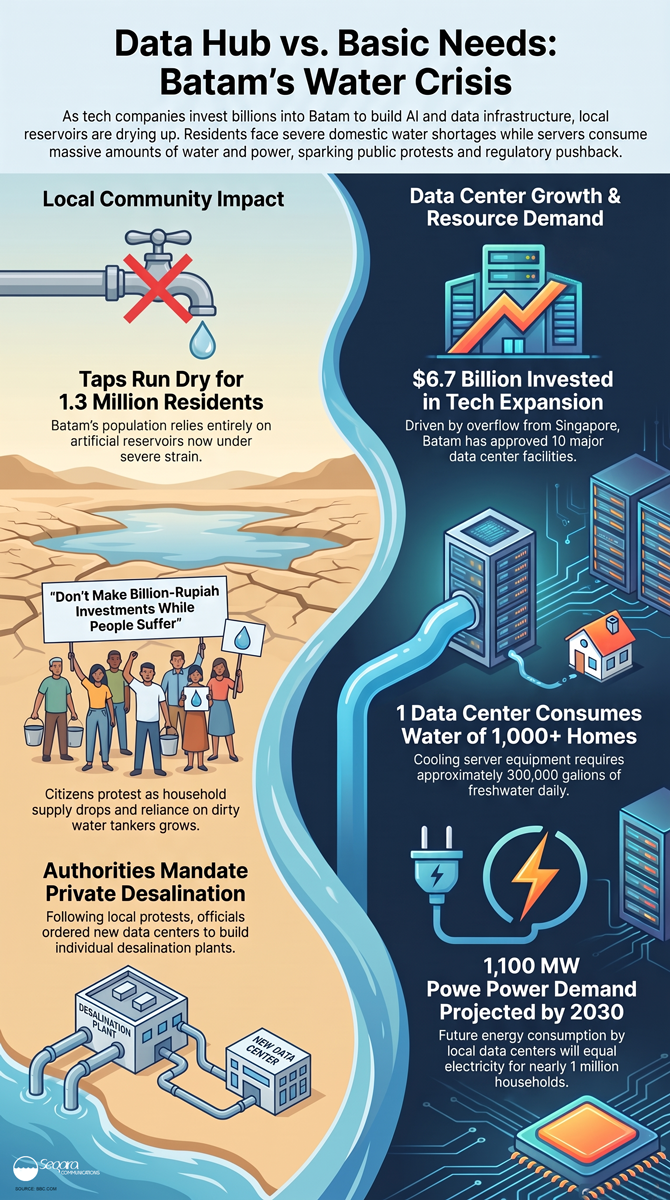
Research in the US suggests a typical data centre consumes around 300,000 gallons of water a day, or about as much as 1,000 US households. A larger, 50MW facility could take as much water as 2,200 households per day, and enough electricity to power 22,000 homes, according to Malaysia’s central bank.
An Island of Limited Water
Batam’s geography compounds the problem. As an island, it cannot draw on distant river basins or vast groundwater reserves in the way a mainland site might. Its freshwater system is finite, seasonal, and increasingly stressed by a combination of population growth, industrial expansion, and changing rainfall patterns. The main reservoirs that supply the island’s potable water were designed for a smaller population and a lighter industrial footprint. Development has outpaced that original design by a wide margin.
Residents in certain districts already describe erratic water pressure, rationing during dry periods, and dependence on purchased water delivered by truck—an expensive and exhausting daily reality. For many households, water is not a utility they can take for granted; it is a daily negotiation. Into this fragile equilibrium arrives an industry whose water appetite is not merely large but continuous, unyielding to season or weather.
It’s unclear how much water or electricity the data centres in Batam are consuming. But the island routinely faces water shortages, and the levels are worse this year, possibly because of a historic “super” El Niño. Devoid of natural freshwater sources, Batam’s 1.3 million people rely on rainwater collected in six artificial reservoirs.
Competing Priorities, Unequal Leverage
The heart of the conflict lies in who commands priority when supplies run thin. Water utilities and local governments must, in principle, balance the needs of residential customers against those of industrial users. In practice, the incentives are skewed. Data centers bring investment agreements, employment promises, and international prestige. They negotiate multi-decade water supply contracts with dedicated volumes. Households, by contrast, negotiate nothing; they are simply expected to receive what remains.
This creates a structural asymmetry that is rarely acknowledged in public discourse. A data center’s water allocation is contractual and enforceable; a family’s access to clean water is often aspirational. During a drought or a reservoir shortfall, the industrial customer’s supply is the one protected by legal instruments, while residential users absorb the curtailment. The crisis, when it arrives, will not be evenly distributed. It will fall hardest on those with the least power to resist it.
The Climate Multiplier
The situation is further darkened by climate change. Southeast Asia’s rainfall is projected to become more variable, with longer dry spells punctuated by intense deluges that reservoirs struggle to capture efficiently. Rising temperatures also mean two compounding pressures: more water evaporates from reservoirs, and data centers require even more water to reject the same amount of heat as ambient temperatures climb. The very conditions that threaten water supply simultaneously increase water demand from the digital sector.
This is a feedback loop with no obvious exit. Each new facility added to the island deepens the baseline demand. Each year of warming weather tightens the supply. The distance between the two lines—what the island can reliably provide and what its industries insist upon—shrinks year after year, with ordinary residents squeezed into the gap.
Beyond Water: The Broader Footprint
Water is the sharpest point of conflict, but it is not the only shared resource under pressure. Data centers demand enormous electrical loads, drawing power from grids that already strain to serve a growing city. The diesel generators that back up these facilities raise air-quality concerns. Land clearing for digital parks disrupts watersheds and reduces the natural retention capacity that recharges groundwater and fills reservoirs. In this sense, water is both a direct input and a symptom of a larger pattern: an island ecosystem asked to absorb an industrial scale it was never designed to carry.
Official figures put investment in data centres on the island at more than $6.7bn (£5.1bn) as of mid-2026, spurred in part by demand from Singapore, which is just an hour away by ferry. Singapore paused construction of data centres in 2019, citing land and energy constraints. It lifted the ban in 2022 after introducing new efficiency standards, which prompted investors to look elsewhere. Singapore has long been promoting the Riau Islands, which includes Batam, and the Malaysian state of Johor as “complementary” regions.
Across the strait, Batam is just as attractive to investors – from the US, China, Australia, Singapore – because of relatively low operating costs, proximity to Singapore and connections to major subsea cable routes.
Toward an Honest Accounting
None of this is to argue that Batam should refuse data centers. The economic opportunity is real, and the digital transition is inevitable. But an honest conversation requires abandoning the marketing language that frames these projects as cost-free boons. Development of this kind carries externalities, and those externalities are falling disproportionately on residents who had no seat at the negotiating table.
Several adjustments would begin to rebalance the ledger. Water audits for new facilities should account not only for direct consumption but for upstream effects on watersheds and downstream effects on potable supply. Contracts should include enforceable curtailment clauses that prioritize residential access during shortages, rather than insulating industrial users. Investments in reservoir capacity, water recycling, and non-potable cooling sources—such as seawater or treated effluent—should be mandatory, not optional. And the public deserves real transparency: published water budgets that show, in plain terms, how much each facility draws and what remains for the community.
Batam’s data center story is being written as a triumph of connectivity and investment. But every server rack cooled by a shared, shrinking water supply is also a subtraction from someone’s daily life. The island can host the digital future, or it can guarantee water to its people, but unless its leaders deliberately engineer a truce between the two, it may find that the promises of one quietly drain the foundations of the other.
The question hanging over Batam is not whether the data centers will arrive—they already have. It is whether the island’s institutions can act quickly enough to ensure that when the reservoirs run low, the first taps to go dry do not belong to those who need them most.
Nongsa, Batam is home to a 13,000-sq-m data centre by Hong Kong-based private equity firm Gaw Capital and Indonesian developer Sinar Primera. In April, Singapore’s DayOne signed a deal with an Indonesian state utility to build one of the country’s largest data centres with around 450MW capacity, enough to power 350,000 average households. In June, DayOne, chip maker Nvidia and Australian AI start-up Firmus Technologies announced a 360MW “AI factory”.
By 2030, power demand from data centres in Batam is expected to cross 1,100MW, which is enough to power nearly a million homes.
Writer: Adit
Source: bbc.com