
Advertorial vs. Editorial: How to Pick the Right Mix for Your PR Strategy
TL;DR
A smart PR – like SEQARA Communications – plan blends both advertorial (paid, controlled) and editorial (earned, independent). Use advertorials to guarantee placement and shape the message; chase editorial to build credibility and trust. The magic is in the mix.
Wait—what’s the actual difference?
If you’re new to PR, the advertorial/editorial split can feel like jargon soup. Here’s the clean version:
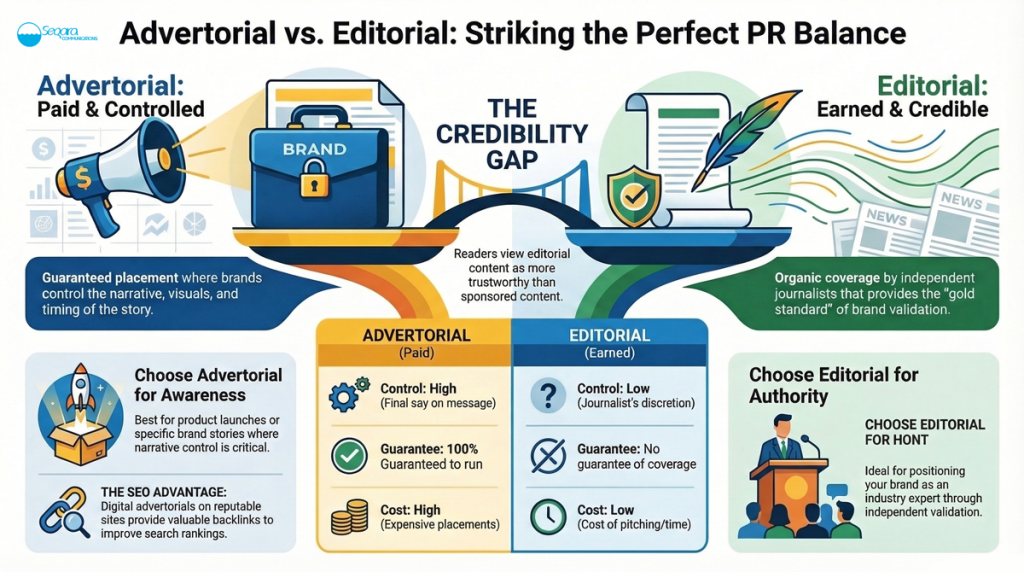
- Advertorial (aka paid, sponsored, native): You pay to publish content that looks and reads like an article. It’s usually labeled “Sponsored” or “Paid Content” and often appears as a feature, a sponsored post, or a dedicated section. You control the copy, visuals, and timing.
- Editorial (aka earned coverage): Journalists and editors decide whether your story runs. It’s unpaid, independent, and ideally unbiased. You don’t control the final cut—but when you land it, it’s gold.
Pros and cons—real talk
- Advertorial
- Pros: Guaranteed placement, full message control, precise timing, platform targeting, potential SEO value from reputable sites.
- Cons: Costs money, readers may be skeptical, must be clearly labeled, can feel salesy if not well-crafted.
- Editorial
- Pros: High credibility, trust halo from the publication, third‑party validation, often free aside from pitching time.
- Cons: No guarantees, little control over angles or headlines, longer lead times.
So…which one should you use?
Both—just not equally all the time. Think of advertorials as your “on-demand spotlight,” and editorials as your “earned applause.” Match the tactic to the moment:
- Launches and big announcements: Advertorials ensure your message hits on your chosen date with the exact framing you want.
- Authority building: Editorials position you as the expert because someone else chose to quote or feature you.
- Complex or nuanced topics: Advertorials let you explain thoroughly without edits; pair with editorial briefings for credibility.
- Evergreen brand storytelling: Use advertorials sparingly to seed narratives; let editorial accumulate proof over time.
Decision checklist
Ask yourself:
- Goal: Awareness fast, or credibility compounding? If speed and control matter, lean advertorial. If trust and third‑party validation matter, chase editorial.
- Budget: Can you fund paid placement plus good creative? Advertorials can get pricey. Editorial costs time, relationships, and a compelling hook.
- Brand voice: Playful and polished content shines in advertorial. Editorial tone is shaped by the outlet—be ready to flex.
- Publication fit: Some outlets love native content; others are purist. Research sections, rates, lead times, and past pieces.
- Newsworthiness: Be honest—is there a real angle? If not, don’t force editorial. Use advertorial to educate or entertain while you build a stronger hook.
Best practices for advertorials
- Label clearly. Follow guidelines (think FTC-style disclosures). Ambiguity erodes trust.
- Lead with value. Teach, reveal data, or tell a story. Save the pitch for the close.
- Blend the brand. Weave mentions naturally; avoid billboard energy.
- Match the house style. Headline cadence, subheads, image treatments—mirror the publication.
- Target precisely. Favor niche or vertical outlets where your buyers actually read.
- Measure like a hawk. Track views, time on page, CTR, assisted conversions, and backlink quality.
Best practices for editorial
- Have a news hook. Tie to timely trends, data, launches, or human stories.
- Be useful to journalists. Clear facts, quotable lines, assets ready (images, bios, data).
- Build relationships. Personalize pitches; respect beats and deadlines.
- Be ready to let go. You won’t control the headline. Focus on clarity and accuracy in your quotes.
- Follow up once—politely. Then move on and refine your angle.
Sample scenarios
- New product drop next month: Run an advertorial on launch day for control; pitch exclusives/embargoed reviews to select journalists for editorial lift.
- Repositioning the brand: Commission a thought‑leadership advertorial from your CEO, backed by proprietary data; pursue interviews and op‑eds for third‑party validation.
- Sensitive update or policy change: Use advertorial to explain context thoroughly; offer background briefings to trusted reporters.
Where a platform can help
A centralized media hub (like an industry‑trusted comms platform) streamlines editorial success: upload high‑quality images, detailed product info, and timely updates so journalists can discover, verify, and pull assets fast. That reduces friction and increases the odds of being included in organic coverage.
Quick matrix: picking your play
- Need certainty and speed? → Advertorial.
- Need credibility and reach through trust? → Editorial.
- Have both budget and a real story? → Do both, staggered.
- No real news yet? → Advertorial for education; keep building toward an editorial hook.
Metrics that matter
- Advertorial: Impressions, scroll depth, CTR, assisted conversions, brand lift, backlink authority.
- Editorial: Share of voice, domain diversity of mentions, sentiment, referral traffic, lead quality.
Final thought
You don’t have to pick a side. Calibrate the mix to your goals, budget, news pipeline, and audience. Lead with respect for readers—clearly label paid, deliver value either way—and your PR strategy will compound over time.

Writer: Aditya Wardhana