

Crossing 100: How Tzu Chi Hospital’s Robotic Laparoscopy Is Rewriting the Rules of Precision Surgery
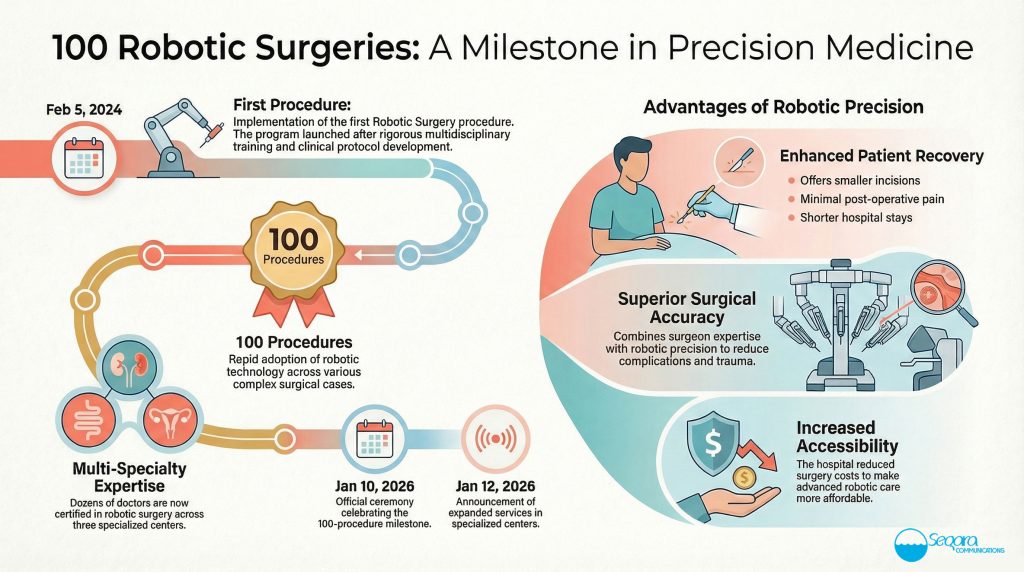
Beneath the calm glow of operating room lights, Tzu Chi Hospital Pantai Indah Kapuk marked a defining milestone: the completion of 100 robotic-assisted laparoscopic surgeries. The achievement was celebrated on Saturday, January 10, 2026, during a public seminar and Milestone Ceremony themed “A Century of Robotic Excellence: Precision Surgery for a Better Tomorrow,” hosted at the hospital’s 23rd-floor auditorium.
More than a round number, the century mark reflects a steady fusion of advanced technology, cross-disciplinary clinical expertise, and a rigorous culture of patient safety. In these operating rooms, smaller incisions, steadier hands, and quicker recoveries are becoming the new normal—a living expression of Tzu Chi Hospital’s ongoing commitment to care that is both deeply human and clinically exacting.
“Robotic technology in healthcare took shape in the United States in the 1980s and has since advanced to become widely used in minimally invasive surgery. Over time, this technology has been adopted around the world, including in Indonesia, as part of efforts to elevate surgical quality,” said Prof. DR. Dr. Satyanegara, Sp.BS (K), Senior Director of Tzu Chi Hospital, grounding the milestone in a broader global evolution that now resonates in North Jakarta’s operating suites.
Tzu Chi Hospital embarked on its robotic laparoscopy journey on February 5, 2024. Before the first scalpel touched skin, months of groundwork were laid: training and certification for clinical teams, the formation of a multidisciplinary unit, and the establishment of stringent clinical and patient-safety protocols. Since then, the service has expanded steadily to surpass 100 cases in under two years. Today, dozens of physicians across specialties are certified to perform robotic procedures at Tzu Chi Hospital.
“In keeping with Tzu Chi Hospital’s founding spirit to provide the most professional medical services possible, we introduced robotic laparoscopy to deliver superior surgical outcomes—less pain, shorter hospital stays, lower infection risk, and reduced surgical trauma,” said President Director Dr. Gunawan Susanto, Sp.BS, explaining the strategic rationale for investing in technology and strengthening the team.
In the early days, the relatively high cost of robotic surgery posed a barrier for some patients. Recognizing the challenge, the hospital reduced procedure costs to broaden access while maintaining quality and safety. Today, robotic laparoscopy is most commonly used in urology, digestive surgery, and obstetrics/gynecology. Beyond the OR, Tzu Chi Hospital also operates other robotic systems for knee interventions, breast mammography, and medical rehabilitation.
In practice, robotic platforms have supported complex cases across digestive, urologic, and gynecologic disciplines, and are integrated into the hospital’s Hernia Center, Prostate & Urinary Stone Center, and Oncology Center. The scope of procedures ranges from abdominal hernia repair, myomectomy, and prostate cancer treatment to neobladder creation and other intra-abdominal operations.
“Robotic laparoscopy is the synergy of human skill and machine precision. For patients, it means smaller incisions, lighter postoperative pain, fewer complications, and faster recovery. For surgeons, it brings greater accuracy and procedural efficiency,” said DR. Dr. Barlian Sutedja, Sp.B, Head of the Hernia Center’s surgical team, summarizing benefits on both sides of the table.
The 100-case milestone came to life through a day of learning and demonstration—seminars, a talk show, and a live showcase of the technology at work. Dr. Andri Hondir, Sp.OG, explored the role and trajectory of robotic surgery in clinical practice, with a focus on patient safety and recovery. An interactive talk show featured Dr. Anthony Pratama, Sp.B, M.Kes, AIFO, alongside a patient, while Dr. Stevano Sipahutar, Sp.U, FICRS, led a live robotic surgery demonstration using the Versius CRM system—offering a real-time view of instrument dexterity and three-dimensional visualization in the clinical field.
Looking beyond celebration, the hospital outlined the road ahead: expanding team competencies through continuous training, strengthening research collaborations, and deepening the integration of technology into services centered on patients’ quality of life. By pairing science and skill with a spirit of compassion, Tzu Chi Hospital is writing its next chapter in precision surgery—safer, kinder, and ever more relevant to today’s health challenges.
—
Quick Facts and Timeline (Infographic-ready)
- 100 robotic-assisted laparoscopic surgeries completed (Feb 2024–Jan 2026)
- First procedure: February 5, 2024
- Core specialties: Urology, Digestive Surgery, Obstetrics/Gynecology
- Integrated programs: Hernia Center; Prostate & Urinary Stone Center; Oncology Center
- Reported benefits: smaller incisions, reduced pain, lower infection risk, faster recovery
Patient’s-eye View (Human Interest)
“I never imagined surgery could feel this manageable. I went home sooner than expected, and I was back to daily routines with minimal discomfort,” said a patient who underwent a robotic-assisted procedure at Tzu Chi Hospital.
What is Versius CRM?
- A European-origin robotic surgical system designed for minimally invasive procedures
- Modular, bedside units that enhance OR flexibility and ergonomics
- High-definition 3D visualization to improve precision and control
- Built to support a wide range of laparoscopic procedures across specialties
About Tzu Chi Hospital:
Tzu Chi Hospital is a private hospital under the auspices of the Tzu Chi Medika Indonesia Buddhist Foundation, established on the principles of valuing life, prioritizing life, and compassion. All services at Tzu Chi Hospital prioritize professionalism and a humanistic culture, which is realized through international quality services and a warm human touch.
Tzu Chi Hospital has 5 Centers of Excellence, namely Blood Stem Cell Transplantation, Stroke Treatment and Neurosurgery, Comprehensive Maternal and Child Care, Integrated Cancer Treatment, and Palliative Care.
About PT Surgika Alkesindo (Distributor of CMR Versius Modular Robotic Surgery):
PT Surgika Alkesindo (PT SA) is a medical device provider/distributor established on January 31, 2000, by Dr. Handy Gunawan, who currently serves as President Director. Initially, PT SA focused solely on selling medical devices specializing in surgical sutures with only 1 division. Over time, PT SA now has more than 12 divisions with various medical specialties (Suture & Gloves, OR ICU, Surgery, Ortho Rehab, ENT & Ophthalmology, Aesthetic, Laboratory, Airway, Hemodialysis, Radiology), and has branch offices and representative offices spread across major cities throughout Indonesia, making it one of the largest medical device distributors in Indonesia. PT SA is currently highly committed to providing high-quality medical devices with competent after-sales service fully supported directly by the brand-holding manufacturer.
Writer: Aditya Wardhana & Sider.AI