
The Great Marketing Convergence: Why Your Inbound Strategy is Failing Without Outbound Precision
For decades, the marketing landscape was a monologue—a high-decibel roar from brands that owned the airwaves and dictated the narrative. In this era of traditional media, families were passive recipients of TV, radio, and print advertisements that were often as intrusive as they were entertaining. It was a game of volume and endurance, forcing messages upon an audience with limited alternatives.
However, the digital revolution has fundamentally rewritten human psychology. Today’s consumers—particularly in the B2B sector—have become the absolute “masters of their destinies.” They no longer wait for information to find them; they hunt for specific answers and they demand them at a high velocity. To thrive in this environment, the modern brand must move beyond the binary choice of inbound or outbound. The path to growth lies in a sophisticated harmony where precision meets relevance.
1. Stop Selling to Start Winning
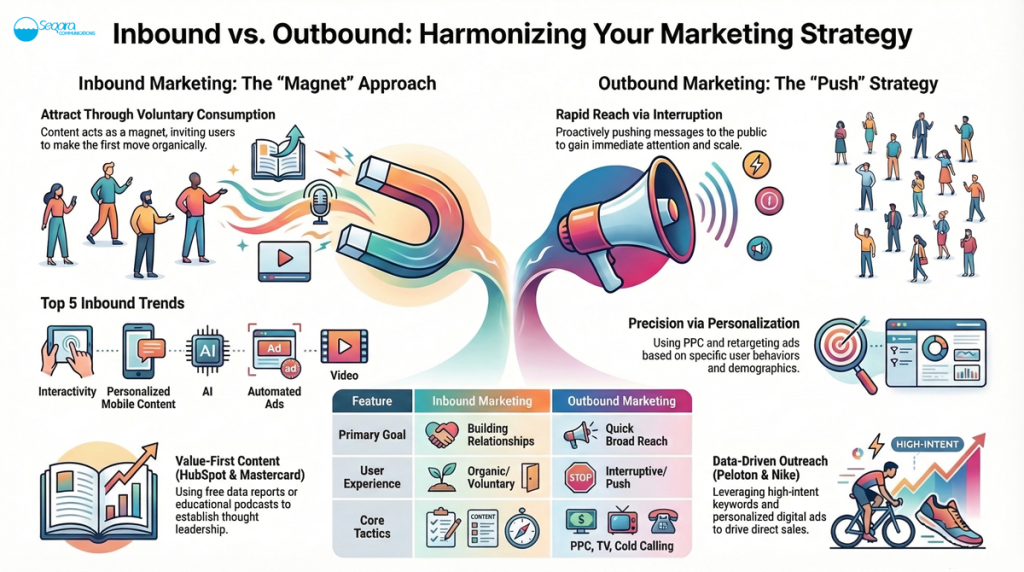
In a marketplace saturated with noise, the most counter-intuitive strategy is often the most effective: to attract more customers, you must stop focusing on the sale. Inbound marketing functions as a magnet, shifting the dynamic from “pushing” a product to “pulling” an audience that engages voluntarily. This transition isn’t just a philosophical shift; it is a financial one, saving brands significant time and capital by reducing friction.
For B2B customers, value is measured in speed and utility. They aren’t looking for a pitch; they are looking for a shortcut to a solution. As a thought leader, your goal is to make the user’s everyday life easier. When your content addresses a specific pain point rather than a sales quota, your brand becomes an essential resource rather than a temporary interruption. As the core philosophy suggests: “The ultimate goal is to attract the public by focusing on their needs. As long as you have a solution that makes their everyday life easier, you win it.”
2. The “Movie Effect” – Why Subtlety is Your Strongest Asset
The most impactful films don’t announce their intentions; they immerse you. Through a delicate alchemy of visuals, music, and emotion, they influence your perspective without you ever feeling “sold” on a theme. This is the “Director’s Cut” of modern marketing: an integrated approach where the brand voice and authentic storytelling work beneath the surface.
In this convergence, modern vehicles like interactivity, AI, automated ads, personalized mobile content, and video promotion act as the “cinematography” of your brand. When these elements are woven together with authenticity, they build deep-seated relationships rather than fleeting transactions.
“The way the best films impact you, the right combination of tactics does to your brand.”
3. Combatting “Visual Fatigue” Through Audio Authority
We have reached a point of “visual fatigue,” where the endless scroll of text and video has become a cognitive burden. In response, consumers are reclaiming their time through audio. Podcasts have emerged as the ultimate “pull” tactic because they allow the “masters of their destinies” to multitask—learning while they move, rest, or commute.
Mastercard mastered this with their “Fortune Favors the Bold” series. By providing genuine industry value, they positioned themselves as a thought leader in an organic, accessible format. The promotion of their brand wasn’t a commercial break; it was a natural extension of a relevant conversation. This is audio authority: being there when the customer has turned their eyes away but kept their mind open.
4. The Power of the “High-Value Freebie” (Utility Over Hype)
Top-tier brands have moved away from “content for content’s sake” and toward the “High-Value Freebie.” The goal is to provide a collection of insights so substantial that it shifts the audience’s trajectory. However, the delivery of this utility must match the audience’s bandwidth:
- Deep-Dive Analysis: HubSpot’s 2021 Marketing Report succeeded by offering a massive, free repository of data. It wasn’t an ad; it was a map of the industry that attracted its target audience through sheer weight of evidence.
- Actionable Scannability: Recognizing that not everyone has the time for thousands of words, American Express (Amex) utilized the “Small Business Recovery” infographic. This wasn’t just data visualization—it was a resource specifically designed to provide recovery solutions for entrepreneurs post-pandemic.
5. Outbound Reimagined – From Interruption to Personalization
Outbound marketing is often dismissed as a “dinosaur” tactic, yet it remains the fastest way to scale reach. The evolution lies in moving from “blind interruption” to “digital precision.” When outbound adopts the soul of inbound, it ceases to be an annoyance and becomes a service.
Nike’s 2021 strategy is the gold standard for this. By betting heavily on personalization, Nike targeted specific segments based on behavior, interests, and demographics. Crucially, they utilized retargeting—the bridge where outbound reach meets inbound relevance—to re-engage users who had already shown interest. Similarly, Peloton utilizes PPC with high-intent keywords to ensure they appear at the exact moment a user is seeking a fitness solution. By combining intent-based keywords with visually appealing ads and clear CTAs, they prove that outbound can be just as “unmissable” as any blog post.
Closing Thought: The Harmony of the Integrated Approach
The future of brand growth does not belong to the loudest voice, but to the smartest combination. Inbound provides the magnet and the emotional payoff, while outbound provides the precision and the scale. They are not competitors; they are collaborators in a single content action plan.
As you evaluate your current trajectory, ask yourself: Is your strategy merely making noise, or is it solving problems? If you find yourself leaning too heavily on the “roar” of the past, it may be time to rethink how you harmonize your message for an audience that is finally in control.
Writer: Aditya Wardhana