
The Participatory Shift: Strategic Integration of Shared Media in the PESO Model
1. The Evolution of Brand Communication: From Broadcasting to Collaboration
The contemporary public relations landscape is currently navigating a paradigm shift in brand equity management, moving decisively away from the era of static, one-sided broadcasting toward a sophisticated model of dynamic collaboration. In a digital ecosystem where consumer trust is the primary currency, brands can no longer rely on sanitized, top-down messaging to sustain relevance. Instead, strategic imperative dictates the orchestration of participatory environments where audiences transition from passive recipients to active brand co-authors. This shift fosters a level of authenticity that traditional broadcasting cannot replicate, transforming brand communication into a shared journey of value creation.
Defining Shared Media Shared Media is defined by its core architecture of collaboration and real-time interaction. It encompasses the ecosystem of content that is created, distributed, or amplified by audiences through social platforms, user-generated content (UGC), and decentralized community networks. Unlike traditional channels, Shared Media represents a collaborative nexus where the brand and its stakeholders converge to generate organic reach through collective actions—such as shares, likes, and comments—thereby extending the narrative far beyond the brand’s initial sphere of influence.
| Feature | Traditional Media Models (Paid, Earned, Owned) | Shared Media | Success Metrics |
|---|---|---|---|
| Nature of Interaction | Static and One-Sided | Dynamic and Collaborative | Reach vs. Engagement |
| Primary Driver | Brand Control | Audience Participation | Impressions vs. Sentiment |
| Narrative Flow | Linear (Brand to Consumer) | Decentralized (Networked) | Frequency vs. Velocity |
This evolution necessitates a fundamental reconfiguration of the brand-audience relationship, transitioning the organization from a “broadcaster” of information to a “participant” within the broader PESO model® ecosystem.
——————————————————————————–
2. Strategic Integration: Shared Media’s Role within the PESO Model
Shared Media represents a critical evolution in corporate communication; it is no longer a peripheral tactic but a vital corporate asset that completes the PESO model® for maximum reputational equilibrium. By integrating Shared Media into the core strategy, organizations extract exponential value, evolving their presence from static campaigns into living, breathing conversations. This integration serves as the connective tissue that allows a brand to maintain relevance by embedding itself into the ongoing public discourse.
The synergy between Shared Media and other PESO components is essential for optimizing communication ROI:
- Amplifies Owned Media: Shared Media serves as the distribution engine for brand-controlled content. Through audience engagement—sharing and commenting—the reach of internal assets is propelled into high-velocity networks, extending the lifecycle of owned content.
- Complements Paid Media: It functions as a cost-effective extension of reach. While Paid Media requires a direct financial investment for every impression, Shared Media leverages the “multiplier effect” of organic participation to scale messages without linear increases in spend.
- Drives Earned Media: There is an established pipeline between user-generated buzz and institutional media attention. When Shared Media activity achieves critical mass, it functions as a social proof signal that attracts journalists and traditional outlets, successfully converting social momentum into Earned Media authority.
This holistic integration allows for multi-dimensional campaigns that synchronize visibility with deep engagement, utilizing specific operational vehicles to navigate the participatory landscape.
——————————————————————————–
3. Taxonomy of Shared Media: Social, UGC, and Community Engagement
The formats of Shared Media serve as the operational vehicles for the integration strategies mentioned above, providing the infrastructure for real-time interaction that shapes public perception.
Social Media Platforms Social media remains the cornerstone of Shared Media, providing the real-time connectivity required for brands to spark meaningful dialogue. Platforms like LinkedIn, X (Twitter), and TikTok allow for high-velocity message amplification.
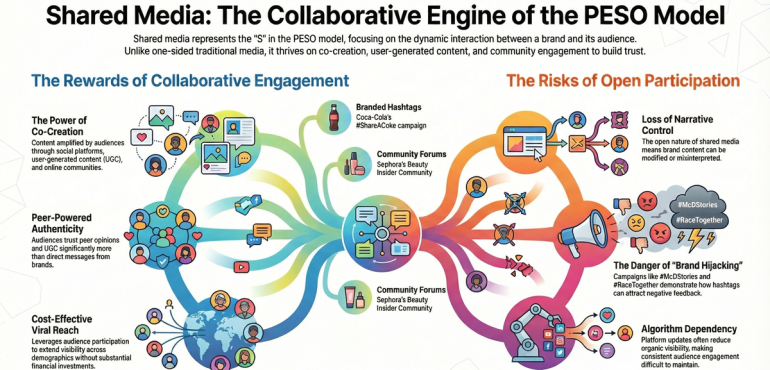
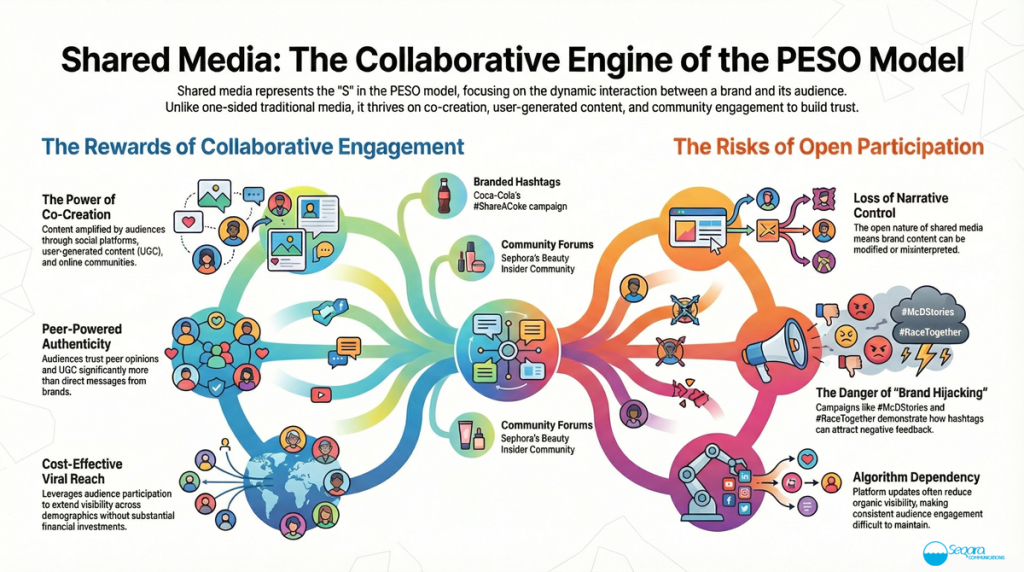
- Real-World Example: Coca-Cola’s #ShareACoke campaign utilized branded hashtags to mobilize a global community. By encouraging users to post personalized bottles, the brand triggered a viral wave of participation that transformed a simple product into a social catalyst.
User-Generated Content (UGC) UGC provides a “veneer of authenticity” that brand-authored content can rarely achieve. Consumers inherently trust peer evaluations over corporate mandates, making UGC a powerful tool for credibility. Beyond social proof, UGC serves as a functional proof-of-concept for products.
- Real-World Example: Apple and Samsung frequently leverage fan-generated content to showcase specific hardware capabilities, such as camera fidelity. Similarly, Airbnb curates collaborative stories from travelers, utilizing peer-to-peer storytelling to build a brand narrative rooted in genuine experience rather than marketing copy.
Community-Driven Engagement Decentralized forums and support networks are essential for driving long-term rapport and high-value business metrics like customer retention. These spaces allow brands to move from high-level marketing to niche, enthusiastic problem-solving.
- Real-World Example: Sephora’s Beauty Insider Community creates a dedicated space for enthusiasts to discuss trends, while Peloton utilizes private groups to foster a sense of belonging. For Peloton, these groups are not just social outlets; they are strategic drivers of retention, ensuring users remain tethered to the ecosystem through community accountability.
While these formats generate immense brand equity, they are underpinned by a specific value proposition that requires careful strategic alignment.
——————————————————————————–
4. The Value Proposition: Driving Reach, Trust, and Cost-Efficiency
The strategic advantage of Shared Media lies in its ability to leverage the power of the collective to achieve authentic awareness and community-led growth.
- Exponential Reach and Funnel Progression: Shared Media allows content to transcend the brand’s immediate following. Through viral hashtags and challenges, content is introduced to new demographics, creating a clear funnel progression from initial visibility to community engagement and, ultimately, customer conversion.
- Authentic Connections through Co-creation: Shared Media is rooted in co-creation, which personalizes the brand experience. When an audience participates in a narrative, they transition from consumers to advocates, fostering a psychological bond that traditional advertising cannot buy.
- Humanization through Real-Time Feedback: The capacity for rapid responsiveness—whether managing a crisis or participating in a trending cultural moment—humanizes the corporate entity. This real-time interaction makes the brand appear grounded and approachable.
- Cost-Effective Awareness: Shared Media relies on the audience to provide the labor of distribution. By leveraging organic participation—exemplified by Starbucks’ use of customer photo contests—brands can achieve global reach and high-impact awareness without the massive capital expenditure required for equivalent paid reach.
However, these strategic benefits are inextricably linked to inherent risks that require sophisticated mitigation.
——————————————————————————–
5. Risk Mitigation: Navigating the Challenges of a Decentralized Narrative
The primary challenge of Shared Media is the inherent loss of narrative control. In a decentralized environment, the brand is no longer the sole author of its story, leaving it vulnerable to the volatility of public sentiment.
Loss of Narrative Control
- The McDonald’s Case: The #McDStories campaign, intended to showcase positive experiences, was quickly weaponized by users to share negative anecdotes.
- Strategic Takeaway (The “So What?”): Positive intent is irrelevant if the brand has unresolved customer friction points; in open forums, these grievances will inevitably be weaponized, turning a participation tool into a reputational liability.
Brand Hijacking and Public Criticism
- The Starbucks Case: The #RaceTogether initiative was widely panned as tone-deaf and inconsistent with the brand’s perceived role.
- Strategic Takeaway (The “So What?”): High-stakes social activism requires a precise degree of brand-cultural alignment. Without a foundation of established credibility on a topic, a brand risks a total loss of narrative control and the alienation of its core customer base.
Algorithm Dependency
- The Platform Reality: Social platforms frequently update algorithms (e.g., Facebook) to deprioritize organic brand content in favor of paid placement.
- Strategic Takeaway (The “So What?”): This creates a “pay-to-play” reality where Shared Media often regresses into a Paid Media expense, requiring brands to balance organic engagement with strategic spend to maintain visibility.
Consistency and Relevance The demand for “freshness” forces brands into high-risk tactics like newsjacking. While staying relevant is necessary, the speed of digital discourse increases the likelihood of a tonal mismatch or mistimed engagement.
In the final analysis, Shared Media is the bridge between corporate identity and community reality. To thrive in the digital age, organizations must abandon the safety of the broadcast booth and embrace the complexity of the town square. Only by participating as a transparent, responsive member of the community can a brand secure the trust necessary for long-term digital relevance.

Writer: Aditya Wardhana