
PR Measurement and ROI: The Statistics That Are Redefining Communications Value
The communications industry is undergoing a profound transformation. For years, PR measurement meant little more than tallying press clippings and calculating Advertising Value Equivalency (AVE) — a metric widely discredited by industry bodies like AMEC and PRSA, yet stubbornly persistent in boardroom presentations. Today, that approach no longer cuts it. The gap between tracked outputs and actual business outcomes is precisely where communications teams either cement their seat at the executive table or find themselves sidelined when budgets come under scrutiny.
C-suite leaders increasingly expect PR to justify its budgets with the same analytical rigor applied to paid media and performance marketing. Every dollar spent now demands a demonstrable return, and the pressure is reshaping how communications professionals allocate their time, structure their reporting, and — ultimately — define success.
The Time Investment: Measurement Is a Major Commitment
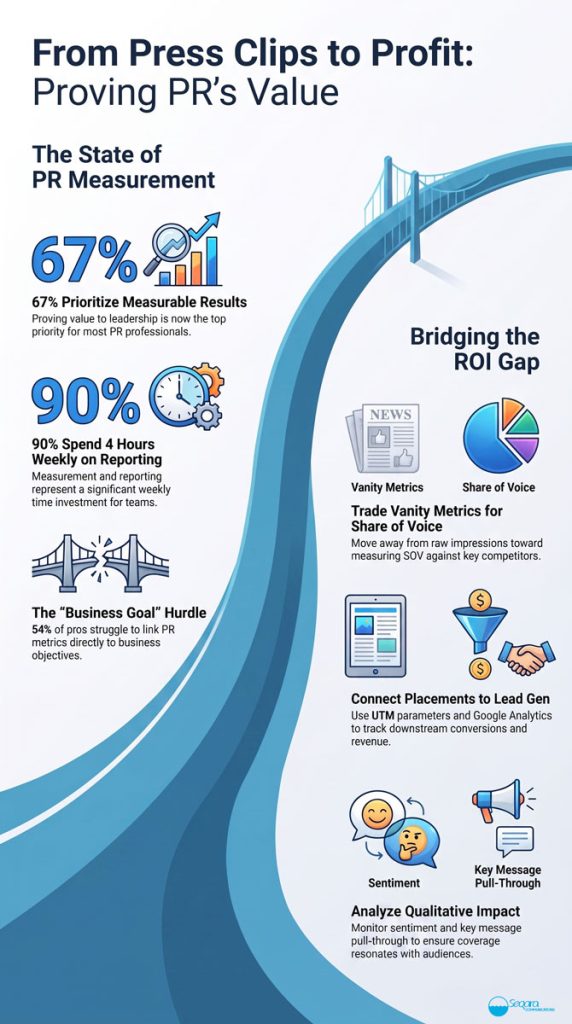
The sheer volume of effort poured into measurement tells its own story about the direction the industry is heading. Research shows that 90% of PR professionals spend up to four hours every single week on media measurement and reporting. For a typical full-time week of 40 hours, that represents up to 10% of working time dedicated exclusively to proving value — not creating it.
This statistic is revealing on multiple levels. First, it underscores that measurement is no longer a quarterly or monthly afterthought. It has become an embedded weekly discipline, woven into the operational rhythm of modern communications teams. Second, it highlights a tension that every PR leader knows intimately: the more time you spend measuring your work, the less time you have to do the work itself. This tension is driving investment in automation, AI-powered monitoring tools, and integrated dashboards that can compress four hours of manual clipping into a fraction of the time.
But the message from the data is clear. PR professionals are voting with their calendars, and they are voting for measurement.
The Ultimate Priority: Measurable Results Over Everything Else
If there were any lingering doubt about what communications professionals believe matters most to leadership, the numbers settle the debate decisively. A striking 67% of PR professionals say that producing measurable results is their absolute top priority for proving value to leadership.
What makes this figure so powerful is what it eclipses. Only 12% of practitioners identified “delivering creative solutions” as their primary value lever with executives. This is not to say creativity has lost its place in PR — far from it. A memorable campaign, a brilliantly timed pitch, or a perfectly crafted narrative remains the engine of earned media. But creativity without measurable impact is now seen as an indulgence rather than an achievement.
The implication is clear: the contemporary PR professional understands that executive audiences speak the language of numbers. A compelling story about a campaign’s cultural resonance will get polite nods; a dashboard showing that earned media placements drove a 23% lift in qualified pipeline will get budget approved.
The Core Challenge: Bridging Two Very Different Worlds
For all the commitment to measurement, significant obstacles remain. 54% of PR professionals cite “managing stakeholder expectations” and “linking PR metrics to business goals” as the greatest challenges they face when measuring and reporting their efforts.
This statistic captures a fundamental tension that sits at the heart of modern communications. On one side sit stakeholders — CMOs, CEOs, CFOs — who increasingly view PR through a performance marketing lens and expect the kind of deterministic attribution they receive from their paid media teams. On the other side sits the reality of earned media: a channel where coverage appears in outlets you do not own, reaches audiences you cannot precisely segment, and generates influence that compounds over time rather than converting in a single click.
Bridging this gap demands more than better tools. It requires PR leaders to become bilingual — fluent in both the nuanced language of reputation and narrative, and the quantitative language of pipelines, conversion rates, and return on investment. The 54% who identify this as their greatest challenge are not failing at measurement. They are grappling with one of the hardest interdisciplinary translation problems in modern business.
What High-Maturity Teams Do Differently
The response from the most sophisticated communications teams has been decisive: abandon isolated vanity metrics in favor of unified reporting frameworks that connect media outputs directly to business outcomes. Three categories of measurement have emerged as essential for any team serious about demonstrating ROI.
Awareness and Reach: Share of Voice as the North Star
Raw impressions — that familiar ten-digit number at the top of a clip report — are increasingly recognized as a hollow metric. A hundred million impressions against an irrelevant audience is worse than useless; it is actively misleading. High-maturity teams have shifted their focus to share of voice (SOV) measured against key competitors. This contextualizes reach within the competitive landscape, answering the question every executive cares about: are we being heard more loudly, more often, and by more of the right people than the companies we are fighting for market share?
SOV analysis also naturally surfaces strategic insights. A declining SOV against a resurgent competitor might trigger a messaging refresh. A commanding SOV in one product category could justify shifting communications resources toward a category where the brand is being drowned out. These are the conversations that earn PR leaders a seat in strategy meetings, not just status updates.
Qualitative Impact: Sentiment and Message Pull-Through
Coverage volume is easy to measure and dangerously easy to misinterpret. A thousand pieces of neutral coverage may do far less for a brand than fifty pieces of genuinely enthusiastic coverage in the outlets that influence purchase decisions. This is why mature measurement frameworks insist on tracking sentiment and key message pull-through.
Sentiment analysis — whether conducted through natural language processing tools or skilled human coding — answers the question: did the coverage actually help us? Message pull-through goes a step further. It measures whether the specific language, themes, and proof points the communications team worked to place in the media actually appeared in the final coverage. A pitch that secured a dozen articles is a win for the media relations team; a pitch where 80% of those articles included the company’s core product differentiators is a win for the business.
Downstream Conversions: Closing the Loop
The most transformative shift in PR measurement is the move toward demonstrating that earned media placements genuinely drive business results. The tools exist: UTM parameters appended to links in press coverage, integrated with platforms like Google Analytics, allow teams to trace website traffic, lead generation, and even revenue impact directly back to individual media placements.
This approach does not promise the kind of last-click attribution that performance marketers often claim (and that even paid media teams increasingly recognize as flawed). But it does bring PR into the attribution conversation on its own terms. When a communications director can show that a feature in The Verge drove 4,700 site visits, 340 demo requests, and an estimated \$85,000 in pipeline value, the conversation with the CFO shifts from “what did we get?” to “how do we get more of this?”
The Path Forward
The statistics paint a picture of an industry in active transformation. PR professionals like SEQARA Communications team are investing significant time in measurement, they are prioritizing measurable results above all other forms of leadership credibility, and they are grappling honestly with the challenge of connecting media outputs to business outcomes.
The teams that succeed in this environment will be those that resist the gravitational pull of easy metrics and commit instead to the harder work of building integrated measurement frameworks. They will track share of voice in competitive context rather than raw impressions. They will measure whether coverage felt right and carried the right messages, not just whether it appeared. And they will do the technical integration work — UTM parameters, analytics dashboards, CRM connections — that makes the link between earned media and revenue visible and defensible.
The gap between press clips and pipeline influence is where reputations are made or lost — not just the reputation of the brands that communications teams represent, but the internal reputation of the communications function itself.
Writer: Adit