
The PR Playbook on Film: 10 Must-Watch Movies That Decode Spin, Strategy, and Story
Overview
Public relations is part persuasion, part psychology, and entirely about shaping narrative. Cinema has been dissecting that dance for decades—sometimes with satire, sometimes with grit, and often with unsettling honesty. Below, I walk through thirteen films that don’t just entertain; they reveal the mechanics of influence, crisis navigation, and reputation—on campaigns, in boardrooms, and across newsrooms.
Thank You for Smoking (2005)
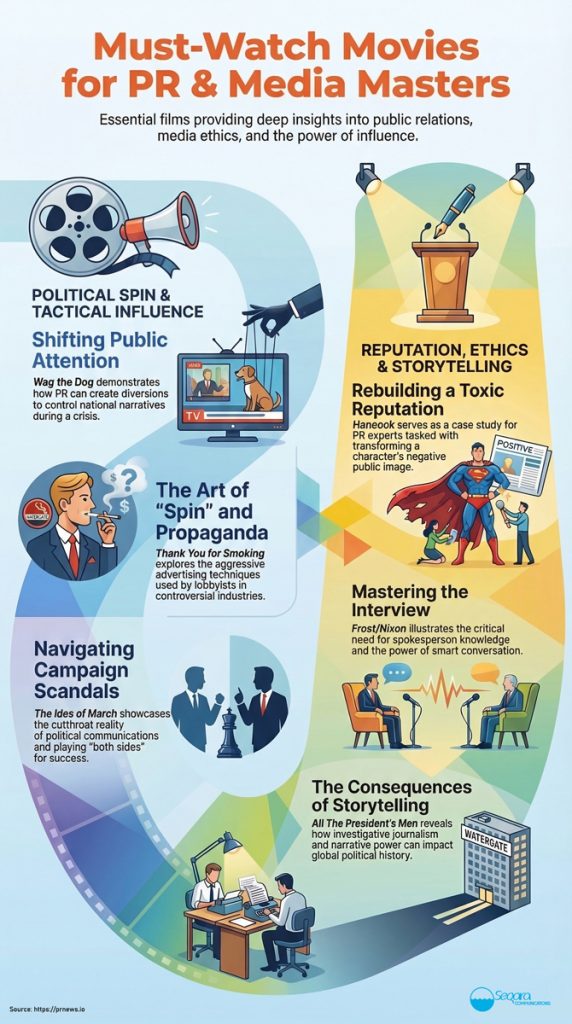
Jason Reitman’s razor-edged satire shadows Nick Naylor, a silver-tongued lobbyist for Big Tobacco whose job is to make the indefensible sound reasonable. The film turns persuasion into a spectator sport—spotlighting framing, reframing, distraction, and moral flexibility—while reminding us that charisma can move the goalposts faster than facts. It’s a master class in message discipline and the ethics quagmire that trails it.
What it teaches
- Crafting frames that redirect blame and soften risk
- Talking-point discipline and the art of the sound bite
- The limits—and costs—of reputation built on controversy
The Ides of March (2011)
A cool, clenched political drama where rising communications star Stephen Meyers learns how quickly ideals buckle under pressure. Spin rooms, leaks, and carefully timed disclosures trace the contour lines of modern campaigns. The film’s heartbeat is a PR truth: credibility is your only real currency—spend it foolishly and you’re broke.
What it teaches
- Crisis triage versus long-term trust
- Back-channeling and agenda setting
- The moral hazards of winning at any cost
Glengarry Glen Ross (1992)
David Mamet’s blistering portrait of sales culture watches desperation turn language into a weapon. The infamous eight-minute monologue—“Always Be Closing”—is a performance in dominance, fear, and motivation. It’s not PR per se, but it underlines how persuasion techniques (like AIDA: Attention, Interest, Desire, Action) can electrify or erode a culture.
What it teaches
- AIDA in its rawest, most coercive form
- Incentives as narrative: how targets script behavior
- The ethical cliff edge between persuasion and manipulation
Wag the Dog (1997)
A political fixer and a Hollywood producer conjure a distraction so grand it swallows the news cycle: a fabricated war, engineered detail by detail. It’s funny until it’s terrifying, illustrating how narrative scaffolding—symbols, visuals, “spontaneous” moments—can redirect public attention at scale.
What it teaches
- Agenda-setting through spectacle
- Building believable falsehoods with concrete details
- The choreography of crisis distraction
Jerry Maguire (1996)
A sports agent grows a conscience, loses everything, then rebuilds on clarity and care. This is relationship management as a redemption arc: one stakeholder, one promise, one brave memo at a time. The movie reframes “PR” as trust, service, and the compounding value of authenticity.
What it teaches
- Stakeholder-first positioning
- Reputation recovery through consistent values
- The ROI of sincerity
Frost/Nixon (2008)
Two men, two agendas, four interviews. This is controlled confrontation as choreography. Watch the prep, the pretext, and the pressure—the slow accrual of small openings that culminate in revelation. For spokespeople, it’s an anatomy lesson in preparation, message bridging, and managing high-stakes contrition.
What it teaches
- Interview strategy and counter-strategy
- The timing of apology and acknowledgment
- Research depth as a competitive edge
Primary Colors (1998)
A fictionalized presidential bid unpacks charisma wrapped around compromise. Behind-the-scenes handlers spin, sand, and recut reality into something more electable. It’s a primer on the soft power of proximity: who crafts the message often matters as much as what the message says.
What it teaches
- Vetting, oppo research, and narrative inoculation
- The invisible labor of comms teams
- Values drift under the heat lamp of ambition
All the President’s Men (1976)
Procedural, patient, relentless. Two reporters follow a thread into the heart of political rot, proving that transparency itself can reshape power. For PR pros, it’s a humbling reminder: the truth has a tempo, and when it lands, your preparedness (or lack thereof) writes the epilogue.
What it teaches
- Source cultivation and verification
- The long arc of reputation risk
- Why stonewalling is a short-term strategy with long-term costs
Hancock (2008)
A superpowered antihero with a public image problem submits to life coaching, rebranding, and contrition. The superhero gloss hides a tidy case study in rebuilding from sentiment data: apologize, change behavior, stage visible service, repeat.
What it teaches
- Image triage and staged redemption
- From sentiment to storyline: turning public feedback into action
- The danger of quick fixes without structural change
The Post (2017)
Publisher Katharine Graham faces a crucible: protect a fragile company or publish the Pentagon Papers and defend the public’s right to know. Leadership, legal risk, and newsroom courage converge. It’s governance meets communications—where values are strategy, not slogan.
What it teaches
- Crisis communication under legal constraint
- Executive decision-making and message alignment
- Purpose as a reputational moat
Almost Famous (2000)
A tender coming-of-age journey doubles as a field guide to access journalism. Backstage passes blur boundaries; proximity jeopardizes objectivity. But there’s also joy: curiosity, empathy, and the sheer love of story that draws many to PR and journalism in the first place.
What it teaches
- Relationship access versus independence
- Ethnographic listening and narrative empathy
- Why passion can power craft—if you set guardrails
How to watch like a PR pro
- Track incentives: Who benefits from each narrative beat?
- Note framing: Which words move the story? Which are never spoken?
- Watch the audience: What do crowds, voters, or customers do in response?
- Separate tactics from values: Could this work—and should it?
By the time you finish this list, you won’t just spot spin; you’ll see the scaffolding that holds it up. And once you see it, you can decide how to use it—or dismantle it.
Writer: Aditya Wardhana