
Trust, Transparency, and the New Playbook for Public Affairs PR
Introduction: Why Trust Now Decides Everything
I’ve learned that in Public Affairs Public Relations (PR), trust isn’t a nice-to-have; it’s the operating system. When the public and policymakers are skeptical—and they are—every message, meeting, and memo is judged through the lens of credibility. In sectors like healthcare, energy, and technology, where stakes are high and oversight is intense, trust becomes the currency that buys both time and permission to act.
Redefining Transparency: From Disclosure to Dialogue
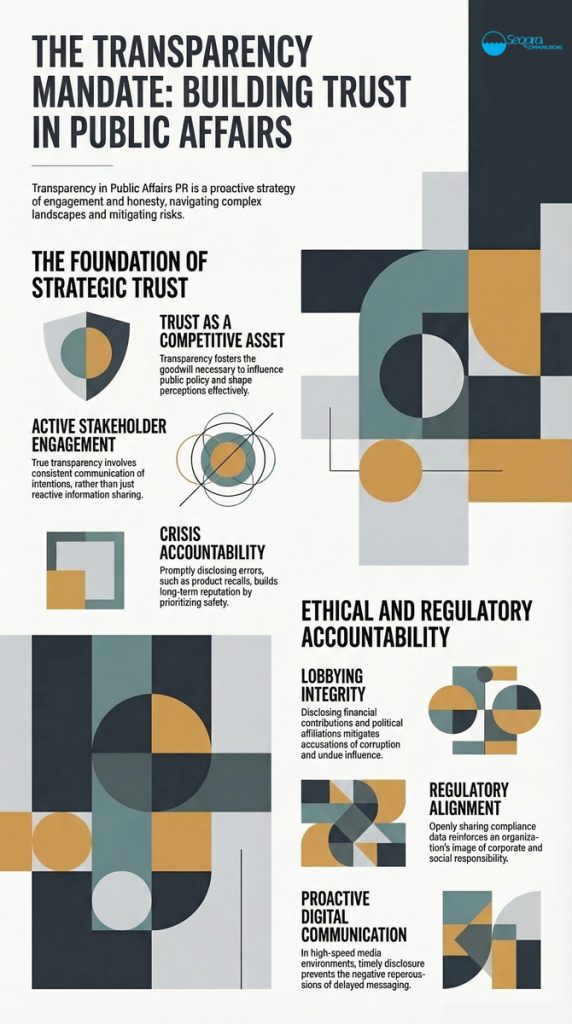
Transparency isn’t a press release or a PDF on a compliance page. It’s the practice of showing your work in public—intentions, trade-offs, and results—then inviting feedback and answering hard questions. That ongoing, two-way flow does three things: it signals good faith, reduces the oxygen for rumor, and steadily compounds trust. With that trust, organizations can influence policy debates, shape perceptions, and cultivate goodwill across stakeholders—from regulators and legislators to communities and customers.
- Be explicit about intentions: why you’re acting, what outcomes you seek, and how you’ll measure progress.
- Keep a consistent cadence: align messages across executive statements, filings, and stakeholder briefings.
- Close the loop: report back on what you heard and what you changed as a result.
Open Communication as a Risk Control
Clear, candid communication is the most reliable hedge against reputational volatility. When addressing regulatory proposals, lobbying priorities, or policy shifts, plain language beats careful vagueness every time. Ambiguity invites suspicion; specificity earns patience.
Consider crises—product recalls, data breaches, environmental incidents. The decisive moment isn’t the incident itself; it’s the timeline of truthful disclosure. Organizations that promptly publish what happened, what’s known and unknown, and what steps are next, demonstrate a bias for responsibility. That posture reframes the narrative from “caught” to “accountable,” which is the foundation of durable reputation.
A practical sequence:
- Acknowledge facts early, even if incomplete; promise updates on a schedule.
- Prioritize safety and public interest over commercial convenience.
- Share corrective actions with verifiable milestones; invite third-party validation.
- Keep communications centralized to prevent contradictions, but diversify channels to meet audiences where they are.
Regulatory and Legal Transparency: Credibility in the Policy Arena
Public Affairs lives where corporate ambition meets public rules. Lobbying, rulemaking comments, coalitions, and testimony all shape that interface. Here, transparency has two jobs: upholding ethics and sustaining credibility.
- Disclose the who, what, and why of advocacy: partners, funding, and intended outcomes.
- Surface potential conflicts of interest before critics do; make recusal and governance protocols visible.
- Publish positions and evidence used in policymaker briefings; submit them to open dockets when possible.
In highly scrutinized domains—environmental standards, healthcare access, data privacy—regulatory transparency isn’t merely about compliance. It’s about demonstrating stewardship. Share impact assessments, explain methodologies, and discuss risks and mitigations in language non-experts can grasp. Doing so turns “trust us” into “verify with us,” which is a far stronger proposition.
The Frictions: Competing Duties in a Fast-Clock World
Organizations juggle legitimate constraints: confidentiality duties, fiduciary obligations, and competitive sensitivities. The challenge is to err toward disclosure without betraying lawful limits.
- Define red, amber, green information categories in advance; pre-clear what can be shared in a crisis.
- Build a rapid review lane with legal, compliance, and policy leads to avoid paralysis.
- Use plain-English summaries alongside technical annexes to prevent misinterpretation.
Digital media compresses time. Silence or hedged language creates a vacuum that adversaries and algorithms will fill. The practical fix is to be proactively transparent: publish FAQs, dashboards, and update logs; timestamp changes; and correct errors publicly. Speed with humility outperforms slowness with perfectionism.
From Buzzword to Backbone: Making Transparency Operational
Turning values into muscle memory requires systems, not slogans.
- Governance: empower a cross-functional transparency council with escalation authority.
- Metrics: track trust-leading indicators—update latency, message consistency, correction visibility, stakeholder sentiment.
- Training: rehearse disclosure scenarios; teach spokespeople to own uncertainty and cite evidence.
- Tools: maintain a single source of truth for statements, data, and commitments with audit trails.
Looking Ahead: The Advantage of Being Understood
Public Affairs PR is moving from persuasion to comprehension—helping stakeholders understand how and why decisions are made. In complex political environments, the organizations that win won’t be the loudest; they’ll be the most legible. Transparency is the strategy that makes legibility possible.
Trust compounds when honesty, openness, and accountability are practiced consistently, not episodically. Done well, transparency guides organizations through policy turbulence, fortifies public goodwill, and aligns enterprise goals with the public interest. That’s not just ethical—it’s effective.
Writer: Aditya Wardhana