
10 PR and Marketing Trends Shaping 2026: How Mission-Driven Brands Will Win
Introduction
I’m stepping into 2026 with a notebook full of experiments that worked—and a candid list of lessons learned. This year, the most effective Public Relations (PR) and marketing teams will double down on strategies that compound: smarter AI (Artificial Intelligence) adoption, creator partnerships that move people to act, rigorous data practices, elevated thought leadership, and measurement that proves outcomes (not just activity). Organizations across nonprofit, education, animal health, food retail, and healthcare are already tightening operations around these pillars, aligning tools and KPIs to what truly matters.
It’s no wonder AI has become foundational. A vast majority of organizations now use AI in at least one function, signaling a rapid shift from “promising” to “practical.” For PR – like SEQARA Communications, comms, and marketing, that means embedding AI into day-to-day workflows while protecting the brand with thoughtful governance. What follows are 10 trends I see defining 2026—and how mission-driven brands can use them to earn attention, build trust, and drive measurable results.
1. AI becomes the backbone of content—under human guardrails
AI now touches every stage of content: research, planning, drafting, personalization, testing, and continuous optimization. The best teams operationalize this with prompt libraries, brand voice guides, editorial QA checklists, and approval workflows. The goal isn’t to replace expertise—it’s to scale it responsibly.
Here’s my rule: automation speeds the routine; experts own the judgment. Organizations that document when and how to use AI, require expert validation, and enforce brand standards will preserve trust while freeing humans to focus on strategy, narrative, and relationships.
2. Thought leadership drives growth—and real influence
In 2026, executives and subject-matter experts are the face—and the filter—of the brand. Expect more incisive LinkedIn articles, op-eds, byliners, podcast appearances, and conference stages that channel experience into practical insight. When leaders speak from lived expertise, they shape policy conversations, catalyze funding, and build durable partnerships.
This only works when it’s intentional. Media training, editorial support, and precise positioning unify voice across earned, owned, social, and paid channels. I’ve seen mission-driven organizations transform credibility by treating thought leadership like a product: researched, iterated, and distributed with purpose.
3. Community storytelling becomes the trust engine
Nothing is more persuasive than first-person impact. In 2026, we’ll see more student, patient, educator, volunteer, researcher, practitioner, and KOL (Key Opinion Leader) narratives at the center of campaigns. Short-form video will remain a staple—not as glossy brand reels but as authentic, well-lit, phone-shot clips that move quickly and feel real.
Pair community voices with expert commentary to strengthen narratives and donor confidence. Build repeatable systems for capturing, clearing, and sharing stories so teams don’t need big budgets or studio gear to publish consistently.
4. AI-shaped search rewards depth, clarity, and authority
Search is shifting from lists of links to AI-generated summaries. To show up, content must be precise, well-sourced, and optimized for question answering. That means addressing specific queries, layering expert analysis, and updating assets frequently to reflect current data and guidance.
Attention to detail wins here: rigorous citations, clear structure, and unmistakable expertise. The more your content demonstrates depth and credibility, the likelier it is to be surfaced—and cited—by AI-driven search experiences.
5. Creators become collaborators, not one-off megaphones
Mission-focused teams are moving past transactional influencer placements toward longer-term creator partnerships rooted in shared values. The difference is measurable: collaborative storytelling sparks sustained engagement—sign-ups, donations, volunteer interest, petitions—not just vanity reach.
Consider how a well-matched creator collaboration can extend an investigation, elevate a petition, and carry a story through podcasts and social. Align incentives, co-create content plans, and define outcome metrics that reflect real behavior.
6. Accessibility upgrades lift UX—and your SEO
Accessibility isn’t a checkbox; it’s good marketing. Alt text, captions, descriptive headers, logical structure, and clear formatting improve discoverability and user experience across devices. Teams are baking fast accessibility checks into production so every asset is inclusive and indexable.
Treat accessibility as part of your SEO (Search Engine Optimization) and content standards. It widens reach, reduces friction, and signals quality to both humans and search engines.
7. First-party data becomes the growth engine
As third-party cookies fade, consented first-party data—collected via loyalty programs, surveys, events, and gated experiences—powers personalization and performance. The mandate: prioritize privacy, secure storage, and transparent value exchange.
Handled responsibly, this data reveals what stakeholders actually need. Use it to refine content, services, and experiences without compromising trust.
8. Measurement gets sharper, smaller, smarter
The dashboard is changing. Teams are ditching volume-only metrics in favor of indicators tied to actions and outcomes: sales, donations, registrations, depth of engagement, and quality of coverage across earned, owned, paid, and social.
This requires better planning and integrated analytics. Build measurement frameworks that connect activities to behavior over time. Pilot new attribution tools. Audit the KPIs (Key Performance Indexes) you reward so teams optimize for impact, not impressions.
9. Trust and transparency set the bar for value
Stakeholders want clarity on how you use AI and data—and candid communication about program results, community impact, and operational choices. Brands that acknowledge challenges, correct quickly, and communicate consistently earn grace when it matters.
Integrity has always been a differentiator. Align your messages with your actions, empower credible experts to speak plainly, and publish content that reflects real work and real outcomes.
10. Hybrid experiences bring stories to life
Virtual and augmented reality are moving from novelty to narrative devices. Paired with on-the-ground events—campus walk-throughs, interactive demos, patient or donor stories—they help audiences feel, not just see, your impact.
In 2026, experiment with ways to measure how these immersive moments affect attendance, engagement depth, and participation. Keep accessibility front and center so innovation doesn’t outpace inclusivity.
How to operationalize these trends now
- Document AI usage, review steps, and escalation paths; train your teams and your models.
- Treat thought leadership as an editorial program with positioning, a content calendar, and media training.
- Build a “community voice” pipeline for short-form video and written narratives with clear consent and QA.
- Rework cornerstone pages for AI search: intent clusters, expert Q&A, and frequent updates.
- Shift creator work to long-term partnerships with outcome-based KPIs.
- Bake accessibility checks into every content workflow.
- Invest in first-party data with explicit value exchange and privacy-first design.
- Redesign measurement: fewer metrics, closer to behavior; integrate PR, SEO, and social data.
- Publish AI and data use statements; share outcomes and learnings regularly.
- Prototype hybrid experiences with clear success criteria and accessibility requirements.
The 2026 mandate
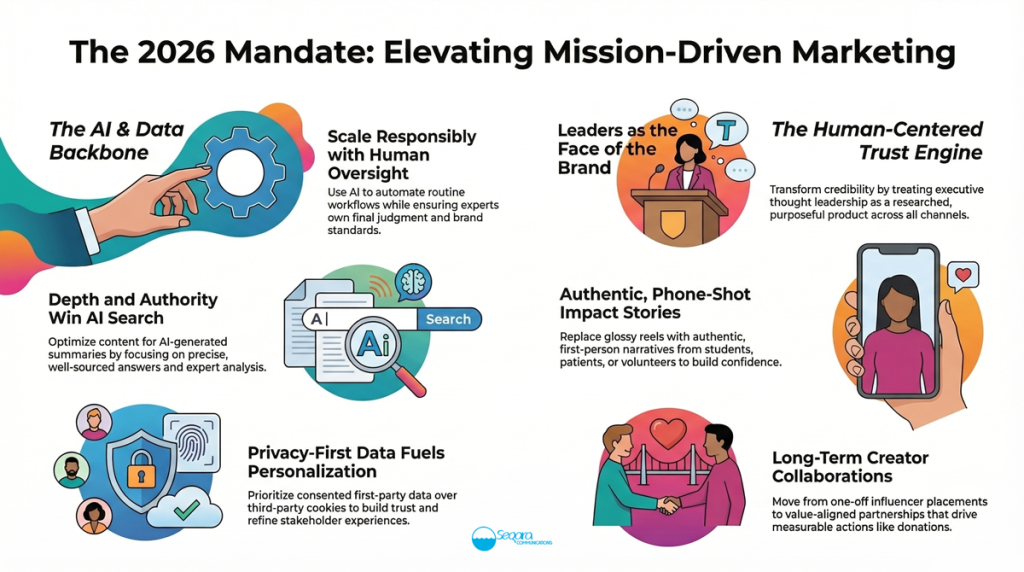
This year is about balance: AI scalability with human oversight, performance with reputation, speed with compliance. The teams that win will treat AI as a teachable copilot, not a substitute for judgment. They’ll integrate PR, SEO, social, KOL programs, and content marketing to grow authority and demand while strengthening trust.
Invest in accessibility, protect data, and communicate transparently about how technology shapes your work. Pair all of that with authentic storytelling and you’ll deepen stakeholder involvement throughout 2026.
Writer: Aditya Wardhana