
Why Most Crisis Plans Fail: 5 Hard Truths About Surviving a Brand Meltdown
The Hook: The 24-Hour Myth
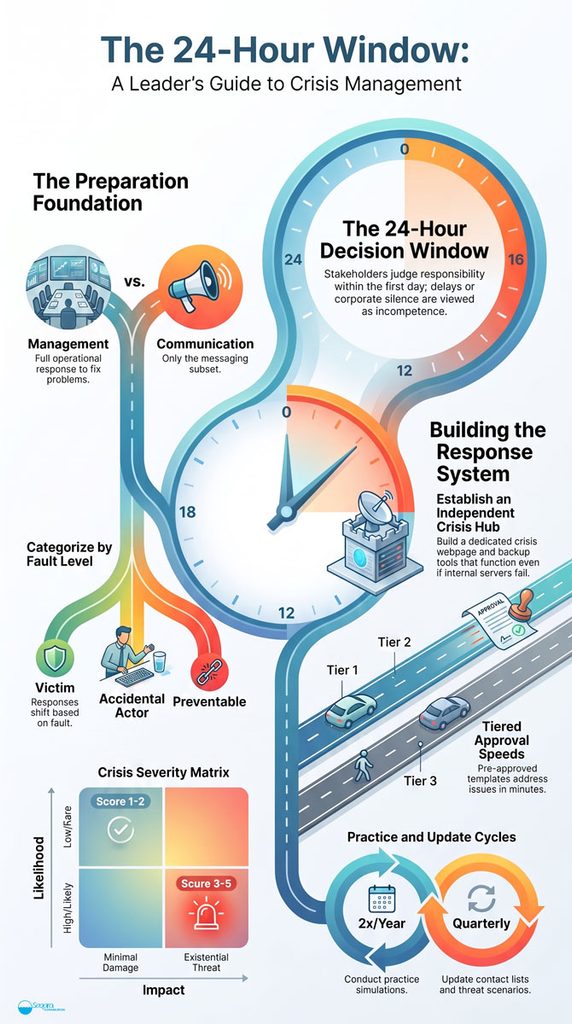
In modern crisis management, the first 24 hours are not for solving the problem; they are for determining who owns the narrative. In an era where social media moves at the speed of a refresh button, silence isn’t a strategy—it’s a confession. When a brand stays quiet, the public fills the void with their own version of the truth.
Take the 2025 “preventable leadership crisis” at Astronomer. When executive misconduct went viral, the organization burned its first 24 hours navigating internal basics and debating initial steps. By the time they were ready to speak, the internet had already acted as judge, jury, and executioner. If you aren’t visible and prepared with a clear activation trigger the moment a high-threat scenario breaks, you aren’t just losing the narrative; you’ve already surrendered it.
Takeaway 1: You Aren’t Solving the Problem, You’re Managing the Judgment
The first 24 hours of any crisis are dedicated to public judgment. According to Situational Crisis Communication Theory, the public categorizes your crisis into one of three buckets: Victim (natural disasters), Accidental (technical glitches), or Preventable (leadership scandals or cutting corners). This categorization happens instantly and dictates the level of outrage you face.
If you are perceived to be in the “Preventable” bucket—as Astronomer was—the public expects an immediate apology and accountability, not “corporate riddles” or defensive stalling. Waiting for internal consensus leads to fatal delays.
“The first 24 hours of a crisis decide if you’re managing the situation or getting managed by it.”
To survive, you must pivot from “technical problem solving” to “managing the perception of control.” This requires moving away from slow, defensive approval chains and toward immediate, honest acknowledgment based on the specific type of fault.
Takeaway 2: Your Scheduled Content is a Ticking Time Bomb
One of the fastest ways to destroy brand equity is to appear tone-deaf. If your company is reeling from a data breach or a safety failure, yet your social media accounts are still pushing “Happy Monday” promotions, you look like an opportunistic profiteer.
A functional crisis plan requires a Content Pause Protocol, also known as a “Kill Switch.” This is the technical ability to immediately freeze all pre-scheduled emails, social posts, and automated campaigns.
The Technical Crisis Infrastructure To maintain a “living” response even if internal servers crash, a Reputation Architect ensures the following tools are deployed:
- A Dedicated Crisis Hub: A standalone URL (e.g., yourcompany.com/crisis-updates) with pre-set admin access that can be updated independently of the main site.
- Professional Monitoring & Mass Notification: Utilize high-authority platforms like Brandwatch or Meltwater for sentiment tracking, and Everbridge or AlertMedia to ensure internal messages reach every employee with read receipts.
- Cloud-Stored Plans: Crisis playbooks must live on Google Drive or Dropbox so they are accessible when the office network is unreachable.
Takeaway 3: Legal Safety is Often Reputational Suicide
There is a permanent tension between legal teams and reputation architects. Lawyers are trained to minimize liability, which often results in a recommendation of silence. However, while silence is legally safe, it is rarely the right move for maintaining trust.
“Silence during a crisis sends a message too, and rarely a good one.”
Reputational longevity requires honesty under pressure. Legacy brands like Johnson & Johnson (Tylenol) and KFC (chicken shortage) maintained their status by admitting what they didn’t know and taking visible, immediate action. Your response must feel like an act of leadership, not a legal disclaimer.
Takeaway 4: Your Employees Are Your Most Dangerous (or Powerful) Channel
The “Internal First” rule is non-negotiable. Your employees should never learn about a company crisis from a news alert or a social media thread. If they are left in the dark, they become a primary source of chaos, inadvertently spreading misinformation. If they are informed, they become your most credible advocates.
Internal Employee Messages Before an external statement is released, internal messaging must be distributed via mass notification systems. This communication should include the confirmed facts, specific instructions on where to funnel external inquiries, and a clear timeline for the next update.
Takeaway 5: Speed Requires a “Tiered” Permission Slip
Traditional, multi-department approval chains are why companies lose control. To move at the speed of the internet, you must utilize Pre-Approved Templates—legal-cleared drafts where you only fill in the specifics during the event. These templates enable Tiered Approval Levels:
- Tier 1 (Immediate): The spokesperson posts immediately using pre-approved templates for minor issues like service outages.
- Tier 2 (30-Minute Window): The Crisis Lead approves responses for customer incidents or moderate PR issues.
- Tier 3 (Executive Review): The CEO and legal counsel sign off only on high-stakes matters such as major safety issues or regulatory violations.
This structure allows your team to follow a playbook instead of inventing a strategy while the building is on fire.
The “Bot” Filter: Separating Real Outrage from Noise
Not all digital noise is a crisis. Before pivoting your entire strategy, use Advanced Search to filter by account age and posting patterns. Real customers have established accounts with varied histories. Manufactured outrage—or “bot” campaigns—typically features:
- Generic/alphanumeric usernames and recent creation dates.
- Low follower counts and repetitive, copy-pasted messaging.
Distinguishing between genuine stakeholder pain and a coordinated bot attack allows for a targeted, clinical response rather than a reactive over-correction.
Closing: The Price of Preparation
A plan built under pressure is not a strategy; it is merely damage control. True crisis management is an investment made months before the emergency. Failure to prepare doesn’t just hurt your immediate stock price; it creates a “long tail” of damage—a permanent search result legacy that affects future hiring, contracts, and partnerships for years.
Is your team equipped to handle the first 24 hours of your next inevitable meltdown? If your plan is a static document sitting on a server you haven’t tested in a year, you are not prepared.
“The difference isn’t what went wrong. It’s how visible your control was when things broke.”