
Crisis Communications After the Algorithm Shift: What PR Leaders Need to Know in 2026
Why the Old Playbook Broke—and What Replaces It
Crisis communication no longer moves in neat stages. Facts don’t lead, context rarely arrives first, and what “happens” matters less than what the platforms choose to elevate. The feed—its dials, incentives, and timing—decides what rises, what spreads, and what explodes. If that makes you uneasy, good. In 2026, unease is a healthy strategic reflex.
I’ve come to accept a hard truth: crises are now algorithmic events disguised as reputational ones. To lead well, we don’t fight that reality—we design for it.
1) Algorithms Reward Conflict, Not Clarity
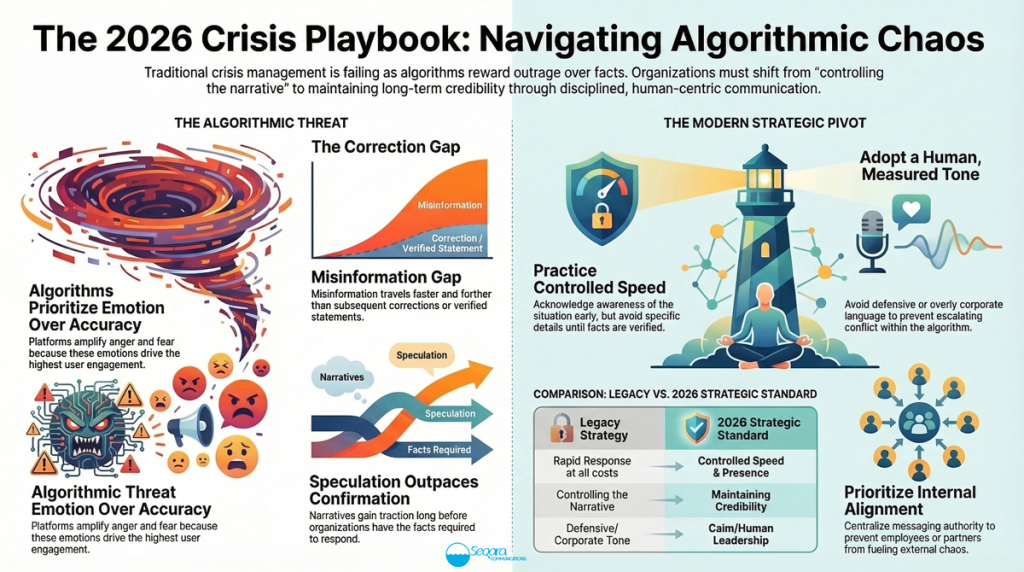
Social platforms optimize for engagement, and engagement loves emotion. Anger, fear, and outrage sprint; verified information jogs. In the window when attention is forming, speculation outpaces confirmation, emotion beats accuracy, and partial narratives lock into place before an organization can even convene its first call.
- What this means in practice:
- Treat early attention as volatile fuel. Don’t add sparks you can’t control.
- Assume the first narrative is sticky—even if it’s wrong.
- Prepare for uneven distribution: fringe claims can gain mainstream reach in minutes.
The reputational terrain is set before the facts are settled. Plan accordingly.
2) Speed Isn’t the Edge—Control Is
For years, we worshiped speed. Today, reflexive speed is a liability. Responding too fast with partial data breeds misinformation. Silence without a plan creates a vacuum. Overcorrection burns credibility you’ll need later.
- The new operating standard: controlled speed.
- Acknowledge awareness quickly—without speculating.
- Hold details until they’re verified by two independent internal sources.
- Commit to a predictable cadence of updates via official channels only.
- Timestamp everything; it anchors expectation and reduces rumor churn.
Be present. Don’t guess.
3) Tone Is Half the Message
Algorithms don’t just amplify content; they amplify affect. Defensive language inflames. Corporate jargon reads as evasive. Over-casual notes trivialize harm.
- The effective 2026 tone is calm, human, and measured.
- Show concern without hypothesizing causes.
- Avoid absolutes and premature assurances.
- Name uncertainty and what you’re doing to reduce it.
Tone should signal leadership, not reactivity. If your copy sounds like legalese or adrenaline, rewrite it.
4) Practice Intentional Transparency
Transparency isn’t “say everything now.” It’s clarity about what’s known, unknown, and next. Oversharing early traps you in statements that may age poorly—and algorithms punish inconsistency more than delay.
- Components of intentional transparency:
- State only confirmed facts; separate facts from in-progress inquiries.
- Explain process without assigning blame.
- Provide a timeline for the next update and the channel you’ll use.
- Correct misinformation once you have verified contradictory evidence.
Precision today protects credibility tomorrow.
5) Treat Misinformation Like a Triage Problem
Bad information outruns corrections, almost always. You won’t reverse every falsehood, so you must choose your battles.
- Build a proactive monitoring and triage routine:
- Map narratives and track momentum by reach and resonance, not just volume.
- Decide response tiers: quiet outreach, community reply, formal statement, or no action.
- Intervene where corrections will actually be seen by the affected audience.
Not every rumor deserves oxygen. Strategy beats ubiquity.
6) Align Internally Before You Amplify Externally
In an algorithmic crisis, internal misalignment becomes external within minutes. Employees post, partners speculate, and unofficial voices fill gaps.
- Safeguards that reduce chaos:
- Issue clear holding statements and FAQs for staff first.
- Provide simple social media guardrails and a single escalation path.
- Centralize message authority; version-control all external copy.
Internal clarity is your first reputational moat.
7) Evolve Preparedness for Platform Dynamics
Traditional crisis plans were built for reporters and press cycles. Today’s plans must anticipate platform behavior under stress.
- Modern planning checklist:
- Define trigger thresholds for respond/monitor/silence.
- Pre-build channel-specific templates and asset kits.
- Stand up real-time monitoring with cross-functional analysts.
- War-game algorithmic amplification scenarios and dry-run decisions.
Preparedness is now a systems discipline, not a press discipline.
The Bottom Line
In 2026, systems reward emotion and speed. Our (SEQARA Communications) job is to slow decisions, tighten language, and communicate with discipline. The goal isn’t to control the narrative—that era’s gone. The goal is to maintain credibility while information outruns verification. In an algorithm-driven world, judgment is your rarest, most valuable crisis asset.

Writer: Aditya Wardhana