
The Speed of Silence: What the Latest Crisis Communications Data Reveals About Brand Survival
In the summer of 2026, corporate crisis management finds itself at a paradoxical moment. The tools for monitoring, detecting, and responding to reputational threats have never been more sophisticated — yet organizational readiness is quietly eroding. A constellation of new data from Sprout Social, PwC, and industry-wide surveys paints a picture that should concern every communications professional: the gap between the speed of a crisis and the speed of a corporate response is widening, and consumers are less forgiving than ever.
The Preparedness Gap: Confidence Without Capability
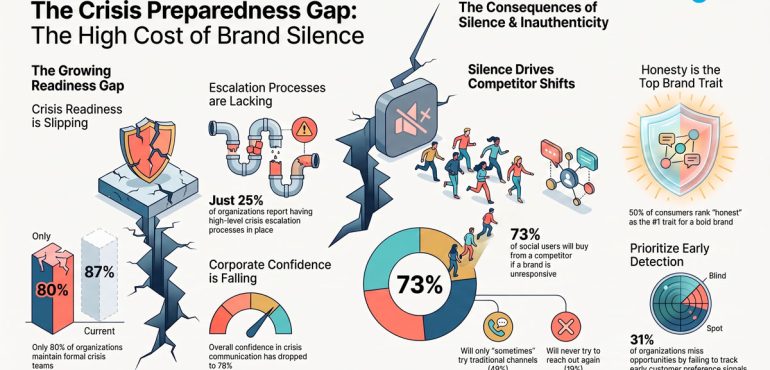
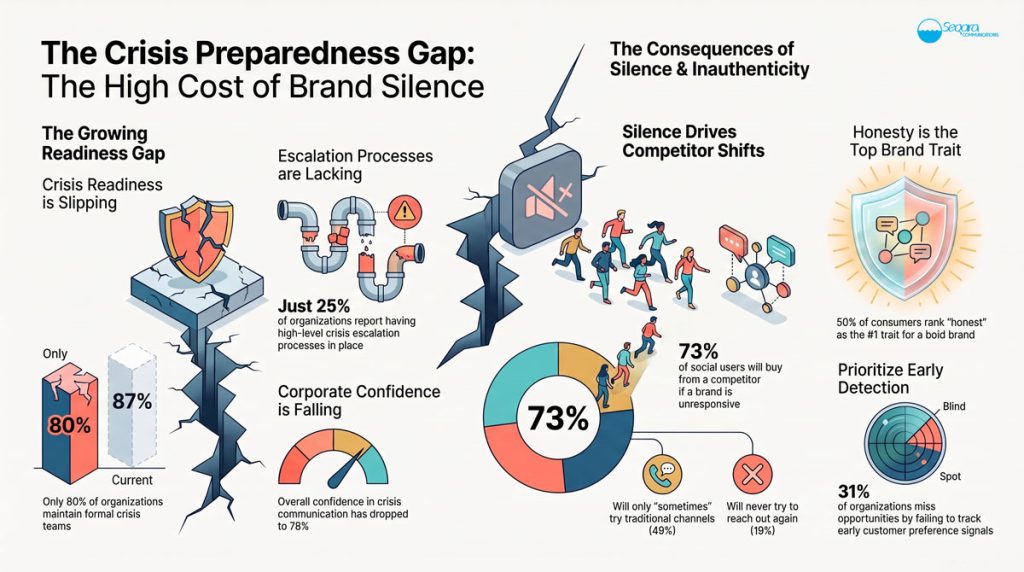
On the surface, corporate crisis readiness appears stable. But dig into the numbers and a more troubling trend emerges. Only 80% of organizations maintain formal crisis teams today, down from 87% in 2024 — a seven-point decline in a single year that suggests crisis infrastructure is being deprioritized or absorbed into broader operational functions. More striking still: just 25% of organizations report having the highest level of crisis escalation processes in place. Three-quarters of companies, in other words, are operating with less than optimal response protocols.
Overall corporate confidence in crisis communication has slipped to 78%. While that figure might not seem alarming in isolation, it represents a meaningful retreat from previous years, and it arrives at a time when the consequences of poor crisis response have never been more severe. The confidence gap is not a communication problem — it is a structural one. Organizations know the stakes; they simply have not built the scaffolding to meet them.
This erosion is not happening in a vacuum. A 2026 report from the AMW Group highlights that crisis response times, AI monitoring adoption, and the financial impact of social media crises are all areas where the majority of companies remain underprepared . Meanwhile, PwC’s Global Centre for Crisis and Resilience has pointed to an increasingly complex risk landscape — from supply chain disruptions to cyber incidents to cultural flashpoints — that demands always-on readiness that most organizations lack.
The Cost of Silence: When Brands Go Dark
If preparedness is slipping, consumer expectations are not. New data from the Sprout Social Q2 2025 Consumer Pulse Survey delivers a stark warning to brands that treat responsiveness as optional. When a brand is unresponsive on social media, 49% of users say they will only sometimes try reaching out through traditional channels — and 19% say they never will. That is nearly one in five customers permanently lost to silence.
The commercial consequences are even more direct: 73% of social media users agree that if a brand does not respond to them on social channels, they will actively buy from a competitor next time. The math is brutal. A single ignored message does not just cost a company one interaction — it can cost a lifetime of transactions. In an era where switching costs between brands have never been lower, responsiveness is not merely a customer service metric; it is a retention strategy with direct revenue implications.
What makes this data particularly urgent is that it reflects a broader shift in how consumers navigate their relationships with brands. The Sprout Social Index reveals that 40% of social users think brands should jump on trends, while 33% find it embarrassing — a split that underscores just how difficult the authenticity calculus has become . The margin for error is razor-thin, and silence — whether strategic or accidental — lands squarely on the wrong side of it.
The Intelligence Gap: Signals Missed, Opportunities Lost
One of the most consequential findings in the recent data concerns early detection. According to Sprout’s Social Intelligence Report, 31% of organizations admit they have missed opportunities because they failed to detect early signals of changing customer preferences. Another 26% cite escalated customer issues that could have been mitigated earlier — problems that simmered beneath the surface until they boiled over into full-blown crises.
These numbers point to what Sprout has termed an “intelligence gap”: 86% of organizations missed opportunities due to delayed or siloed insights, while only 10% can act on real-time data within hours . That statistic alone is sobering. In a landscape where a brand crisis can unfold in minutes, the overwhelming majority of companies are operating on a timeline measured in days or even weeks.
The 2026 Social Intelligence Report underscores a clear consensus among professionals: 93% now see social intelligence as essential for future growth . And yet, the gap between recognizing its importance and operationalizing it remains vast. Social listening — the practice of tracking mentions, sentiment, and emerging themes — has graduated from a nice-to-have to a must-have, but implementation lags behind awareness.
Authenticity as Armor: The “Honest” Imperative
If crisis readiness is the defensive strategy, authenticity is the offensive one. And here, the data speaks with unusual clarity. Fifty percent of consumers rank “honest” as the number one trait they associate with a “bold” brand. They also agree — emphatically — that brands should stop using “salesy” and “corporate” messaging.
This is not a minor stylistic preference. It is a fundamental rejection of the voice that dominated brand communications for decades. The press release cadence, the legal-department-vetted phrasing, the carefully hedged language — all of it registers to modern audiences as inauthentic, and inauthenticity in a crisis is fatal. A brand that sounds like a committee during a moment that demands human clarity will lose the narrative, no matter how defensible its position may be.
The implications for crisis communications are profound. Traditional crisis playbooks emphasize caution: say as little as possible, stick to approved talking points, and avoid setting precedents. But in an environment where 50% of consumers are actively scanning for honesty, and 73% will punish unresponsiveness by taking their business elsewhere, the cautious approach is increasingly the risky one.
Rewriting the Crisis Playbook
What emerges from this data is not a call for panic but a call for re-evaluation. The crisis communications landscape of 2026 demands three shifts in how organizations think about reputation and response.
First, speed must be treated as a structural priority, not a rhetorical one. The seven-point decline in formal crisis teams suggests that organizations are conflating the presence of social media managers with crisis readiness. They are not the same thing. A crisis team needs clear escalation pathways, pre-approved response frameworks, and — crucially — the authority to act without multi-day approval chains. Only 25% of organizations have this today. The other 75% are betting their reputations that a crisis will not strike during the wrong part of the approval cycle.
Second, responsiveness must be recognized as a revenue function. When 73% of users say they will switch to a competitor after being ignored, silence ceases to be a public relations issue and becomes a commercial liability. Customer service, social media engagement, and crisis response are no longer separate disciplines — they are three facets of the same imperative: be present, be prompt, be human.
Third, authenticity is not a tone; it is a discipline. The demand for honesty and the rejection of corporate-speak mean that every piece of crisis communication must pass a simple test: would a reasonable person find this to be a truthful, straightforward account of what happened and what the company is doing about it? If the answer is no, polishing the language will not save it.
The numbers are unambiguous: organizations that invest in early detection, empower rapid response, and commit to authentic communication will navigate the crises of the late 2020s. Those that don’t will learn the most expensive lesson in modern brand management — that in an age of instantaneous judgment, silence is the loudest statement a company can make.
Writer: Adit