
131 AI Statistics and Trends Shaping 2026: What Businesses, Educators, and Consumers Need to Know
Introduction
Artificial Intelligence isn’t a distant buzzword anymore—it’s the operating system of modern life. In 2026, I’m watching AI move from pilots and proofs-of-concept to production at scale, touching everything from supply chains and classrooms to our playlists and healthcare visits. This feature distills 131 data points and trends from National University into a practical field guide: where adoption is real, where anxiety is warranted, and how to turn noise into strategy.
AI Adoption: From Experiment to Enterprise Muscle
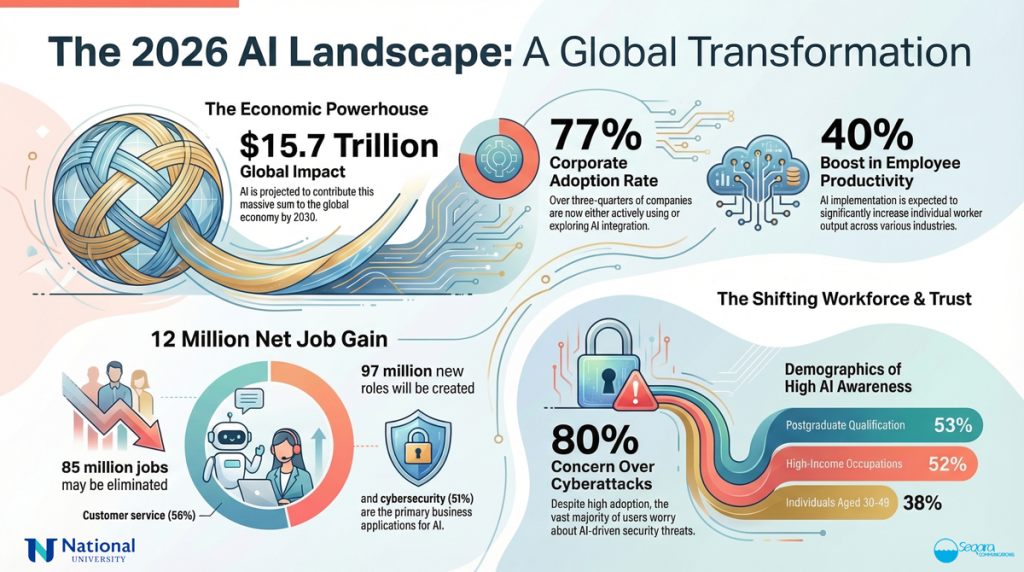
- 77% of companies are using or actively exploring AI, and 83% now treat it as a strategic priority. Translation: pilots have budgets.
- Nearly 2 in 3 organizations plan to expand AI globally in the next three years, and the market is compounding at triple-digit rates in some segments.
- Devices are already quietly intelligent—about three-quarters contain some form of AI. That’s recommendation engines, spam filters, and on-device inference doing daily, invisible work.
- Competitive edge is the motivator: 9 in 10 organizations say AI is essential for staying ahead.
- Economic horizon: AI’s contribution to global GDP by 2030 is projected in the tens of trillions, even as job churn accelerates.
What I’m telling leaders: treat AI like cloud—central platform, distributed enablement, strong guardrails.
Fast Facts to Anchor Your Roadmap
- AI market momentum remains steep, with YoY growth in the 30%+ range globally and specific categories growing >120%.
- Perception gap: only a third of consumers think they use AI; actual usage sits near three-quarters when you count assistants, filters, and recommendations.
- Generative AI still confuses non-users—nearly 9 in 10 are unsure how it will affect their lives.
- Workforce reshuffle: automation displaces roles and creates new ones, netting job growth in aggregate but requiring reskilling at scale.
My rule of thumb: design for augmentation first; automate only when quality and safety are provably superior.
Who Uses AI—and How Often
- Awareness skews toward Asians, men, ages 30–49, postgraduates, and higher-income earners. Political affiliation also nudges familiarity.
- By age, weekly use clusters around virtual assistants—surprisingly strong even among 61+.
- Gender patterns are nuanced: men show slightly higher awareness; women report broader monthly usage in practical tools like assistants and wearables.
- Many young adults haven’t tried large language models yet—exposure isn’t the same as adoption.
Implication: onboarding beats evangelizing. Make first-run experiences concrete, private by default, and immediately useful.
Where AI Works in Business Today
- Leading enterprise applications: customer service, cybersecurity/fraud, digital assistants, CRM, and inventory optimization.
- Sectors out front: IT/telecom and automotive; manufacturing shows the largest long-term value pool.
- Productivity lift is the throughline. Employers expect sizable gains; employees remain split, with over half worried about replacement.
- Functions most transformed so far: software development, marketing, and customer service.
Playbook I use:
- Start with a high-volume, rules-heavy process (tickets, claims, routing).
- Instrument quality tightly (golden datasets, human-in-the-loop, A/Bs).
- Scale only after reliability, latency, and cost stabilize.
Jobs: Disruption with a Direction
- The hottest postings: data engineers, data scientists, analysts, ML engineers, and applied/research scientists—plus a growing wave of analytics engineers.
- Productivity gains could add over a percentage point to labor growth over a decade, but only with training. Expect role redesign, not just headcount change.
- Practical advice: build “AI-adjacent” skills—prompting with structure, retrieval design, data quality ops, evaluation—and pair them with domain expertise.
Career ladder I recommend:
- Foundation: SQL, Python, data modeling, version control.
- Systems: API design, orchestration, vector stores, eval harnesses.
- Governance: privacy, model risk, red-teaming, audit trails.
- Communication: decision memos, UX for assistants, stakeholder education.
AI in Education: Running to Catch Up
- Teachers mostly agree AI belongs in curricula, yet the vast majority report no formal training.
- Parents are optimistic about potential but anxious about privacy and accuracy; few have had structured AI talks with their kids.
- Awareness correlates with education and income; that gap risks compounding inequality.
What schools can do now:
- Create age-banded AI literacy standards (safety, bias, prompts, citations).
- Offer teacher PD with classroom-ready templates and assessment rubrics.
- Deploy district-safe tools: data minimization, opt-outs, transparent logging.
Owners and Operators: The Adoption Front Line
- More than half of companies plan to add AI; about a third already use it. Exploration rates are high, but cost and capability gaps block progress.
- Top concerns: budget, tech dependency, and in-house skills. Top hopes: better customer relationships and productivity.
- For ChatGPT-like tools, owners expect gains in response generation, content speed, personalization, and summarization—plus workflow streamlining.
30–60–90 plan I use with SMBs:
- 30 days: map 10 workflows; pick 2 pilots with clear KPIs; document policies.
- 60 days: ship internal copilot (email, docs); instrument red flags; train staff.
- 90 days: expand to customer touchpoints; integrate with CRM; review ROI and risk.
Consumers: Quietly Surrounded by AI
- Everyday uses: replying to messages, basic finance Q&A, trip planning, writing help, interview prep, and summarization.
- At work: spam filters and customer-service bots dominate.
- At home: assistants, wearables, and algorithmic recommendations anchor routine engagement.
Design takeaway: the best consumer AI feels assistive, fast, and reversible—undo is a trust feature.
Trust: The Fragile Center
- Half of consumers feel optimistic; many say they can spot AI content, and a majority would try AI over search for some tasks.
- People trust companies using AI when benefits are clear and controls are visible—but security anxiety runs high.
- Risks that worry users most: cyberattacks, identity theft, and manipulative political content.
- In healthcare, openness rises when outcomes and error reduction are demonstrated, and bias mitigation is explicit.
Trust playbook:
- Default to transparency: data use, model scope, and known limits.
- Offer granular controls, local processing where possible, and clear recourse.
- Prove value with measurable quality improvements, not just novelty.
Regulation and Assurance: From Principles to Practice
- Public support for AI safety standards, independent assurance, and pre-market transparency is overwhelming across parties and generations.
- People want AI that assists and empowers; they also want liability clarity and auditability.
How to operationalize:
- Adopt model risk management: inventories, impact assessments, and change logs.
- Align with emerging standards (safety cases, red-team reports, incident response).
- Build an internal “model facts label” for every deployment.
A Practical 2026 AI Action Framework
- Strategy
- Define 3–5 business outcomes where AI is the best lever (revenue, cost, risk, experience).
- Create a platform team for shared services: data, model hosting, security, and evaluations.
- Data
- Prioritize quality over volume: lineage, PII minimization, and feedback loops.
- Invest in retrieval architectures before custom model training.
- Product
- Ship thin slices: one workflow, one metric, weekly iterations.
- Add affordances: edit, cite, compare, and escalate to humans.
- People
- Upskill with role-based curricula; incentivize adoption with saved-time budgets.
- Set clear boundaries for AI outputs in compliance-heavy tasks.
- Governance
- Document decisions; log prompts and model versions; test for bias and drift.
- Establish incident hotlines for model misbehavior and security.
Conclusion
AI’s center of gravity in 2026 is pragmatic value—less hype, more shipping. The statistics tell a consistent story: adoption is broad, usage is often invisible, productivity upside is real, and trust hinges on safety and clarity. My advice is simple: pick durable problems, measure relentlessly, communicate openly, and design for humans first. That’s how National University turn 131 data points into better products, better jobs, and better days.
Sources:
- https://www.authorityhacker.com/ai-statistics/
- https://explodingtopics.com/blog/ai-statistics
- https://www.pwc.com/us/en/tech-effect/ai-analytics/ai-predictions.html
- https://www.forbes.com/sites/falonfatemi/2019/05/29/3-ways-artificial-intelligence-is-transforming-business-operations/?sh=5634fedc6036
- https://www.statista.com/topics/11516/artificial-intelligence-ai-in-labor-and-productivity/#topicOverview
- https://www.gartner.com/en/newsroom/press-releases/2023-10-03-gartner-poll-finds-55-percent-of-organizations-are-in-piloting-or-production-mode-with-generative-ai
- https://www.mitre.org/news-insights/news-release/public-trust-ai-technology-declines-amid-release-consumer-ai-tools
- https://www.forbes.com/advisor/business/ai-statistics/
- https://www.aiprm.com/ai-statistics/
- https://www.agilitypr.com/pr-news/public-relations/ai-super-users-new-research-asserts-that-about-one-sixth-of-the-general-population-uses-generative-ai-every-day-are-you-among-them/
- https://explodingtopics.com/blog/companies-using-ai
- https://www.pewresearch.org/science/2023/02/15/public-awareness-of-artificial-intelligence-in-everyday-activities/