

6 Critical Times to Deploy Strategic Public Relations
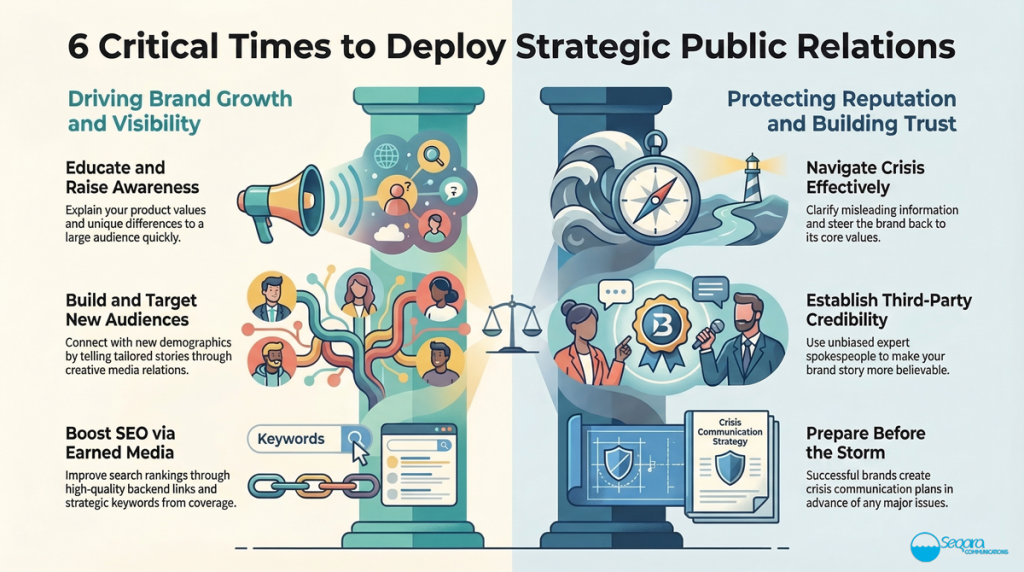
When should I step on the Public Relations (PR) gas pedal? I ask myself this every quarter. Strategic public relations isn’t a constant megaphone—it’s a timing game. Deployed at the right moments, it shapes perception, opens doors, and compounds ROI (return on investment) long after the press cycle ends. Here are six critical inflection points from SEQARA Communications’ perspective when turning on PR delivers outsized value.
1) Educate and Raise Awareness
Education is the quiet engine of market creation. When I’m introducing a new category, reframing a misunderstood problem, or making a complex idea simple, PR becomes my syllabus.
- Start with the “why”: define the stakes, the pain, the status quo’s limits.
- Translate jargon into stories: use plain language, vivid analogies, and real user outcomes.
- Program a cadence: thought-leadership bylines, explainers, webinars, and panels that ladder into a narrative arc.
- Make editors’ jobs easy: data cuts, visuals, and quotable lines that carry.
Success signals: growing share of voice, inbound questions that mirror your key messages, and peers adopting your vocabulary.
2) Build and Target New Audiences
PR is a precision instrument when I’m expanding into fresh segments or geographies. I tailor the message to their motivations and the channels they trust.
- Map personas and their media diets: niche trade outlets, newsletters, podcasts, and local press.
- Craft segment-specific proof: case studies, pilots, and partnerships that resonate in their context.
- Borrow reach: co-author pieces with influencers, customers, or respected associations.
- Localize: adjust references, regulations, and cultural cues without diluting core positioning.
Watch for: new referral sources, upticks from targeted regions, and community invitations I didn’t ask for.
3) Boost SEO via Earned Media
Earned media is the unfair advantage I can’t buy at scale. Authoritative coverage compounds search visibility while building reputation.
- Keyword-informed pitching: align story angles with high-intent, mid-funnel queries.
- Anchor assets: publish data reports, tools, or studies journalists want to cite.
- Digital hygiene: ensure the newsroom, founder bios, and media kit are indexable and fast.
- Repurpose with restraint: syndicate to owned channels, but keep canonical references clear.
Outcomes: quality backlinks, richer SERP (Search Engine Results Page) features, and brand queries that lift all channels.
4) Navigate Crisis Effectively
In a storm, silence writes its own headline. I build a disciplined response that acknowledges impact, centers people, and moves facts faster than rumors.
- Form the core team: legal, communications, operations, and an empowered exec.
- Triage the facts: what we know, what we don’t, and what we’re doing next.
Communication pillars:
- Empathy first, precision always.
- Single source of truth updated on a cadence.
- Spokesperson training and media monitoring in real time.
- Post-crisis debrief with public commitments.
Measure by: resolution time, sentiment recovery, and whether stakeholders repeat your framing—not the speculators’.
5) Establish Third-Party Credibility
Trust accelerates everything. When I need to shorten sales cycles or reassure regulators, third-party validation is my shortcut.
- Target validators: analysts, academics, standards bodies, auditors, and respected journalists.
- Offer auditable substance: publish methodologies, open up sandbox access, and invite peer review.
- Activate social proof: customer quotes, independent rankings, and awards that matter (not pay-to-play).
- Maintain consistency: what you claim, what reviewers find, and what users experience must rhyme.
Proof of progress: fewer objections, stronger close rates, and stakeholders citing external sources on your behalf.
6) Prepare Before the Crisis Storm
The best crisis PR begins in calm weather. I treat preparedness as a product that ships before I ever need it.
- Scenario planning: build playbooks for top risks with message templates and approval trees.
- Stakeholder maps: who needs to hear what, in which order, via which channel.
- Dark sites and assets: prebuilt webpages, FAQs, and visuals ready to publish in minutes.
- Simulation drills: practice with time-boxed exercises and brutal after-action reviews.
Readiness indicators: on-call roles defined, contact trees tested, and muscle memory that keeps the team steady under pressure.
Putting It All Together
PR isn’t a once-a-year campaign—it’s an operating system for reputation. I time my efforts to the business clock: teach when the market is learning, target when expansion beckons, earn citations to power discovery, respond with clarity when the seas get rough, borrow credibility to speed trust, and rehearse before lightning strikes. When I do, I don’t just chase headlines; I compound trust.
Writer: Aditya Wardhana