
The PR Metrics That Matter: Public Relations Statistics Defining 2026
The numbers don’t lie. Public Relations (PR) in 2026 has shed its old skin — the one that measured success in press clippings and gut instinct — and stepped into something sharper, faster and far more consequential. A 24/7 news cycle, an algorithm-driven information ecosystem and a public that scrutinizes every brand move have converged to create a discipline that looks nothing like its pre-pandemic self. The statistics gathered here map that transformation, revealing where the industry is headed, what audiences actually want and which investments are paying off.
A Market in Motion: The Numbers Behind the Boom
The PR industry isn’t just growing — it’s being fundamentally revalued. Organizations that once treated communications as a cost center are now funding it as a strategic asset, and the market data reflects that recalibration.
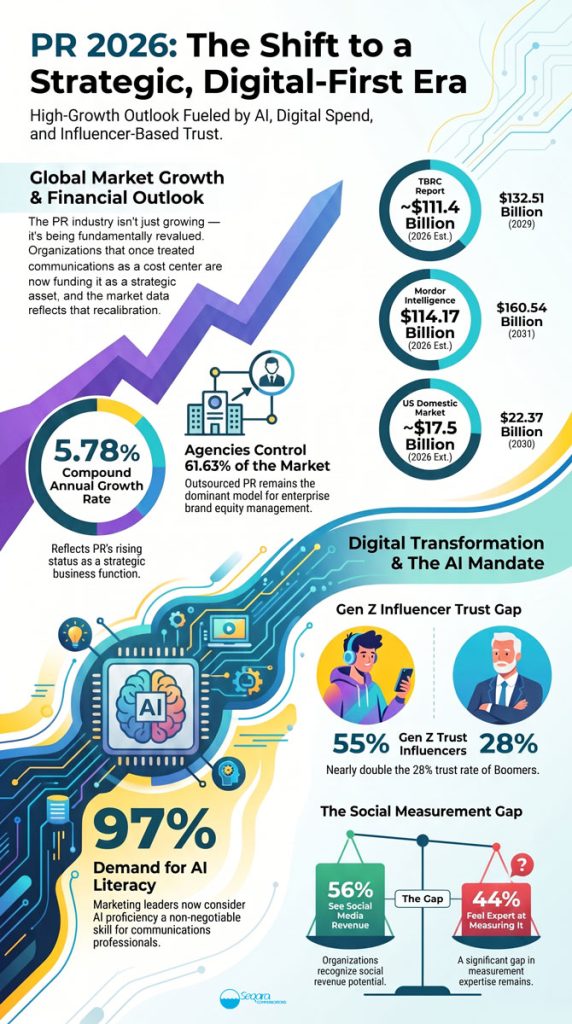
The global public relations market reached nearly US$100.06 billion in 2024 and is projected to climb to US$132.51 billion by 2029, according to The Business Research Company’s Public Relations Market Report. That trajectory — a compound annual growth rate of 5.78% — represents more than incremental expansion. It signals a structural shift in how enterprises perceive the function, with PR moving from reactive damage control to proactive brand equity management.
A separate analysis from Mordor Intelligence paints an even more ambitious picture, placing the 2026 market at US$114.17 billion with a projected rise to US$160.54 billion by 2031 at a 7.18% CAGR. Different methodologies, same directional story: communications is claiming a larger share of the strategic budget.
Two structural trends deserve particular attention. First, digital and online media captured 57.84% of 2025 spend, confirming that traditional media relations, while still relevant, no longer dominates the allocation. Second, agency-based outsourced PR held 61.63% of the market, with that segment expected to expand at a 7.64% CAGR through 2031. The takeaway? Brands are outsourcing not because they lack internal capability, but because the complexity of modern communications demands specialized expertise across paid, earned and owned channels.
On the domestic front, the US PR services market presents a US$15.94 billion opportunity, projected to grow to US$22.37 billion by 2030. For agencies, that rising tide comes with rising expectations — clients are funding more work but demanding measurable outcomes in return.
The Trust Tectonics: Who Audiences Believe and Why
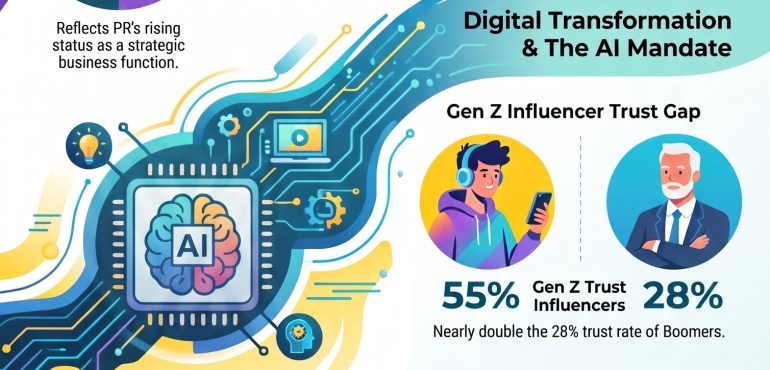
Perhaps no statistic in the 2026 landscape captures the generational divide more starkly than this: 55% of Gen Z consumers trust influencer recommendations, compared to just 28% of Baby Boomers. That gap isn’t merely interesting — it’s strategically decisive. Brands communicating across demographic lines are effectively operating in two different trust economies simultaneously.
The shift is accelerating. Close to 30% of consumers report trusting influencers more today than they did six months ago, a velocity that suggests the trend has not yet reached its ceiling. For PR professionals, this demands a recalibration of influence strategies. The traditional playbook — pitch journalists, secure coverage, amplify through owned channels — no longer covers the full terrain. Influencer partnerships, once the domain of marketing teams alone, now sit squarely on the PR desk.
Meanwhile, the speed of trust has become a metric in its own right. Nearly three-quarters of consumers expect a response to customer service questions on social media within 24 hours or sooner. The customer care window has compressed dramatically, and brands that treat social response as an afterthought are accumulating reputational risk by the hour. In practice, this means the PR function must now operate with the reflexes of a newsroom — monitoring constantly, responding swiftly and understanding that silence, in 2026, reads as indifference.
Artificial Intelligence: From Experimentation to Expectation
If 2024 was the year PR professionals dabbled with generative AI, 2026 is the year fluency became non-negotiable. The data is unambiguous: 97% of marketing leaders say it’s crucial that marketers know how to use AI in their work, and 48% are keen to invest in even more AI tools in 2025.
That near-universal consensus among leadership has downstream implications for PR practitioners. AI literacy is no longer a differentiator on a résumé — it’s table stakes. The technology is reshaping everything from media monitoring and sentiment analysis to crisis simulation and personalized pitch development. Agencies that haven’t integrated AI into their workflows are already feeling the competitive squeeze.
Yet investment enthusiasm doesn’t always translate to capability. The same urgency that drives AI adoption also creates a skills gap, and the organizations bridging that gap fastest — through training, hiring and workflow redesign — are the ones positioned to capture the efficiency gains before the advantage narrows.
The Measurement Gap: Spending More, Tracking Better
Growth without measurement is just spending. And a revealing tension sits at the center of the 2026 PR landscape: 56% of marketing leaders say social media drives revenue for their businesses, yet only 44% rate their teams as experts at measuring that impact.
That 12-point gap represents both a vulnerability and an opportunity. Organizations investing heavily in social PR without robust measurement infrastructure are essentially flying blind — confident that the channel works but unable to prove it with the kind of rigor that secures next year’s budget. Conversely, the brands and agencies that close the measurement gap early are building a defensible advantage, one grounded in attribution rather than anecdote.
The discipline is maturing. Sophisticated measurement frameworks now track not just vanity metrics — impressions, mentions, reach — but downstream indicators like share of voice relative to competitors, sentiment trajectory over time and correlation between PR activity and pipeline velocity. The organizations treating measurement as a strategic capability rather than an after-the-fact reporting exercise are the ones pulling ahead.
The Human Cost: Burnout at the Center of the Model
For all the growth and technological optimism, a sobering statistic cuts through: 50% of PR professionals considered leaving their job in the last year due to burnout, and 96% report difficulty “switching off” after work.
The always-on nature of modern PR — the 24/7 monitoring, the compressed response windows, the blurring boundary between crisis and calm — has produced a workforce operating at the edge of its capacity. Agencies and in-house departments that treat this as a wellness footnote rather than a structural challenge risk losing the very talent that drives their growth.
The burnout data should be read alongside the AI adoption numbers. Automation, deployed thoughtfully, can absorb the repetitive, high-volume tasks that consume practitioners’ time — media list building, initial monitoring sweeps, reporting drafts. But technology alone won’t solve a cultural problem. The organizations retaining talent in 2026 are the ones setting realistic response expectations, staffing for the always-on reality rather than stretching thin teams to cover it, and recognizing that sustainable performance requires sustainable practices.
Where the Market Is Heading
The statistics converge on a single, actionable conclusion: PR in 2026 rewards speed, fluency and rigor. Speed — because the customer care window has shrunk to hours, not days. Fluency — because AI and social platforms now sit at the operational center of the function. Rigor — because measurement separates the communicators who can prove their value from those who can only assert it.
For communications leaders, the mandate is clear. Build the measurement infrastructure that turns social investment into attributable revenue. Integrate AI not as a novelty but as a core competency. Design influence strategies that account for a fractured trust landscape where different demographics believe different sources. And perhaps most importantly, build teams that can sustain the pace — because the organizations that ignore the burnout data won’t just lose people; they’ll lose the institutional knowledge, media relationships and strategic continuity that great PR requires.
The market is growing. The expectations are rising. And the practitioners who treat these statistics not as trivia but as a strategic map are the ones most likely to navigate what comes next.
Writer: Adit