

Inside Indonesia’s Industry 4.0 Push: NEC Indonesia Showcases Smart Manufacturing at JCC
I walked into the bustle of the Jakarta Convention Center and immediately felt the charge of a country moving faster toward a digital future. Under the banner “Smart Nation 2025: Building Stronger, Moving Faster Toward Sustainability,” Indonesia 4.0 Conference & Expo assembled policymakers, factory leaders, and technologists to compare notes, trade playbooks, and—most importantly—show what works. As a Silver Sponsor, NEC Indonesia didn’t just join the conversation; it set a brisk, confident tempo for smart manufacturing.
A showcase of practical Industry 4.0
I’m always wary of buzzwords, but the demos on the floor told a different story: fewer slides, more substance. NEC Indonesia’s smart manufacturing suite zeroed in on three things that matter to plants right now—uptime, quality, and safety—making the case that Industry 4.0 is less a moonshot and more a method.
- Predict, then prescribe: SIAT
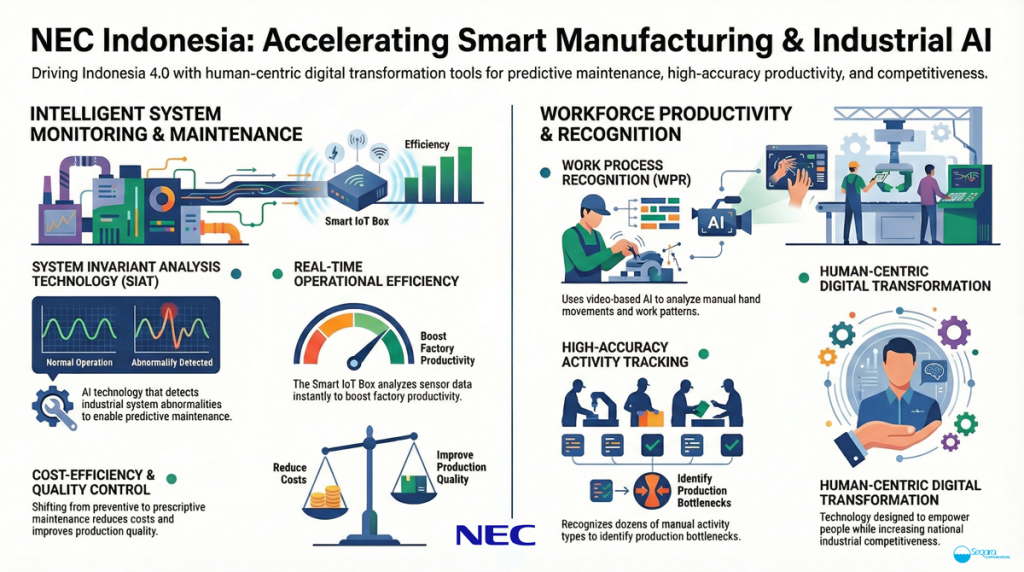
NEC’s System Invariant Analysis Technology (SIAT) leans on AI to detect abnormal behavior in industrial systems. Instead of waiting for a failure signature or relying solely on fixed-interval maintenance, SIAT learns the system’s “healthy” invariants and flags drifts early. The payoff: a pathway from preventive maintenance to predictive—and even prescriptive—actions that curb downtime, trim costs, and stabilize output quality.
- See the work, improve the work: WPR
Work Process Recognition (WPR) uses computer vision to understand manual tasks through video. By reading hand shapes and contextual cues, it learns patterns from a handful of samples, then recognizes dozens of manual activities with high accuracy. The result is clear visibility into cycle times, bottlenecks, and deviations—fuel for productivity gains without adding surveillance fatigue.
- Data to decisions, in the moment: Smart IoT Box
In collaboration with BogorTech, NEC brought a streamlined, AI-powered IoT edge system designed for the plant floor. The Smart IoT Box ingests multi-sensor data and analyzes it in real time—turning machine states, environmental signals, and operator inputs into actionable insights for line balancing, energy efficiency, and quality control.
Why this matters now
Indonesia’s manufacturing base is diverse and distributed—from food processing to automotive components—and the pressure to compete is real. I found NEC Indonesia’s message refreshingly pragmatic: start with targeted, interoperable blocks of capability, then scale. It’s a playbook built to fit brownfield realities as much as greenfield ambitions.
- Operational resilience: Early anomaly detection reduces unplanned downtime and protects yield.
- Workforce enablement: Computer vision that explains process variation supports upskilling and safer, repeatable work.
- Sustainable performance: Real-time optimization trims waste and energy use—small wins that add up across fleets of lines.
A human-centric lens
What stood out across NEC’s booth and sessions was a commitment to what the company calls Human-Centric Digital Transformation. The technology never eclipsed the operator; it augmented judgment, made tacit knowledge visible, and provided decision support rather than black-box edicts. That tone carried through remarks from Joji Yamamoto, President Director of NEC Indonesia, who underscored the company’s role in advancing the nation’s Industry 4.0 vision and sharpening industrial competitiveness.
From concept to cadence
There’s a real difference between a concept demo and a plant routine. The solutions showcased here aim for the latter:
- Fast pilots: Lightweight deployments at the edge lower time-to-value.
- Open integration: APIs and data connectors meet existing MES/SCADA where they are.
- Governance by design: Security and privacy features accommodate factory and regulatory requirements.
The bigger picture at JCC
Across the halls, the event convened ministers, industrial strategists, R&D leaders, and start-ups in a single loop—exactly the coalition needed to translate policy into productivity. With Indonesia’s “Making Indonesia 4.0” agenda as a north star, the discussions felt less like speeches and more like working sessions aimed at measurable adoption.
NEC Indonesia, in context
NEC’s presence in Indonesia stretches back to 1968. Today, the company’s local team supports a broad portfolio—telecommunications networks, biometric identification, smart solutions for financial services, public transport, logistics, manufacturing, and mission-critical applications for government and enterprises. That footprint matters: it gives NEC Indonesia the field experience to design solutions that survive the realities of the shop floor while aligning with national digital priorities.
What comes next
As I left the expo floor, the throughline was unmistakable: momentum with discipline. Smart manufacturing in Indonesia isn’t about chasing novelty; it’s about compounding improvements—line by line, plant by plant—so that competitiveness and sustainability rise together. If this week at JCC is a barometer, the cadence is quickening, and NEC Indonesia is intent on keeping time.
***
About PT NEC Indonesia
NEC established its first representative office in Jakarta in 1968. Today, PT NEC Indonesia delivers innovative ICT solutions that promote safety, security, and improvements to quality of life. As a leading information and communications technology provider, the company offers world-class services and technologies including telecommunications networks, biometric identification, smart solutions for banking and financial services, public transport and logistics, manufacturing, and government and enterprise applications and infrastructure—supporting Indonesia’s digital transformation journey. For more information, visit http://id.nec.com.

Writer: Aditya Wardhana, AI