
What AI in Communications Will Look Like in 5 Years
Five years can feel like a lifetime in technology, and in the field of communications, that sense of acceleration is especially acute. The tools we use to reach audiences today—draft assistants, social schedulers, sentiment trackers, and increasingly capable chatbots—will not disappear. Rather, they will be absorbed into something more ambitious: a comms function where artificial intelligence stops being a novelty bolted onto existing workflows and becomes the connective tissue holding the entire discipline together. The shift ahead is less about a single breakthrough than about a quiet, systemic integration that changes how communicators think, plan, and measure.
From Copilots to Autonomous Operators
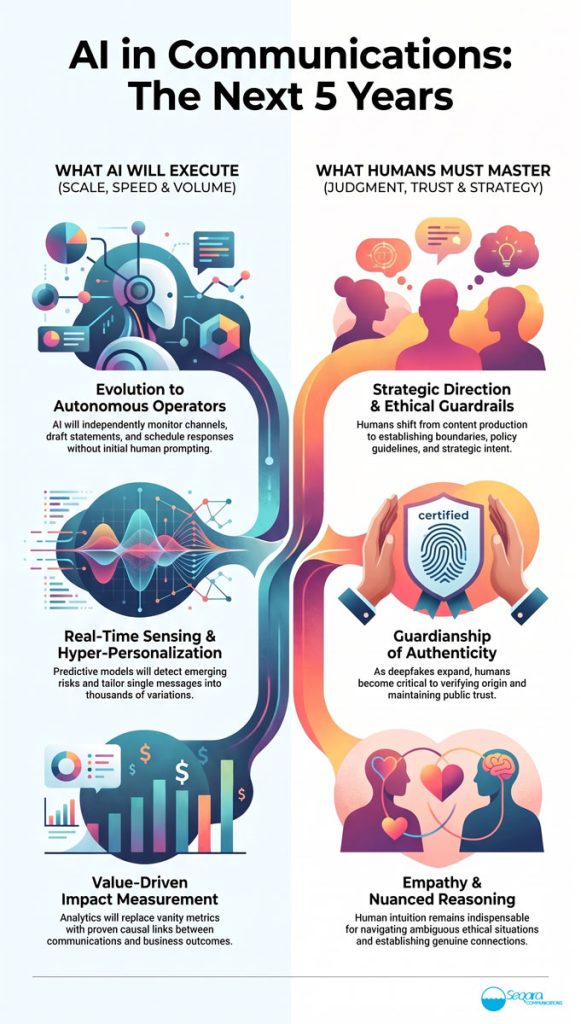
The most visible change over the next five years will be the move from Artificial Intelligence (AI) as an assistant to AI as an operator. Today, most comms professionals use tools like ChatGPT or Claude as drafting partners—producing a first pass, reshaping a paragraph, or generating headline options. Each action still requires a human to prompt, review, and approve. The coming era will invert that dynamic.
Imagine a system that monitors an organization’s public channels, detects an emerging narrative or a brewing issue, drafts a holding statement aligned to the approved tone-of-voice guidelines, routes it to the right approver, and schedules the follow-up posts—all before a human has typed a single word. The communicator’s role shifts from production to direction: setting strategy, defining guardrails, and intervening only when the situation demands judgment. This does not mean AI will run comms departments alone. It means the labor of communication—the repetitive, time-sensitive, high-vigilance work—will be increasingly delegated, while humans focus on relationships, nuance, and ethics.
Real-Time, Always-On Intelligence
The news cycle has already compressed to minutes, and five years from now, communicators will operate on a genuinely real-time plane. AI will continuously ingest signals from news outlets, social platforms, forums, regulatory filings, and internal channels, synthesizing them into a living situational picture rather than a daily or weekly report.
This always-on intelligence changes the nature of the job. Rather than reacting to a media alert or a spike in mentions, comms teams will act on predictive models that flag issues before they crest. An AI might notice that a particular phrase is gaining traction among an influential subcommunity, or that employee sentiment is drifting in a way that historically precedes attrition or leaks. The ability to see around corners becomes a core competency, and the organizations that invest early in this sensing layer will consistently outpace those still working from dashboards that describe what already happened.
Hyper-Personalization at Scale
Audiences have grown sophisticated, and mass messaging increasingly reads as noise. Over the next five years, AI will make true personalization the default rather than the exception. Communications once meant crafting one message and broadcasting it broadly; it will soon mean crafting one message and having AI render it into thousands of tailored variations—each adjusted for language, cultural context, channel norms, and even individual communication preferences.
A single announcement could become a personalized investor note, a concise employee briefing, a region-specific customer update, and a culturally localized social post, all generated from the same approved kernel of fact. The risk here is fragmentation: without careful governance, personalization can drift into inconsistency or manipulation. The strongest comms teams will treat personalization as a discipline, using AI to adapt the surface of a message while keeping its substance and values constant.
The Rise of Synthetic Media and the Trust Problem
Perhaps the most consequential development will be the mainstreaming of synthetic media—voice, image, and full video generated so convincingly that detection becomes a constant arms race. For communications, this cuts both ways. On one hand, organizations will produce localized video messages from a CEO without requiring hours of filming, and scale audio content across languages with natural, on-brand voices. On the other hand, the same technology will enable deepfakes, voice cloning, and fabricated statements that can ignite a crisis in minutes.
This is where the communicator’s role becomes irreplaceable. In a world of perfect synthetic content, the scarce resource is not production capability but authenticity. Organizations will need to prove who is speaking and what is genuinely theirs. Expect the rise of cryptographic provenance—ways of verifying that a message truly came from its claimed source—and a renewed premium on transparency. Comms professionals who understand how to signal authenticity will become the guardians of organizational trust, a role far more strategic than drafting press releases.
Measurement That Reflects Meaning
For decades, comms has struggled with the gap between activities and outcomes. How do you connect a media placement to a shift in reputation, or a campaign to a change in stakeholder behavior? AI is poised to close that gap. Five years from now, measurement will move beyond vanity metrics—likes, impressions, open rates—toward causal and predictive models that estimate the actual impact of communications on business outcomes.
Machine learning can already correlate message exposure with sentiment shifts, and as data quality improves, these correlations will mature into more confident attribution. Comms leaders will be able to say, with evidence, that a particular narrative strategy moved a specific audience segment, and to allocate budget accordingly. This will elevate the function’s credibility inside organizations, turning comms from a cost center into a measured driver of value.
The Human Skill That AI Cannot Copy
Amid all this capability, the most durable competitive advantage will remain stubbornly human. Judgment, empathy, ethical reasoning, and the ability to navigate ambiguity are precisely the skills that AI struggles to replicate. The communicators who thrive over the next five years will not be those who simply adopt the most tools, but those who pair technological fluency with a deep understanding of human motivation.
The winning profile is a hybrid: fluent in the language of data, comfortable steering autonomous systems, and practiced in the art of genuine connection. AI will handle the volume, the speed, and the breadth. Humans will handle the meaning. The future of communications is not a choice between technology and people—it is the deliberate, disciplined fusion of both, and the next five years will be spent learning how to get that balance right.
In the end, what AI in communications will look like in five years is neither utopia nor apocalypse. It is a profession reinvented—faster, smarter, more measurable, and more demanding of the very human qualities that have always made good communication matter: clarity, conscience, and the ability to be believed.
Writer: Adit